
Confidence-Scored KYC Document Verification Explained (September 2026)
Per-field confidence scores let KYC teams automate reliable document reads and route uncertain fields for review. Source citations give reviewers the exact passport, utility bill, or bank statement region behind each value.


KYC tools that automate document extraction but return no signal on extraction quality leave you with a binary choice: automate everything and accept unknown error rates, or review everything and lose the benefit of automation. Neither is good.
The way out is confidence-scored extraction, where each field comes back with a confidence score between 0 and 1. When source citations are enabled, the response also includes bounding boxes that point back to the relevant region of the document. That combination lets you design a routing pipeline where uncertain reads go to a reviewer and clean ones move on untouched. This article walks through that routing logic, explains how to calibrate it, and shows what to demand from an automated KYC verification tool.
TL;DR:
- Periodic KYC case reviews for low-risk customers can take around 100 minutes, dropping to about 30 minutes at the best-performing banks that blend automation with targeted intervention (McKinsey, 2021).
- A starting routing policy might send fields above 0.9 straight through, flag scores from 0.7 through 0.9 for review, and reject or escalate anything below 0.7. Production thresholds must be calibrated by field and risk level.
- KYC tools need per-field confidence scores, source citations, and coverage across scanned IDs, utility bills, and bank statements.
- Unsiloed AI returns a 0-to-1 confidence score on each extracted field. Its extraction API can also return bounding-box citations when
enable_citationsis set totrue, and on-premise or air-gapped deployment is available for compliance-sensitive environments.
What KYC Document Verification Requires
KYC verification requires reading identity documents accurately enough to meet regulatory standards and catch fraud. That means extracting structured fields from passports, national IDs, driver's licenses, and utility bills, each with its own layout, font, and condition. A single misread date of birth or transposed document number can fail a compliance check or let a fraudulent identity slip through.
A production verification system has to solve four problems at once:
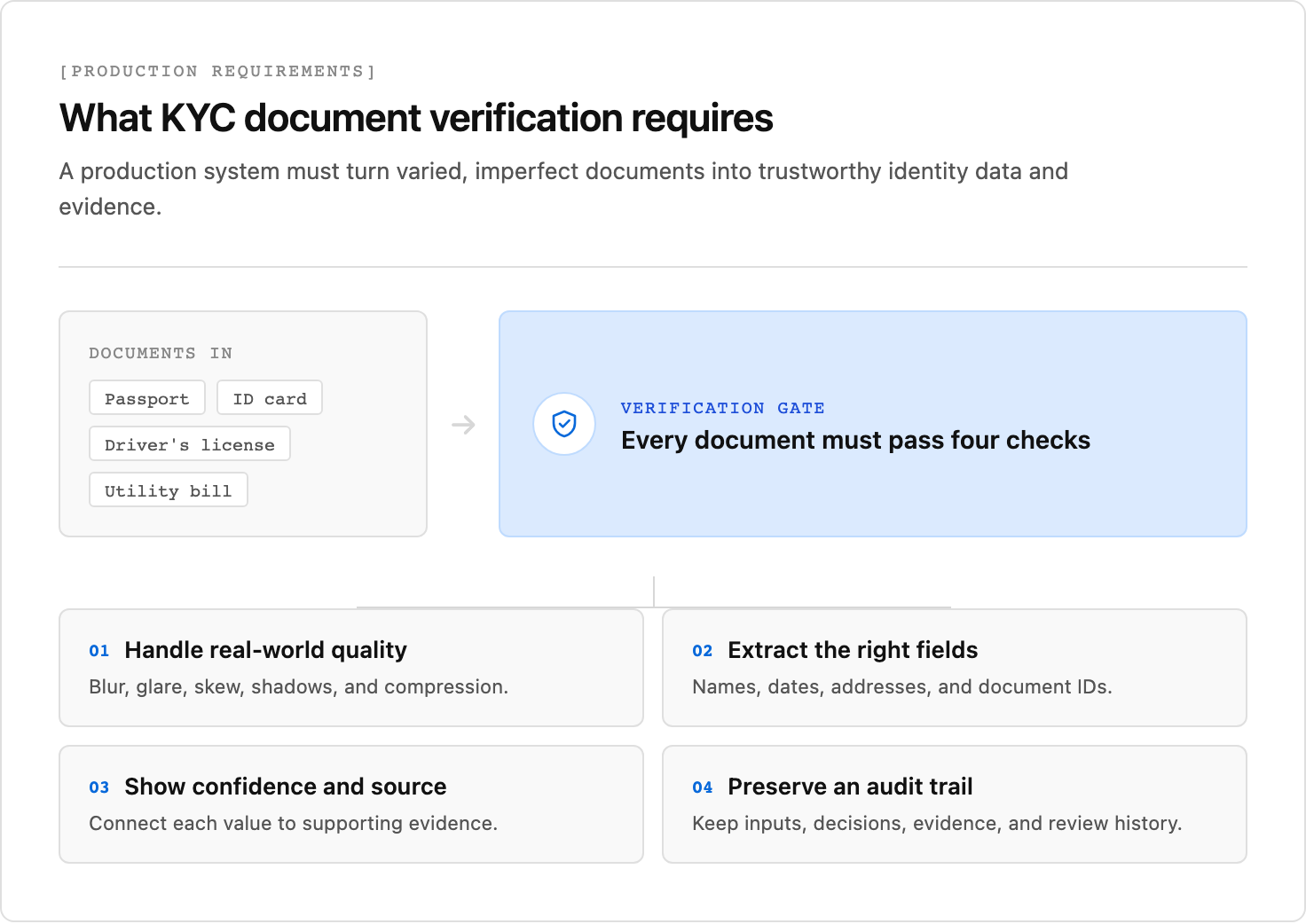
The verification pipeline also needs to handle real-world document quality: scans taken under poor lighting, images at an angle, worn edges, and handwritten OCR annotations over printed fields. These conditions push error rates up in any system that relies on template matching or character-by-character OCR without a confidence score attached to each extracted value.
KYC processes also need an auditable record. The U.S. Customer Identification Program recordkeeping rule is one example: banks must record identifying information, documents relied on, verification methods and results, and how substantive discrepancies were resolved. The retention period depends on the record. Customer identifying information must be kept for five years after the account closes, while descriptions of documents and verification methods must be kept for five years after the record is made.
The Cost of Manual KYC Verification
Compliance teams process passports, utility bills, and bank statements by hand, and that document handling is only one input into a much longer periodic review process. In a 2021 McKinsey study of KYC operations, periodic case reviews for low-risk customers can take 100 minutes to complete. That figure covers data collection, transaction analysis, and source-of-wealth checks, not just document extraction. Banks in the best-performing quartile, blending automation with targeted intervention, complete the same reviews in around 30 minutes on average. At meaningful transaction volume, that gap compounds into review backlogs and onboarding delays.
A financial institution processing thousands of applications each month needs dedicated review capacity. When that capacity cannot keep pace, verification queues grow and applications stall. Confidence-based routing reduces that load by focusing reviewers on the fields most likely to be wrong.
Anti-money laundering (AML) and KYC programs require records of how customer information was verified. A structured extraction record makes those decisions easier to reconstruct than disconnected notes and scanned checklists.
The KYC Verification Process: From CIP to Ongoing Monitoring
For U.S. banks, Customer Identification Program (CIP) requirements establish the identifying information to collect and require risk-based procedures for verifying it. Depending on the customer and institution, verification may rely on a government-issued ID, proof of address, entity documentation, non-documentary checks, or a combination of methods. Each document type carries its own document parsing challenge:
- A passport requires machine-readable zone (MRZ) line parsing.
- A utility bill requires location field isolation.
- A certificate of incorporation requires entity name and jurisdiction extraction.
Customer Due Diligence (CDD) builds on identity verification by establishing a risk profile and monitoring the relationship. Depending on the institution's policy and jurisdiction, checks may include sanctions screening, politically exposed person (PEP) screening, adverse media, and source-of-funds review. Higher-risk customers may trigger Enhanced Due Diligence (EDD) and additional evidence requirements.
Periodic or event-driven re-verification means the same document extraction pipeline may run repeatedly across a customer's lifecycle, not only at onboarding.
For an end-to-end implementation, use the KYC document consistency cookbook. It classifies an identity document and two proofs of address, extracts the required fields with citations, then returns a deterministic PASS, REVIEW, or FAIL decision.
How Confidence Scores Work in KYC Document Extraction
KYC document verification starts with AI document extraction: pulling structured fields from passports, utility bills, bank statements, and corporate filings, then checking them against expected formats, issuing authority rules, and watchlist data. These documents arrive as scanned images, photographed on phones, or exported from legacy systems, with quality varying widely.
When a verification request arrives, a production pipeline can first identify the document type: passport, utility bill, bank statement, or corporate filing. PDF classification and routing sends the document to the correct extraction schema, so field definitions match what the document actually contains. Each extracted field returns the raw value and a confidence score between 0 and 1. With citations enabled, it also includes page and bounding-box data for the source region.
Unsiloed approaches this with a vision-first architecture. A vision model reads layout, field position, and contextual cues, returning each requested value, whether a passport MRZ line, date of birth, or residential address, as a discrete field with its own confidence score. Set enable_citations to true when the workflow also needs bounding boxes for reviewer interfaces or audit evidence.
Routing by Confidence Score
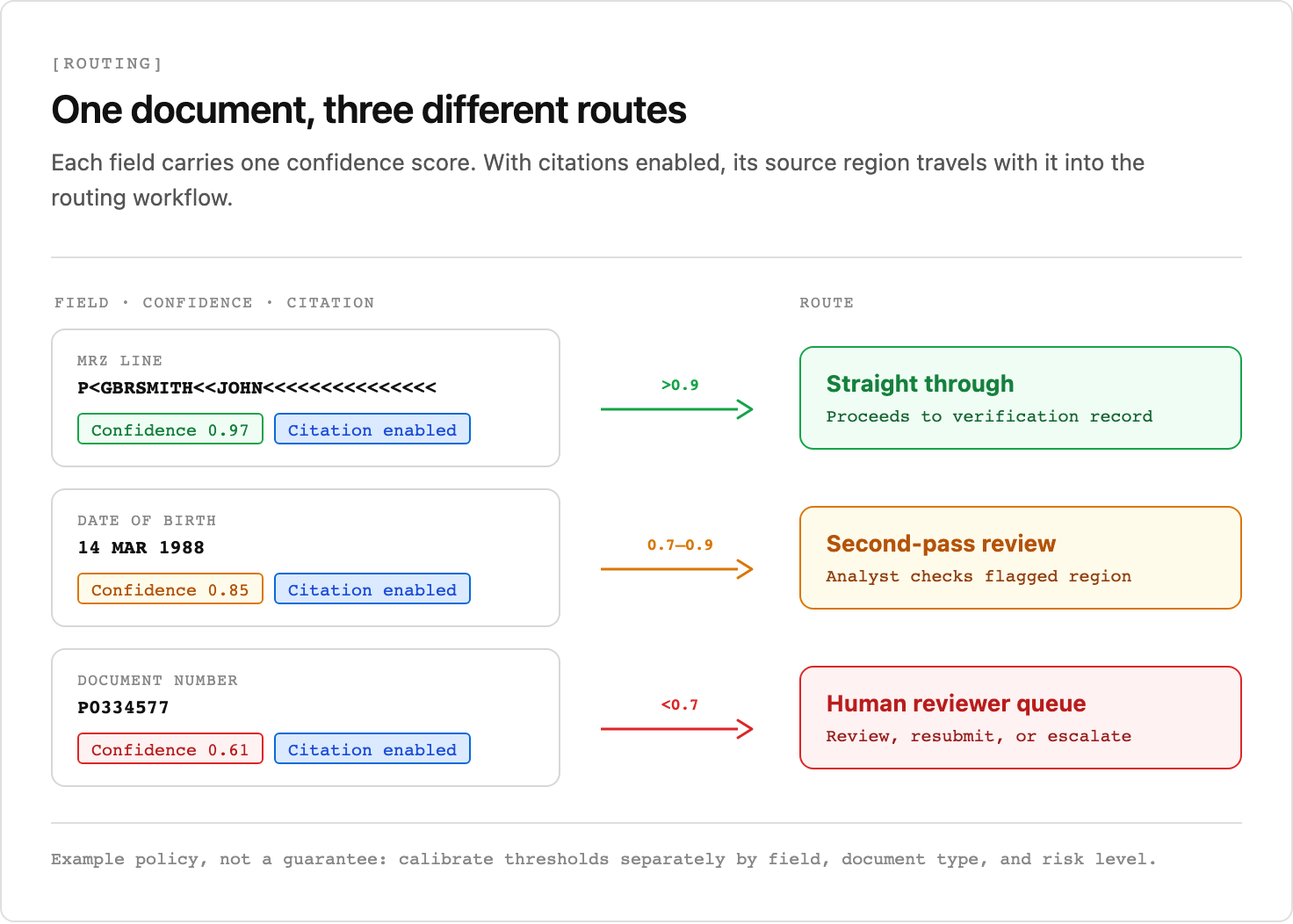
At runtime, a routing layer reads each field's confidence score and applies thresholds calibrated against labeled validation data. The values below illustrate a three-tier policy. They are starting points, not accuracy guarantees or fixed system limits:
- Fields scoring above 0.9 proceed straight through into the verification record for downstream checks, with the citation preserved when citations are enabled.
- Fields in the 0.7 to 0.9 range get flagged for a second-pass review, where an analyst checks the flagged region before the record advances.
- Anything below 0.7 goes to a human reviewer queue. With citations enabled, the reviewer sees exactly which region produced the uncertain read. Depending on the document type, that triggers a resubmission request or an escalation path.
KYC teams review exceptions, not every document.
How to Choose Automated KYC Verification Software
Five factors separate KYC verification software that holds up in production from software that creates more review burden than it eliminates.
| Evaluation Criterion | What to Look For | What Falls Short |
|---|---|---|
| Document type coverage | Extracts reliably from passports, utility bills, bank statements, and corporate filings; handles scanned images and PDFs without a selectable text layer | Works on government-issued IDs only; breaks on inconsistent layouts or image-only files |
| Per-field confidence scoring | Returns a 0-to-1 confidence score on every extracted field, with configurable routing thresholds | Returns extracted values only, with no certainty measure per field, forcing manual review of every record |
| Routing logic | Supports thresholds calibrated by field, document type, and risk level | Binary pass/fail with no tiered routing based on extraction certainty |
| Audit trail | Can return page and bounding-box source data with each field, traceable to the source region | Field values have no traceable source reference, making review and audit reconstruction harder |
| Deployment options | Cloud API plus on-premise or air-gapped deployment for data-residency and compliance requirements | Cloud-only; no option for compliance-sensitive environments with strict data residency rules |
Document Type Coverage
Not all KYC tools handle the same input formats. Some work well on government-issued IDs but fail on utility bills or bank statements with inconsistent layouts, a gap that layout-aware OCR solutions are built to solve. Before committing to a tool, map your actual document mix against what the software can reliably extract from, including scanned images, PDFs without a selectable text layer, and documents in multiple languages.
Confidence Scoring and Routing Logic
A tool without per-field confidence scores forces reviewers to manually inspect every record or accept an unknown error rate. Look for document data extraction software that returns a 0-to-1 confidence score on each extracted value and lets you configure routing by field. A date of birth, passport number, and address do not necessarily deserve the same cutoff: calibrate each threshold against labeled documents and the cost of a false acceptance.
Audit Trail and Compliance Readiness
Regulations define the records an institution must retain, but they do not prescribe bounding-box citations. Those citations are an engineering control: they let a reviewer trace an extracted value to the exact page region without searching the document manually. Log the source document identifier, schema and model version, extracted value, confidence score, routing decision, reviewer action, timestamps, and any cited page coordinates. U.S. anti-money laundering program rules require banks to maintain risk-based procedures for ongoing customer due diligence and monitoring, so treat the audit trail as a maintained system record rather than a one-time setup artifact.
Unsiloed AI for KYC Document Extraction Pipelines
Unsiloed AI was built for exactly the kind of extraction work KYC pipelines demand: structured fields from unstructured documents, with a clear signal on how much to trust each result, going beyond what LLMs alone can deliver for document extraction.
Every field Unsiloed extracts returns a 0-to-1 confidence score. Set enable_citations to true to include page and bounding-box data for the source region. For KYC workflows, that means a passport number or date of birth can arrive with both a reliability signal and a spatial reference to where it appeared. Using configurable thresholds, high-confidence fields can route to straight-through processing while lower-confidence fields go to review, resubmission, or escalation.
The architecture is vision-first rather than tied to rigid coordinate templates, so it can handle scanned IDs, handwritten forms, degraded print, and layout variation. You still define an extraction schema for the fields your workflow needs.
For industries where data residency matters, Unsiloed supports on-premise and air-gapped deployment, keeping document data within your infrastructure boundary, a requirement shared by healthcare document processing APIs operating under HIPAA constraints.
Final Thoughts on KYC Compliance and Document Extraction
Automatic straight-through processing on clean documents and reliable human routing on degraded ones are what make a KYC pipeline work at scale. Your compliance team should review exceptions, not every passport and utility bill that enters the queue. Per-field confidence scores supply the routing signal, while optional bounding-box citations make each extracted value faster to verify. Book a demo with Unsiloed to see extraction run on the document types your pipeline handles.
FAQ
What's the difference between automated KYC verification with confidence scoring versus a system that just returns extracted values?
A system that returns extracted values without confidence scores forces compliance teams to review every record manually or accept unknown error rates. Confidence-scored extraction assigns each field a 0-to-1 certainty measure, so high-confidence reads can route straight through while lower-scoring fields go to a human queue. When citations are enabled, the reviewer also gets the bounding box that produced the uncertain read.
How do I choose between KYC tools when my document mix includes scanned IDs, utility bills, and bank statements with inconsistent layouts?
Map your actual document types against each tool's extraction architecture before committing. Rigid template-based systems can break when layouts vary across issuers or when documents arrive as scanned images without a selectable text layer. A vision-first system reads layout, field position, and contextual cues from the page image directly, making it more resilient to degraded scans and format variation. You should still test every tool on a labeled sample that represents your document mix.
Can I build an automated KYC compliance pipeline without reviewing every document manually?
Yes, if the extraction system returns per-field confidence scores that drive routing logic. After you calibrate thresholds on labeled data, high-confidence fields can proceed to straight-through processing, while uncertain fields go to review, resubmission, or escalation. With citations enabled, the source region stays attached to the field for faster review. Compliance teams then handle exceptions, not every document in the queue.
What does "audit trail" mean in the context of KYC document extraction?
An extraction audit trail records which document and schema produced a field, the extracted value and confidence score, the routing decision, reviewer actions, and timestamps. With citations enabled, Unsiloed also returns page and bounding-box data for the relevant source region. Bounding boxes do not replace regulatory records, but they make the extraction result easier to verify and reconstruct.
How should I calibrate confidence thresholds for KYC fields?
Start with a labeled validation set that reflects your real document types, scan quality, countries, languages, and fraud patterns. Plot error rates at candidate thresholds, then choose a cutoff for each field based on the cost of a false acceptance versus a manual review. Use stricter cutoffs for high-impact identifiers, monitor drift after deployment, and recalibrate whenever the model or document mix changes. The 0.9 and 0.7 values in this article are examples, not universal safe thresholds.