
Bank Statements, Invoices, SEC Filings: Auditable Extraction (June 2026)
A single misread figure rarely stays contained. An extraction tool reads a scanned financial document, returns $5,900 where the page said $9,500, and nothing errors out. That value flows into a report, a model, or a ledger, and the mistake only surfaces later, in an audit, when someone has to explai


A single misread figure rarely stays contained. An extraction tool reads a scanned financial document, returns $5,900 where the page said $9,500, and nothing errors out. That value flows into a report, a model, or a ledger, and the mistake only surfaces later, in an audit, when someone has to explain where the number came from.
That is the hard part of pulling financial data out of documents: not reading the numbers, but knowing which ones to trust and proving where each one came from. Surviving an audit takes three things: extraction that preserves the table's structure, a confidence score on every field so uncertain values get routed to review, and a word-level citation back to the source page so anyone can verify a figure without reopening the file.
Rent rolls make a good example. They list every lease in a property and arrive in formats that range from clean spreadsheets to scanned PDFs. A wrong value carries real cost, so they exercise all three requirements at once. The same approach applies to invoices, bank statements, and filings.
TLDR:
- A misread figure in a financial document can flow downstream silently and only surface later in an audit, when someone has to prove where the number came from.
- Naive parsers flatten a table into a run of text, so values lose the row they belong to; rent rolls, with their merged cells and irregular layouts, break them routinely.
- Audit-ready extraction needs three outputs: layout-aware parsing that keeps each row intact, a confidence score on every field, and a word-level citation back to the source page.
- Confidence scores triage the result: above 0.9 passes straight through, 0.7 to 0.9 goes to human review, and below 0.7 is flagged before it reaches anything downstream.
- Unsiloed AI applies this vision-first approach to rent rolls and other financial documents, with on-premise or air-gapped deployment for sensitive data.
What a Rent Roll Is and Why Accuracy Matters
A rent roll lists every lease in a property: the tenant, unit, lease term, contracted rent, and actual rent collected for each one. Lenders and auditors treat it as the ground truth for a property's income, which is why they rely on it to verify that income before committing to a deal.
That reliance is what makes accuracy non-negotiable. A single misread rent figure or missed vacancy flag doesn't stay a local error; it propagates into every projection and report built on top of the document, and the mistake usually surfaces far from where it was introduced. This is the pattern for any financial document feeding a downstream system: a wrong number is a data integrity failure someone has to answer for, not a formatting glitch.
Why Rent Rolls Break Naive Parsers
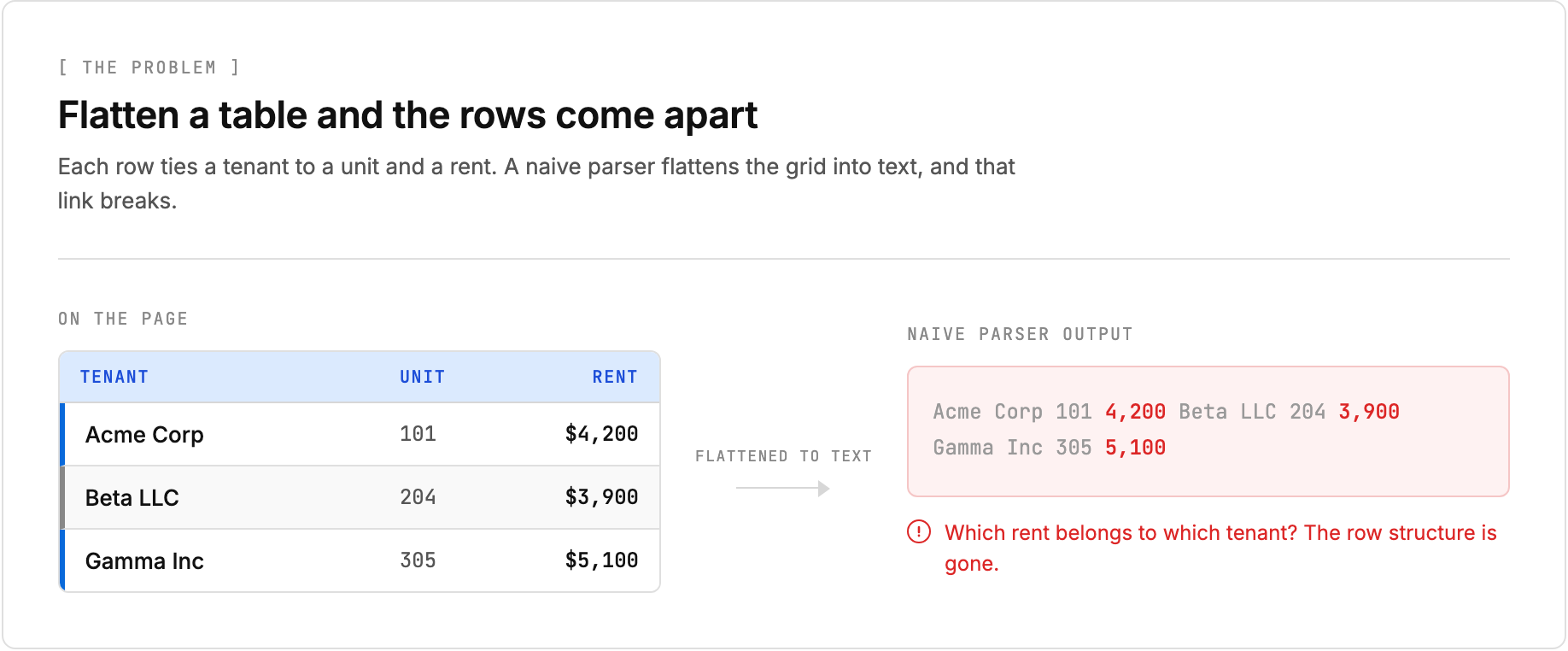
Rent rolls arrive as PDFs, Excel exports, and scanned tables with inconsistent column headers, merged cells, and no standard layout. Each row ties related values together: this tenant, in this unit, pays this rent. A naive parser flattens the table into a plain run of text, and that link breaks, so you can no longer tell which rent belongs to which tenant:
A handful of common layouts trigger this. Merged cells orphan a tenant's charges on the wrong row, multi-line headers get split so values land under the wrong label, and a column that mixes a structured date with free-text notes like "MTM" or "see amendment" leaves the parser with no consistent format to read. Standard OCR reads each of these as disconnected fragments rather than as the structure a human sees.
What Audit-Ready Extraction Requires
The challenge is not reading the numbers; it is reading them in the right context. Manual extraction introduces transcription errors at scale: a reviewer can misread a date or transpose a figure, and those errors compound silently as the data moves downstream. Automated extraction changes the error profile, flagging low-confidence fields for review before they reach anything that depends on them.
A reliable extraction pipeline needs three outputs:
- Layout-aware parsing that preserves columns and row alignment across multi-page tables, so each tenant's values stay together on one row
- Per-field confidence scores that surface uncertain extractions, such as a partially obscured unit number or a non-standard date, before they flow downstream
- Word-level citations that trace each extracted value back to its source location in the original document, which is what an auditor needs to verify a figure
Without those three outputs, the extraction result is a number with no provenance, and a number with no provenance cannot pass a compliance review.
How Vision-First Extraction Reads a Rent Roll
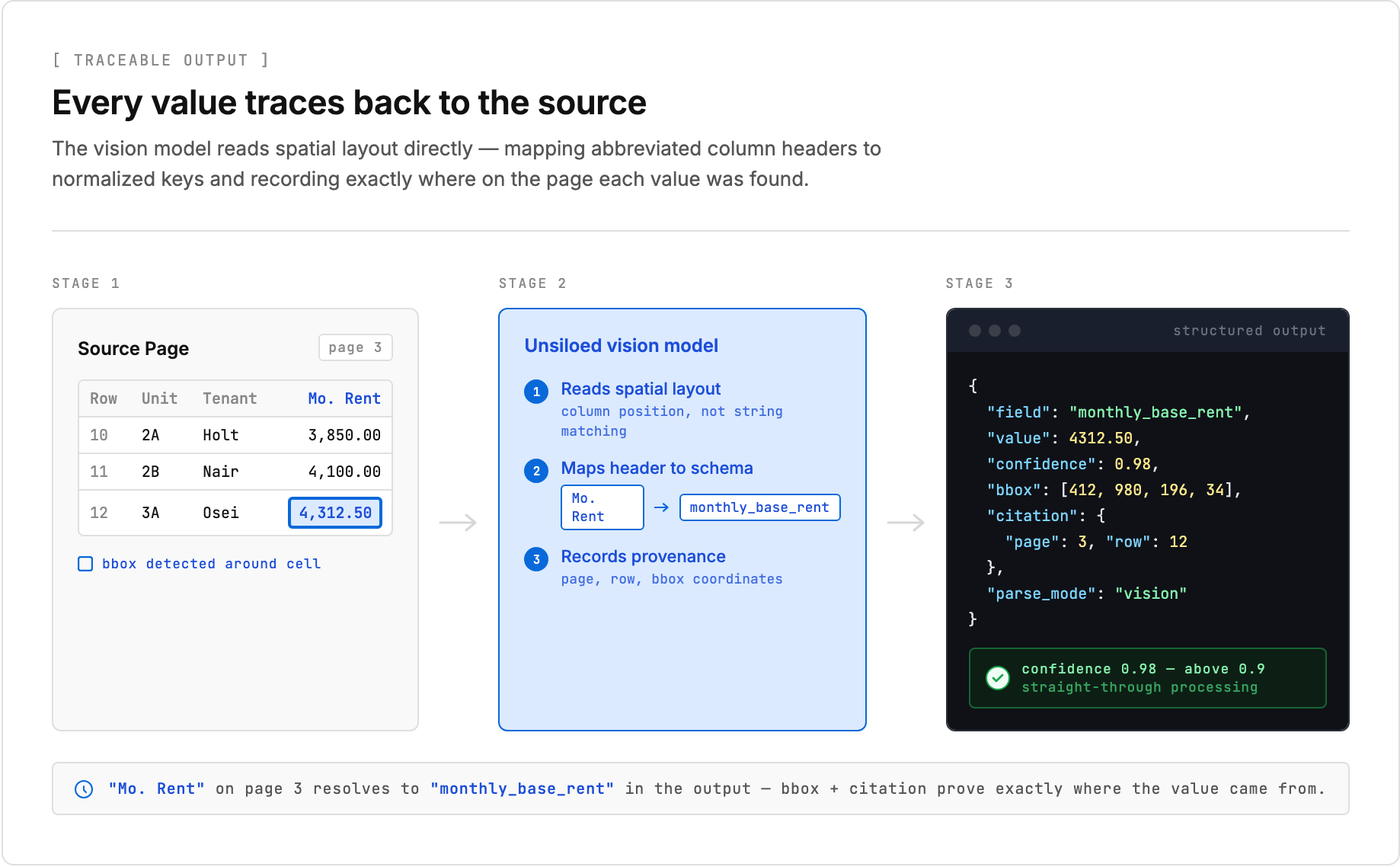
A vision-first parser reads the page the way a person does: by where values sit, not by matching column names exactly. It takes in the table's layout, works out what each column holds from its position and the values around it, and maps each cell to a normalized schema. Columns labeled "Mo. Rent" and "Monthly Base Rent" both map to the same field, each with a confidence score attached. When a PDF has no selectable text layer, the parser reads the structure off the page image instead of flattening it into a run of text.
Each extracted field carries more than a raw value: a bounding box pointing back to its source location, a confidence score from 0 to 1, and the original text as parsed. Fields scoring above 0.9 can pass straight through, fields in the 0.7 to 0.9 range get flagged for human review, and anything below 0.7 is held before it is written downstream.
This is what makes the output audit-ready. When someone questions a value, the system can point to the exact page, row, and cell it came from.
Reconciling a Rent Roll Against Its Leases
Audit-ready extraction often involves more than one document. A rent roll's numbers only hold up if they match the leases behind them, and the gaps between the two are where errors slip through. Cross-document reconciliation catches those gaps automatically: a tenant listed as current whose lease ended six months ago, a rent that doesn't match the signed lease, or a unit marked vacant that still has an active lease. Comparing the rent roll against the lease documents this way surfaces mismatches as the documents come in, instead of weeks later in a manual review.
Building Auditable Financial Data Extraction with Unsiloed AI
Unsiloed AI is built for exactly the extraction problems this post has covered: variable layouts, multi-page documents, and audit requirements that make a simple text dump unacceptable.
Every field extracted returns a confidence score, a bounding box, and a word-level citation back to the source page. For rent roll ingestion, that means a reviewer can trace any flagged value directly to the line it came from, without reopening the original file.
The parser is vision-first. When a PDF lacks a selectable text layer, it falls back to vision model inference, signaled by a parse_mode: "vision" field in the API response. Table structure and reading order are preserved instead of being collapsed into a flat text stream, which is where most downstream extraction errors originate.
The same confidence-based routing applies to any downstream financial workflow: high-confidence fields pass straight through, while uncertain ones are flagged for human review before they touch a ledger.
Deployment runs on-premise or air-gapped for compliance-controlled environments where SEC filings and bank statements cannot leave the network.
Final Thoughts on Audit-Ready Extraction
Getting a number right is only half the job; proving where it came from is the other half. Extraction that flags its own uncertain fields and cites every value back to the source page is what turns a stack of documents into data you can defend. If your team processes rent rolls, or any financial documents where a wrong figure carries real cost, book a demo to see word-level citations and confidence scoring in action. You get values you can trust, and your auditors get a trail they can follow.
FAQ
Can I build auditable extraction without a custom OCR pipeline?
Yes. API-based parsers like Unsiloed AI combine OCR with vision models that understand table structure and return per-field confidence scores and bounding box citations, so you don't have to build and maintain custom post-processing code yourself.
What's the difference between traditional OCR and vision-first parsing for rent rolls?
Traditional OCR flattens a multi-column table into an undifferentiated run of text, losing track of which value belongs to which row. Vision-first parsing reads the spatial layout, keeps each row's values together, and outputs structured JSON you can trace back to the page.
How do confidence scores reduce manual review?
Confidence scores power automated triage: fields scoring above 0.9 pass straight through, scores between 0.7 and 0.9 queue for human review, and values below 0.7 are flagged before they reach anything downstream. You review the uncertain values instead of re-checking every field by hand.
Should I use template-based extraction or schema-driven extraction for rent rolls?
Template-based extraction breaks whenever a document changes format or column names. Schema-driven extraction maps variable names like "Mo. Rent" and "Monthly Base Rent" to the same field using spatial context, so it handles format variation without retraining.
What makes financial document extraction auditable in compliance-controlled environments?
Word-level citations and bounding box coordinates that trace every extracted value back to its exact source location in the original document, creating a verifiable audit trail that compliance reviewers and auditors can follow without re-reading raw files.