
Unsiloed AI vs Reducto: Which Is Better in September 2026?
Unsiloed led Reducto's tested agentic configuration 88.0 to 66.0 in a May 2026 benchmark and adds hosted indexing and retrieval.


Unsiloed AI and Reducto now check many of the same feature boxes: both parse and extract complex documents, return numerical confidence scores and citations, support semantic chunking, and offer private deployment. Two differences still favor Unsiloed. In a published May 2026 olmOCR-Bench run, Unsiloed scored 88.0 ± 1.0 against 66.0 ± 1.0 for Reducto's tested agentic configuration. Unsiloed also offers hosted embedding, vector storage, and retrieval, while Reducto's documented RAG workflow hands those stages to your infrastructure.
TL;DR:
- The closest published head-to-head result favors Unsiloed: 88.0 ± 1.0 versus 66.0 ± 1.0 on a May 2026 run using the same olmOCR-Bench dataset and scorer.
- That result tested Reducto's previous agentic pipeline, not the r-1 preview released on September 1, 2026. Reducto has not published a comparable r-1 score on this harness.
- Both products perform document processing and semantic chunking. Unsiloed goes further with an optional hosted embedding, vector index, and retrieval workflow.
- Unsiloed is the stronger candidate if you value the published benchmark result and want fewer retrieval services to operate. Test both on your own document set before committing.
What Is Reducto?
Reducto is a document processing platform that turns complex documents into structured data. Its API covers parsing, extraction, classification, splitting, and editing, and it returns layout-aware output with bounding boxes, confidence scores, and citations. It handles scanned pages, handwriting, and multiple languages.
Reducto covers parse, extract, split, classify, and edit operations. Its Parse API can also group output into semantic chunks and produce embedding-optimized text. Reducto's documented retrieval-augmented generation (RAG) workflow then sends that text to an embedding model and vector database supplied by your team.
Reducto released the r-1 parsing model in preview on September 1, 2026. Reducto says it reduces error by 20% relative to its legacy agentic pipeline, but it has not published an r-1 result on the same olmOCR-Bench harness used below.
What Is Unsiloed AI?
Unsiloed AI is agentic OCR for AI pipelines that need to trust the page. It parses PDFs, scans, Office files, and images into Markdown and structured JSON, with a confidence score on every value and optional bounding-box citations. Parsing, extraction, classification, and splitting are all available through one API.
You can use Unsiloed two ways:
- As a parser that drops into your existing stack, returning structured, confidence-scored output you feed into your own embeddings, vector store, and retrieval.
- As a full pipeline, where a workflow layer chunks parsed content, embeds it, and stores it in a hosted vector index with a retrieval endpoint, so you can go from a raw document to a queryable index without leaving the platform.
Either way, every value stays auditable through its confidence score, and Unsiloed leads olmOCR-Bench at 88.0 on an open harness that scores every parser the same way.
How Unsiloed AI and Reducto Compare
Both platforms parse, extract, classify, and split, with confidence-scored, cited output, so the table below focuses on where their scope and accuracy diverge rather than on basic capability.
| Capability | Unsiloed AI | Reducto |
|---|---|---|
| Usable as a drop-in parser for your own stack | Yes | Yes |
| Semantic chunking | Yes | Yes |
| Hosted embedding, vector index, and retrieval | Yes | No documented hosted service |
| May 2026 olmOCR-Bench result | 88.0 ± 1.0 | 66.0 ± 1.0 (pre-r-1 agentic pipeline) |
| Parsing, extraction, classification, and splitting | Yes | Yes |
| Numerical confidence scores and citations | Yes | Yes |
| Schema-based structured extraction | Yes | Yes |
| Managed cloud and private deployment options | Yes | Yes |
Drop-in Parser or End-to-End Pipeline
One clear difference is how much of the retrieval pipeline each product makes your team own. Reducto turns documents into clean, structured, LLM-ready output and handles semantic chunking. Its RAG documentation then shows your application generating embeddings and writing them to your vector database.
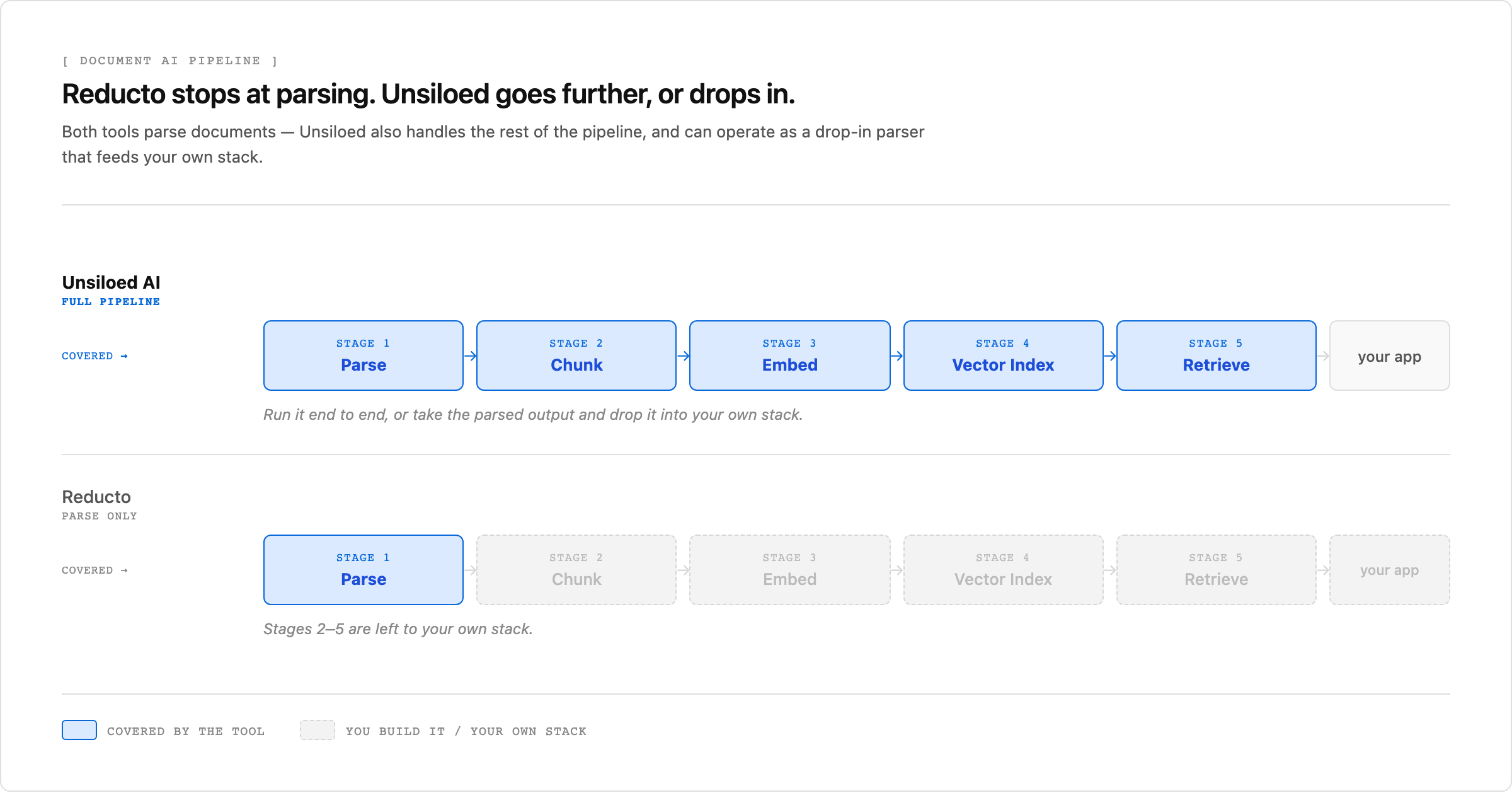
Both products process and chunk documents. Unsiloed can also embed, index, and retrieve through a hosted workflow, or hand its output to your existing stack.
Unsiloed gives you both options on the same API. Use it purely as a parser and you get structured, confidence-scored output to feed into whatever stack you already run. Or use the workflow layer, and the chunking, embedding, hosted vector index, and retrieval are handled for you. For a RAG system, that is the difference between always maintaining three more services and being able to hand those stages to the platform when it suits you.
The drop-in parser option reduces the migration risk of adopting the hosted workflow. You can keep your existing vector infrastructure or move more of the pipeline into Unsiloed as your requirements change.
Parsing Accuracy
Both tools are vision-based parsers that preserve tables, multi-column reading order, and scanned content that generic OCR loses. The cleanest way to compare them is on the same benchmark, scored the same way.
The published May 2026 benchmark report covers 1,403 PDFs and 8,413 tests using the unmodified olmocr==0.4.27 scorer. Unsiloed scored 88.0 ± 1.0. Reducto's then-current agentic pipeline, configured for text, tables, and figures with the benchmark instruction, scored 66.0 ± 1.0.
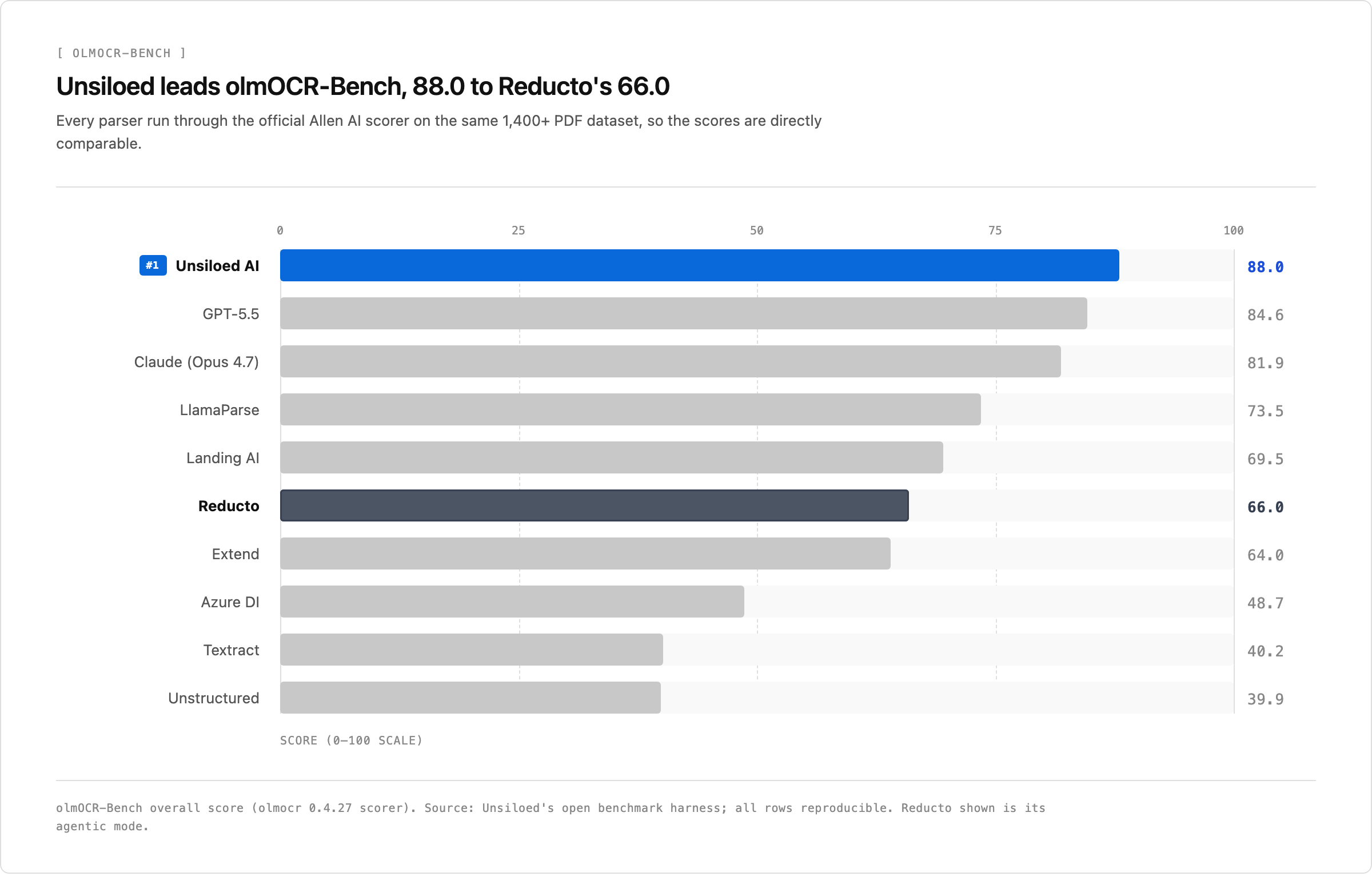
The May 2026 report used the same dataset and scorer for each service. It predates Reducto r-1.
This is a vendor-run parsing benchmark, not a measure of extraction accuracy, confidence calibration, latency, price, or production reliability. The runner code, configuration manifests, and raw score artifacts are public, but reproducing commercial-service results requires credentials. Reducto r-1 needs a new run before anyone can claim the 22-point gap still applies to its current preview model.
Verifiable Output
For finance, legal, and healthcare workflows, traceability is a production requirement: each extracted value needs a confidence signal and a way back to the source.
Both platforms provide numerical confidence and source citations. Unsiloed returns a 0-to-1 confidence score on every extracted value, with optional word-level bounding boxes. In Reducto v3, enabling citations returns source locations and enables numerical parse and extraction confidence by default. For audit-heavy workflows, compare the coverage and calibration of those scores on your fields instead of treating either checkbox as a differentiator.
Deployment and Compliance
Deployment is often where enterprise procurement decisions get made, and here the two are closely matched. Both run as managed cloud services and advertise private deployment options. Reducto lists VPC and on-premise deployment on its Enterprise plan, while Unsiloed supports on-premise and air-gapped deployments.
For regulated workloads, verify the exact topology, data-retention terms, audit reports, and Business Associate Agreement availability during procurement. Neither product should be ruled in or out based on a generic compliance label.
Where Each Tool Fits
- Unsiloed AI suits teams that want the strongest result in the published May benchmark and the option to run embedding, indexing, and retrieval in the same platform.
- Reducto suits teams that value its current document-processing workflow and already operate their embedding, vector storage, and retrieval layers.
Why Unsiloed AI is the Better Choice for Document AI
Unsiloed matches Reducto on the core document-processing requirements. Its case rests on two narrower, verifiable advantages:
- Optional retrieval infrastructure: use Unsiloed as a drop-in parser, or add hosted embedding, vector indexing, and retrieval. Reducto handles semantic chunking but documents external embeddings and vector storage.
- The published benchmark result: Unsiloed led the Reducto configuration tested in May by 22 points. The claim is reproducible within that dated setup, not a claim about the newer r-1 preview.
For teams choosing from published evidence today, those advantages make Unsiloed the stronger candidate. A representative evaluation should still include Reducto r-1 and your own documents, schemas, latency targets, and review thresholds.
Final Thoughts on Choosing a Document AI Platform
The two products are close on document-processing features and private deployment. Unsiloed separates itself with the best published head-to-head result available in this comparison and a hosted path from parsed output to retrieval. Try Unsiloed AI on the documents that matter to your workflow, then compare the result with Reducto r-1 before making a production decision.
FAQ
How do I decide between Unsiloed AI and Reducto?
Both work as parsers you can drop into your own stack, and both support chunking. If you also want hosted embedding, vector indexing, and retrieval in the same platform, Unsiloed includes those stages. Reducto's documented workflow sends embedding and vector storage to your infrastructure.
Do both tools return confidence scores and citations?
Yes. Unsiloed returns a 0-to-1 confidence score on every extracted value, with optional word-level bounding boxes. When Reducto citations are enabled, Reducto v3 returns source locations and enables numerical parse and extraction confidence by default.
Does Reducto handle retrieval, or just parsing?
Reducto performs semantic chunking and returns embedding-optimized text, but its documented RAG flow uses your embedding function and vector database. Unsiloed can also host embedding, vector storage, and retrieval through its workflow layer.
Can I deploy either tool on my own infrastructure?
Both advertise private deployment options. Reducto lists VPC and on-premise deployment on Enterprise. Unsiloed supports on-premise and air-gapped deployments. Confirm the exact security and contractual requirements with each vendor.
Which tool is more accurate on complex documents?
In the May 2026 olmOCR-Bench report, Unsiloed scored 88.0 ± 1.0 and Reducto's tested agentic configuration scored 66.0 ± 1.0. The report predates Reducto r-1, so rerun the comparison on your documents rather than applying that result to the new preview model.