
Top Healthcare Document Processing APIs with HIPAA Compliance (April 2026)
You need a healthcare document API that handles real clinical documents, beyond the clean samples vendors show in demos. The challenge is that handwritten notes, scanned lab reports with complex tables, and insurance forms with nested fields all require different processing approaches, and generic O


You need a healthcare document API that handles real clinical documents, beyond the clean samples vendors show in demos. The challenge is that handwritten notes, scanned lab reports with complex tables, and insurance forms with nested fields all require different processing approaches, and generic OCR breaks down fast when document layouts shift between providers or EHR systems. This guide covers the specific technical requirements and compliance considerations that separate APIs built for healthcare from document processors with a compliance badge attached, so you can assess options based on what'll actually work when you're processing thousands of patient records.
TLDR:
- Healthcare document APIs must parse clinical notes, lab reports, and insurance forms while preserving structural relationships between values
- HIPAA compliance requires encryption, audit logging, BAA agreements, and deployment models that keep ePHI in your environment
- Confidence scoring on extracted fields lets you route uncertain results to human review before they affect care decisions
- Unsiloed AI provides layout-aware parsing with word-level citations and on-premises deployment for healthcare organizations processing clinical documents at scale
Core Capabilities of Healthcare Document APIs
The global healthcare API market was valued at $432.1 million in 2022 and is projected to grow at a compound annual growth rate of 8.0% through 2030. That growth reflects how aggressively healthcare organizations are investing in automated document workflows, but volume alone doesn't capture what makes this category difficult to build for.
What a Healthcare Document API Actually Needs to Do
Clinical documents span an unusually wide range of formats. A single patient encounter might generate:
- Handwritten or typed clinical notes with free-form physician observations
- Lab reports with dense tabular data and reference ranges
- Insurance pre-authorization forms with nested fields and checkboxes
- Scanned radiology reports with embedded imaging metadata
- Prescription records with domain-specific drug nomenclature
A generic OCR tool can pull text off these pages, but it can't preserve structural relationships between values, correctly interpret medical abbreviations, or flag uncertain extractions. Layout-aware parsing is non-negotiable here. APIs built for healthcare need computer vision models that understand how clinical documents are structured visually. Tables in lab reports carry meaning through row-column relationships, and a value extracted without its corresponding reference range is incomplete.
Confidence scoring matters more in this category than anywhere else. Any API processing clinical documents should return a score alongside every extracted value so downstream systems can route low-confidence results to human review before they affect care decisions.
HIPAA Compliance Requirements for Document Processing APIs
Any API handling electronic protected health information (ePHI) must meet specific technical and administrative controls under HIPAA. Non-compliance can result in fines up to $1.5 million per violation category annually, so integrating a generic document processor into a healthcare workflow creates real legal exposure.
What HIPAA Actually Requires from APIs
The HIPAA Security Rule breaks into three areas every healthcare document API must satisfy:
- Encryption at rest and in transit for all ePHI
- Role-based access controls limiting data exposure to authorized users
- Audit logging capturing who accessed what and when
- Automatic session timeouts and re-authentication policies
- Data integrity controls to detect unauthorized modification
API key authentication alone is often insufficient for clinical environments. OAuth 2.0 flows or certificate-based auth are more appropriate for production healthcare integrations.
Business Associate Agreements
Any API vendor processing ePHI on behalf of a covered entity is legally a Business Associate under HIPAA, requiring a signed Business Associate Agreement (BAA) before live data can flow through. Vendors without BAA processes are a non-starter for compliant deployments.
Deployment model matters here too. Cloud-hosted APIs that co-mingle customer data, or vendors retaining documents for model training, are structurally incompatible with HIPAA. Look for APIs supporting on-premises or air-gapped deployment with explicit guarantees that your data is never used to train shared models.
Healthcare Document Types and Processing Challenges
Over 80% of healthcare data is unstructured, spread across document types that vary widely in structure, vocabulary, and regulatory weight. No single parsing approach handles all of them well.
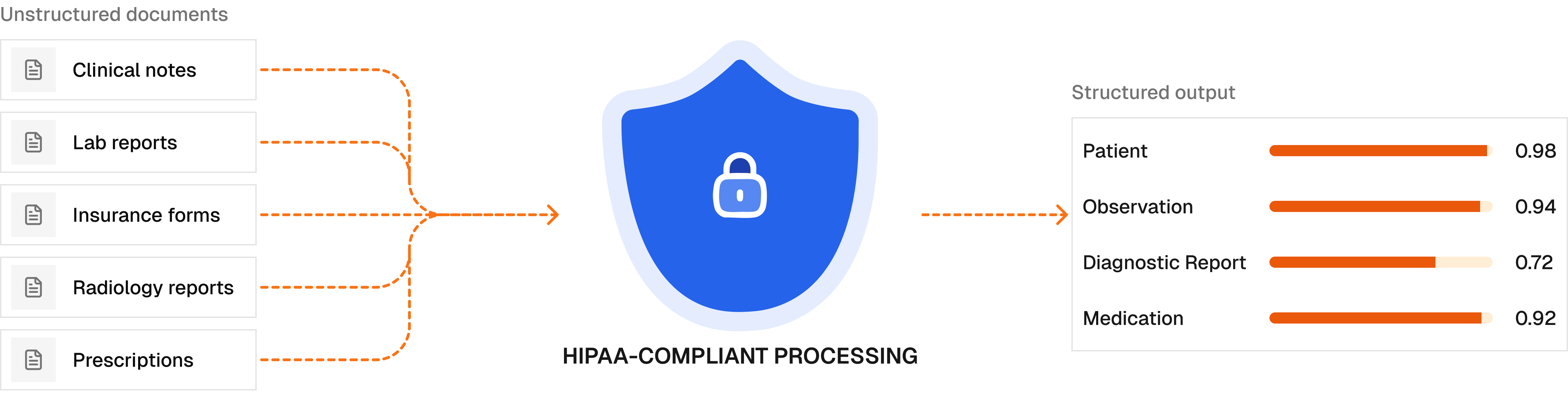
Common Document Types and Why They're Hard to Process
A few categories stand out as particularly difficult for automated processing.
- Clinical notes rely on physician shorthand, free-form narrative, and inconsistent section headers that shift across hospital systems and specialties.
- Lab and diagnostic reports store meaning inside tables, where reference ranges and result flags only make sense relative to their column headers.
- Radiology reports mix structured metadata with free-form impression sections, while insurance claims layer codes, identifiers, and billing fields into dense multi-column layouts.
- Consent forms often arrive as scanned images with handwritten signatures and checkboxes that generic OCR misses entirely.
The deeper issue is that even within a single document type, formatting varies by provider, EHR system, and region. APIs that rely on fixed templates break as soon as the layout changes. What's needed is a vision-first approach that reads documents structurally instead of pattern-matching against a known format.
Data Extraction vs. Document Parsing for Healthcare
Parsing and extraction are related but serve different purposes. Conflating them leads to picking the wrong tool for a given workflow.
Parsing converts a document into a structured, layout-aware representation, outputting hierarchical chunks of Markdown or JSON that preserve reading order, table structure, and visual hierarchy. Use this when feeding clinical documents into RAG pipelines, where an LLM needs full document context to answer questions accurately.
Extraction is more targeted. You define a schema specifying exactly what fields you want, and the API returns just those values, ready for downstream systems without additional processing.
When to Use Each in Healthcare
| Use Case | Recommended Approach |
| Feeding clinical notes into a RAG system | Parsing |
| Extracting patient demographics from intake forms | Extraction |
| Chunking discharge summaries for embeddings | Parsing |
| Pulling billing codes from insurance claims | Extraction |
| Converting lab reports for semantic search | Parsing |
| Structured data entry from EHR exports | Extraction |
Most healthcare teams need both. A hospital admission record may require parsing to preserve narrative sections for retrieval while simultaneously requiring extraction to pull specific identifiers into a database. APIs that offer both under a unified interface reduce integration overhead considerably.
Interoperability Standards: FHIR, HL7, and Healthcare APIs
Healthcare interoperability runs on two dominant standards: HL7 v2, the legacy messaging format still powering most hospital systems, and FHIR (Fast Healthcare Interoperability Resources), the REST-based standard gaining rapid adoption. In 2025, 71% of surveyed healthcare stakeholders reported FHIR is actively used in their country for at least a few use cases, up from 66% in 2024.
FHIR expects structured, typed data, but clinical documents rarely arrive that way. A document processing API sits between raw source files and the FHIR layer, extracting fields into structured JSON that maps onto resource types like Patient, Observation, or DiagnosticReport. Without accurate extraction upstream, FHIR pipelines break on the data they're supposed to standardize.
API Authentication and Access Control for Healthcare Systems
Authentication in healthcare APIs goes beyond API keys. Clinical environments require layered identity controls that reflect who is accessing data, what they're authorized to see, and when.
OAuth 2.0 with OpenID Connect is the baseline for production healthcare integrations. Scoped tokens let you restrict access precisely: a clinician token may read and write patient records, while an administrative token covers scheduling and billing fields only. Patients accessing their own records through a portal get a separate, narrower scope entirely.
Role-based access control maps onto these scopes. Every API call touching PHI should check the caller's role before returning data, beyond validating that a token exists.
Audit logging is non-negotiable. HIPAA requires a record of every access event, including the user, timestamp, and data touched. API gateways sitting in front of document processing endpoints can enforce this uniformly without relying on each downstream service to log independently.
Deployment Options: Cloud, On-Premises, and Hybrid Architectures
Deployment model is often the first decision healthcare organizations make when selecting document processing APIs, and it's rarely purely a technical one. Security posture, data residency laws, existing infrastructure, and audit requirements all weigh in.
Comparing Deployment Models
| Model | Best For | Key Tradeoff |
| Cloud-native | Startups, low-volume use cases | Fastest setup, least control over data |
| On-premises | Large health systems, compliance-heavy environments | Full data control, higher ops burden |
| Air-gapped | Government, defense health agencies | Maximum isolation, no external connectivity |
| Hybrid | Enterprises with mixed workloads | Flexible, but complex to govern |
For organizations under strict data residency requirements or handling sensitive ePHI at scale, on-premises or air-gapped deployments are often the only path to compliance. Vendors that support self-hosted deployment within your own cloud environment (AWS, Azure, GCP) give you infrastructure control without building the parsing layer from scratch.
Cloud-native APIs work well when throughput is unpredictable and you need to scale quickly, but require careful vetting around data retention policies and BAA coverage before ePHI flows through.
Accuracy and Confidence Scoring in Clinical Document Processing
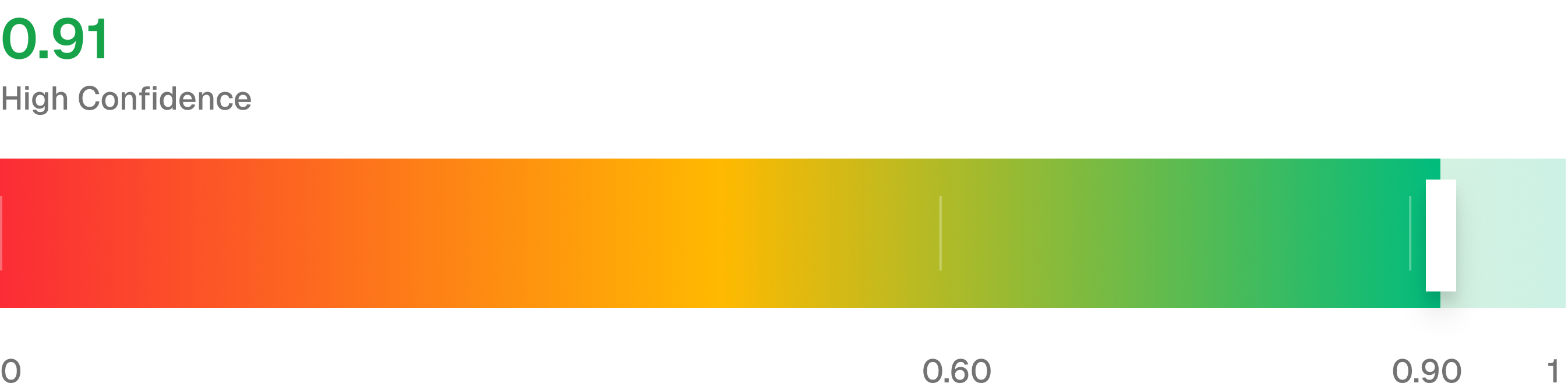
Field-level confidence scores give downstream systems a way to act on uncertainty. When every extracted value returns a score between 0 and 1, low-confidence results can be routed to a human reviewer before reaching any EHR or decision system. Word-level citations with bounding boxes go further, letting reviewers trace exactly where in the source document a value originated.
APIs that return plausible-but-incorrect data without signaling uncertainty are categorically unsuitable for clinical use. A miscategorized lab value or a hallucinated medication dosage can affect care decisions downstream. Silence on confidence is itself a risk signal.
Integration Patterns for EHR Systems and Healthcare Workflows
Healthcare document APIs typically connect to EHR systems through one of three patterns: synchronous REST calls for real-time point-of-care lookups, asynchronous job-based processing for multi-page clinical files, and batch pipelines for high-volume workflows like claims processing or prior authorization queues.
Asynchronous processing fits most clinical document workflows well. Submit a job, receive a job ID, poll for results. This maps cleanly onto intake forms, discharge summaries, and insurance documents where processing time is acceptable and document size varies widely.
Batch mode suits population health and retrospective analysis: send hundreds of records, retrieve structured outputs when ready, route each to the appropriate downstream system based on document type.
For prior authorization, classification and extraction work best together. Classify the incoming document first, then run targeted extraction against the fields your payer system expects, reducing API calls and downstream cleaning.
Unsiloed AI for Healthcare Document Processing
Unsiloed AI's healthcare capabilities are built around the same requirements covered throughout this article: layout-aware parsing, confidence scoring on every extracted field, and deployment models that keep ePHI inside your environment.
For healthcare teams, the practical starting points are:
- Schema-based extraction for intake forms, prior authorization docs, and insurance claims
- Layout-preserving parsing for lab reports, clinical notes, and discharge summaries destined for RAG pipelines
- Document classification to route incoming files before processing begins
- On-premises or air-gapped deployment for environments where data cannot leave your infrastructure
SOC 2 certification, end-to-end encryption, and explicit guarantees against using your data for model training cover the compliance requirements. Every extracted field returns a confidence score and word-level bounding box, so uncertain values get flagged before they reach any downstream clinical system.
If you're processing healthcare documents at scale, book a demo to discuss deployment options and get API access.
Final Thoughts on Implementing Healthcare Document APIs
Most healthcare organizations underestimate what it takes to process clinical documents correctly until they're halfway through a failed implementation. A production-grade healthcare document API needs layout-aware parsing, field-level confidence scores, and deployment options that satisfy your data residency requirements without cutting corners on accuracy. Reach out to discuss how your documents and compliance environment map onto specific deployment models. You can build this capability in-house, but the timeline is longer and the edge cases are harder than most teams anticipate.
FAQ
What's the difference between document parsing and extraction for healthcare workflows?
Parsing converts documents into structured, hierarchical formats that preserve layout and reading order for RAG systems or semantic search. Extraction pulls specific fields based on your schema and returns just those values for database entry or downstream automation. Most healthcare teams need both: parsing for clinical notes fed into AI systems, extraction for demographics and billing codes.
How do HIPAA-compliant APIs handle data retention and model training?
HIPAA-compliant APIs must sign Business Associate Agreements and guarantee your data stays within your environment and is never used to train shared models. Look for vendors offering on-premises or air-gapped deployment where data never leaves your infrastructure. Cloud APIs that retain documents or co-mingle customer data for training create legal exposure.
Why do healthcare document APIs need confidence scores on extracted fields?
Clinical documents carry legal and care-decision weight where incorrect data can affect patient outcomes. Confidence scores let you route low-confidence extractions to human review before they reach EHR systems or decision workflows. Word-level bounding boxes go further by showing exactly where each value originated in the source document for audit trails.
When should you use asynchronous processing instead of real-time API calls?
Use asynchronous processing for multi-page clinical documents like discharge summaries, lab reports, or prior authorization forms where processing time varies and real-time response isn't required. Synchronous calls work for point-of-care lookups with single-page documents. Batch mode fits high-volume workflows like claims processing where you submit hundreds of records at once.
Can a document processing API integrate with existing EHR systems?
Yes, through REST APIs that extract fields into structured JSON mapping onto FHIR resource types like Patient, Observation, or DiagnosticReport. The API sits between raw documents and your EHR's FHIR layer, converting unstructured clinical files into typed data your system expects. OAuth 2.0 with role-based scopes handles authentication for production healthcare environments.