
Agentic Document Processing: Verify Before You Trust (July 2026)
OCR reads a value and passes it downstream; agentic document processing treats that value as a claim to verify first. Here is how confidence scores, bounding-box citations, and validation tools turn extraction into a verified workflow that catches uncertain values before they become trusted data.

OCR reads a value and passes it downstream. Agentic document processing treats that value as a claim to verify before it reaches a system of record.
That difference matters when documents are messy: handwritten loan applications, low-resolution insurance scans, dense tables, scanned invoices, or legal packets with repeated dates and parties. A dropped digit or misread date can look plausible enough to pass basic validation, then surface later as a payment error, compliance issue, or failed audit.
This post explains how agentic document processing works, where confidence scores and bounding-box citations fit, and how to design a pipeline that catches uncertain values before they become trusted data.
TLDR:
Agentic document processing treats extracted fields as hypotheses to verify, not text to trust automatically.
Confidence scores become routing signals: high-confidence fields can pass through, while uncertain fields get checked, reprocessed, or sent to review.
Bounding-box citations let the agent re-inspect the page region that produced a field instead of reprocessing the full document.
Agentic workflows matter most in finance, legal, healthcare, insurance, and back-office operations where a wrong field can trigger downstream cost.
Unsiloed AI provides structured extraction, confidence scores, source citations, and deployment options for agent-ready document pipelines.
Why Static OCR Breaks Down
Traditional OCR converts a document image into text. Once it returns the text, the pipeline usually treats those characters as truth.
That works on clean, structured forms. It breaks down on handwritten fields, skewed scans, mixed-font tables, low-resolution images, and layouts that change between document versions. A date can be read as an account number. A dollar amount can drop a digit. A scanned invoice can return S1,234.56 instead of $1,234.56.
The problem is not only recognition quality. It is the lack of a verification step. Static OCR has no way to ask whether the value is plausible, whether it matches nearby fields, or whether the source region supports the extracted string.
What Agentic Document Processing Changes
Agentic document processing adds a verification layer between extraction and commitment. The extractor returns candidate fields. An agent checks those fields against confidence scores, source regions, schemas, business rules, and related documents before writing them downstream.
That changes the pipeline behavior. A traditional document parsing pass extracts a value and moves on. An agentic pipeline can:
Re-inspect the source region for an uncertain field
Compare related fields for consistency
Check formats, ranges, and checksums
Route low-confidence fields to review
Reject values that cannot be verified
The "agentic" part is the ability to take the next action. If a purchase order total does not match the sum of its line items, the agent can inspect the cited region, compare line items, retry extraction, or escalate the mismatch. The pipeline keeps moving, but bad data does not move silently.
Agentic OCR vs. Traditional OCR and Intelligent Document Processing
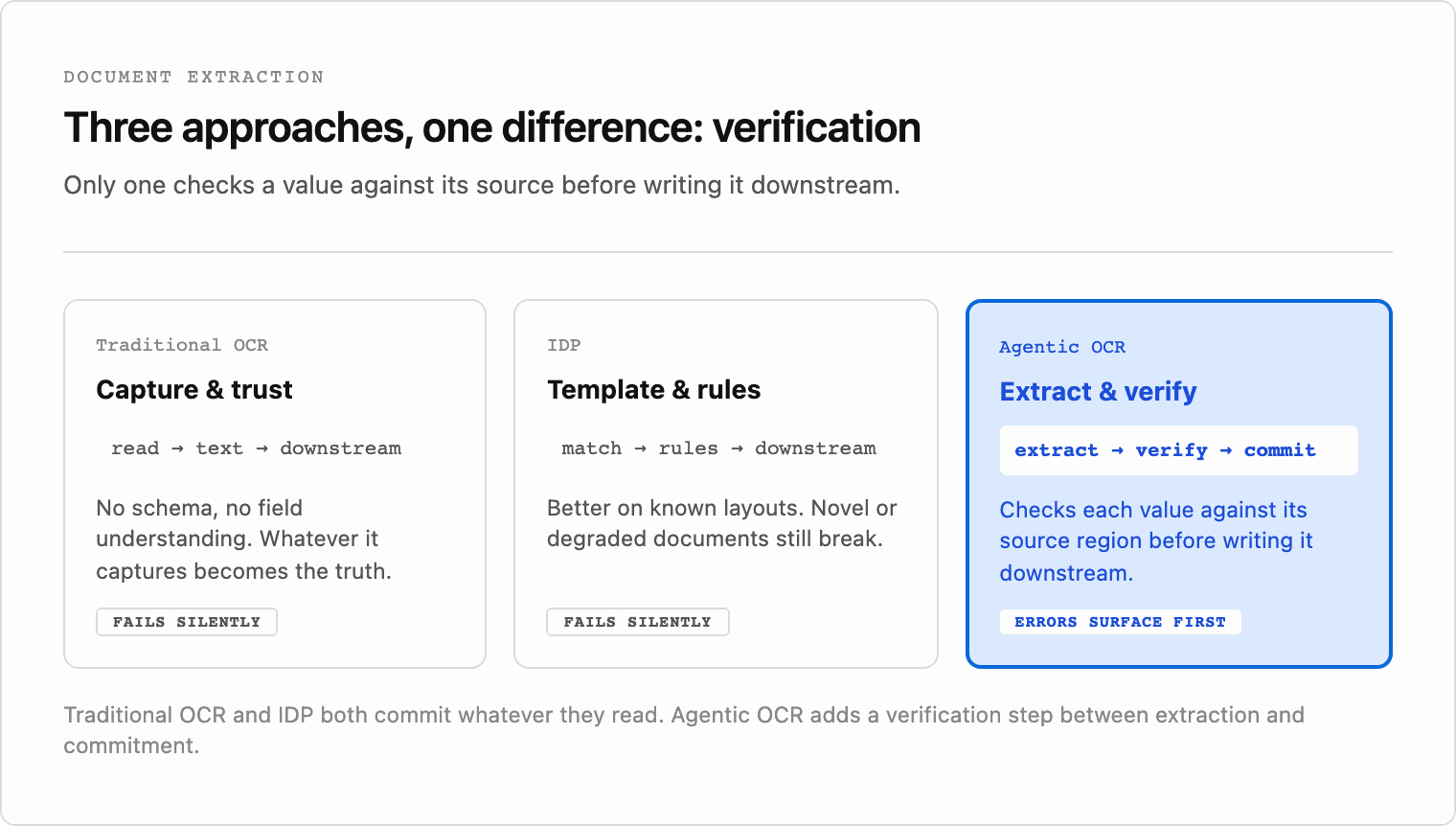
Traditional OCR, intelligent document processing, and agentic document processing solve different levels of the extraction problem.
| Approach | What It Does | Where It Breaks |
|---|---|---|
| Traditional OCR | Converts document images into text | No field understanding, schema awareness, or verification |
| Intelligent document processing | Adds templates, rules, and field extraction | Performs well on known layouts but can fail silently on novel or degraded documents |
| Agentic document processing | Extracts fields, verifies them, and routes uncertain values | Requires confidence, provenance, schemas, and routing logic |
This distinction matters because a more accurate extractor is not the same as an auditable pipeline, a gap that shows up clearly in any document data extraction software comparison. Agentic processing makes extraction decisions inspectable before they affect a workflow.
How an Agentic Document Pipeline Works
An agentic pipeline treats extraction as a sequence of decisions, not a single read.
Extract: A vision-first model parses the document and returns candidate fields.
Score: Each field gets a confidence signal that reflects extraction certainty.
Ground: The field is linked back to the source document with a page region or bounding-box citation.
Verify: The agent checks the field against schemas, business rules, neighboring fields, or related documents.
Route: The pipeline passes, retries, escalates, or rejects the field based on the verification result.
The agent acts on structured extraction output, not raw document bytes. That matters because the agent needs reliable handles: a field name, a value, confidence metadata, and a source region to inspect when something looks wrong.
Confidence Scores as Routing Signals
Confidence scores are useful when they drive action. A field-level score gives the agent a first signal about whether to trust, verify, or reject an extraction.
The routing bands below are a starting point, not fixed rules:
| Confidence Band | Agent Action |
|---|---|
| High confidence | Pass to downstream automation |
| Borderline confidence | Run a second validation step or targeted human review |
| Low confidence | Retry extraction, reject the field, or route to manual review |
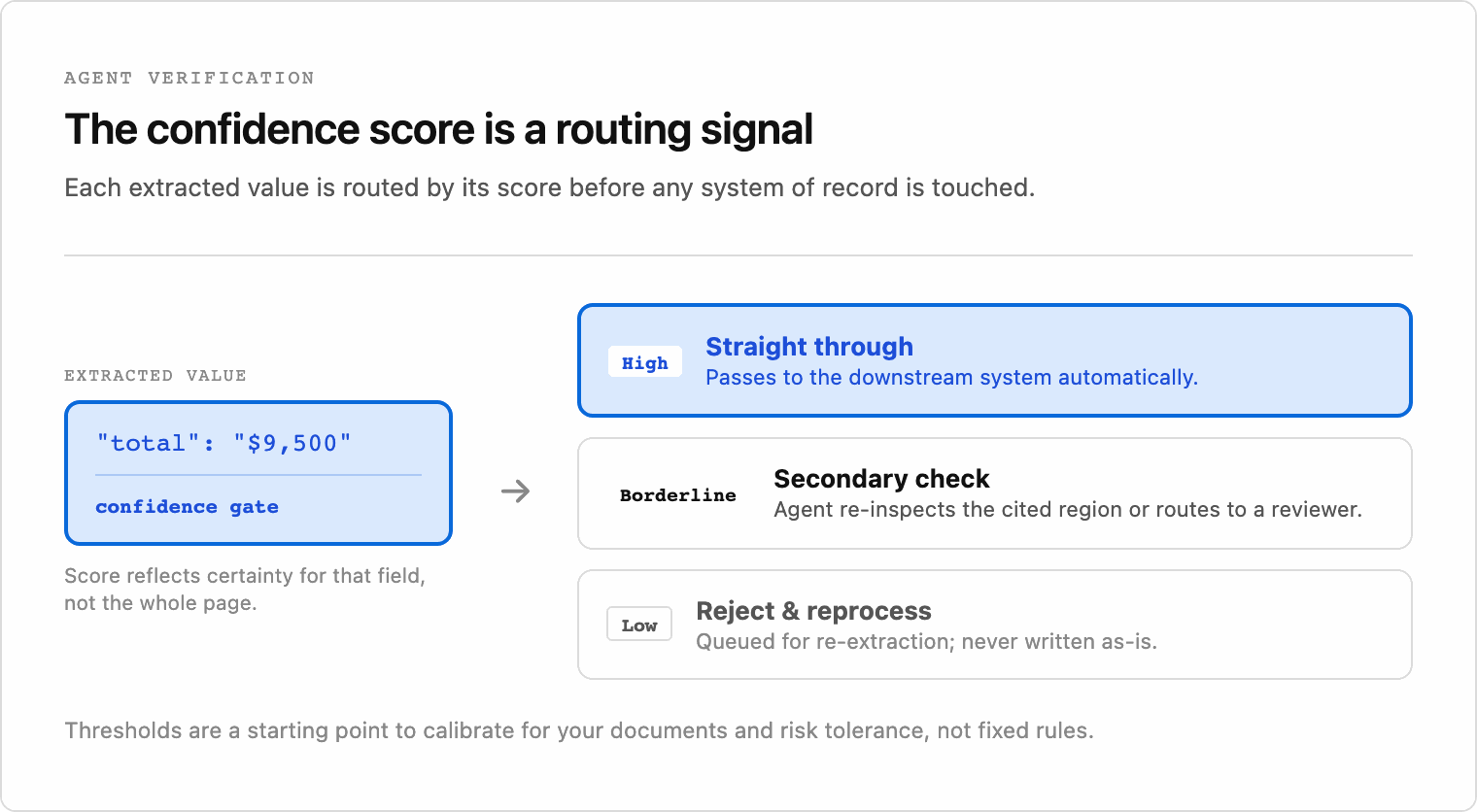
Teams should tune thresholds by field sensitivity. A borrower name, diagnosis code, bank account number, or contract renewal date may need stricter routing than a secondary reference field. The goal is not to review everything. The goal is to make uncertainty visible before a system of record accepts the value.
Bounding-Box Citations and Visual Grounding
Confidence tells the agent whether a field deserves attention. A bounding-box citation tells it where to look.
A bounding-box citation links an extracted field back to the page region that produced it. When the agent flags a borderline field, it can re-inspect that region, compare adjacent fields, or show the exact source area to a reviewer. This is much cheaper than reprocessing the full document or asking a person to search through dozens of pages.
Visual grounding also makes agent decisions easier to audit. If the agent changes, rejects, or escalates a value, the pipeline can preserve the field, confidence score, source region, and verification outcome together.
Tool Use in Agentic Document Processing
An agentic document pipeline does not need unlimited autonomy. It needs a small set of reliable tools.
Useful tools include:
Re-cropping a cited region and rerunning inference on that region
Comparing extracted values against expected formats, ranges, and checksums
Checking related fields inside the same document
Comparing fields across related documents, such as an invoice and purchase order
Routing borderline fields to a review queue with their source regions attached
This is where OCR confidence score reliability becomes practical. The score does not sit in a report. It controls what the agent does next.
Cross-Document Validation
Some errors only appear when the agent compares documents. An invoice total can look valid by itself and still conflict with the purchase order. A borrower name can be extracted correctly from a form and disagree with another form in the same loan packet.
Cross-document validation catches those mismatches. The agent compares normalized fields across documents, checks whether values agree, and routes discrepancies before they reach downstream systems. This matters in mortgage, accounts payable, insurance, and healthcare workflows where the unit of work is often a packet, not a single PDF.
Cross-document validation also improves answer quality in RAG pipelines. If an answer depends on a structured field, the system should know which document produced the field and whether related documents confirm or contradict it.
Where Agentic Document Processing Matters Most
Agentic document processing is most useful when a wrong field has real cost.
Common fits include:
Finance: Loan files, bank statements, trade confirmations, invoices, and onboarding documents, a core use case for document intelligence APIs for financial services
Legal: Contracts, amendments, leases, obligations, dates, and party names
Healthcare: Clinical forms, payer documents, lab reports, and patient intake packets, the inputs behind healthcare document processing APIs built for HIPAA compliance
Insurance: Claims, loss reports, policy documents, and supporting evidence
Back-office operations: High-volume invoice, procurement, and compliance workflows
In these workflows, manual review for every document is too slow, but silent extraction errors are too expensive. Agentic routing gives teams a middle path: automate clean fields and focus human attention where the evidence is weak.
Implementation Considerations
Agentic document processing adds verification work, so the design has to control cost and latency.
Start with a clear schema. Agents need field names, types, expected formats, and validation rules before they can judge whether a value is plausible. Without a structured output contract, the agent has no stable target to reason against.
Use field-level routing instead of document-level routing where possible. Sending an entire document to manual review because a single field is uncertain wastes reviewer time. A better workflow routes the uncertain field with its source citation.
Preserve provenance with the extracted value. Store the field, confidence score, source region, document version, and verification outcome together. That record is what lets teams audit the pipeline later.
Add cross-document checks only where they change decisions. Comparing every field across every document can slow the system down. Focus on fields where disagreement matters: totals, names, dates, IDs, and regulated values.
How Unsiloed AI Supports Agentic Document Pipelines
Unsiloed AI provides the extraction layer an agentic pipeline needs: structured fields, confidence scores, and source citations that downstream agents can use for verification and routing.
The platform is vision-first, so extraction runs against the rendered document rather than assuming a clean text layer. That matters for scanned forms, handwritten fields, dense tables, and mixed layouts where text-layer parsers return empty strings or scrambled output.
Unsiloed also supports deployment patterns for compliance-sensitive workflows, including private, on-premise, and air-gapped environments. That lets teams run agentic document processing where the documents are allowed to live.
Final Thoughts on Agentic Document Processing
Agentic document processing changes extraction from a single read into a verified workflow. The extractor proposes a value. Confidence scores, bounding-box citations, schemas, and validation tools decide whether that value is ready for automation.
For teams processing high-value or regulated documents, that verification layer catches errors where they are cheapest to fix. Book a demo with Unsiloed to see confidence scores, source citations, and routing logic working on your documents.
FAQ
What is agentic document processing?
Agentic document processing is an extraction workflow where an AI agent verifies extracted fields before they move downstream. The agent can inspect confidence scores, source citations, schemas, business rules, and related documents to decide whether to pass, retry, reject, or escalate a field.
How is agentic OCR different from traditional OCR?
Traditional OCR converts an image into text and returns the result. Agentic OCR adds a verification step after extraction. The agent checks whether each field is plausible, grounded in the source document, and consistent with related fields before the value reaches a downstream system.
How should I set confidence thresholds?
Use confidence bands as routing rules, then tune them by field sensitivity. High-confidence fields can pass through automation, borderline fields can get a second validation step, and low-confidence fields can be retried or routed to review. Avoid a single global threshold for every field and document type.
Why do bounding-box citations matter for agents?
Bounding-box citations give agents a source region to inspect. Without a citation, the agent only has the extracted string and cannot reliably decide whether the value came from the right place. Citations also make human review faster because the reviewer can check the exact page region instead of searching the full document.
When does cross-document validation matter?
Cross-document validation matters when related documents should agree. In accounts payable, an invoice total should match the purchase order. In lending, a borrower name or date may need to match across forms. An agent can compare those fields and route discrepancies before they reach downstream systems.
How does Unsiloed AI support agentic document processing?
Unsiloed AI returns structured extraction output with confidence scores and source citations that agents can use for verification. Its vision-first extraction handles scans, handwritten fields, tables, and mixed layouts, and its deployment options support private, on-premise, and air-gapped workflows.