
What Is an Embedding in AI? A Technical Guide
Embeddings turn text, images, and other inputs into vectors that systems can compare by meaning. Learn how they power retrieval, how to evaluate a model, and why parsing and chunk quality set the ceiling for document search.


If you're building retrieval or search, you need to understand what an embedding in AI represents and what embedding models do. They turn text, images, or audio into vectors that systems can compare by meaning rather than exact keywords. This guide explains how embeddings work, how they support retrieval-augmented generation (RAG), and why the source chunks passed to a model limit what its embeddings can preserve.
TL;DR:
- Embeddings represent data as numerical vectors so systems can compare meaning.
- RAG systems use embeddings to retrieve chunks related to a user's query.
- Embedding dimensions affect storage and retrieval costs, but more dimensions do not automatically produce better results.
- An embedding represents the chunk it receives, not the original document.
- Parsing and chunk construction determine which document relationships remain available to retrieval.
What Is an Embedding in AI?
An embedding is a numerical representation of data. An embedding model converts a word, sentence, image, or audio clip into an ordered list of floating-point numbers called a vector, then positions it in high-dimensional space.
Embedding models encode meaning through geometry by placing semantically similar inputs close together in vector space. For example, "dog" and "puppy" occupy nearby coordinates, while "dog" and "interest rate" lie farther apart.
These vector embeddings let systems compare patterns in language, images, and other data without requiring exact matches.
How Do Embeddings Work?
Training determines which relationships an embedding captures. Word2Vec learns a fixed representation for each word. BERT instead produces contextual token representations by conditioning on both left and right context. Those token representations are not automatically useful as sentence-level retrieval vectors.
For sentence or passage retrieval, models such as Sentence-BERT combine contextual token representations into a fixed-length vector trained for similarity comparison. You can store and index those vectors, then compare them using the similarity function recommended for the model, such as cosine similarity or dot product.
How Do Embeddings Support Similarity Search and RAG?
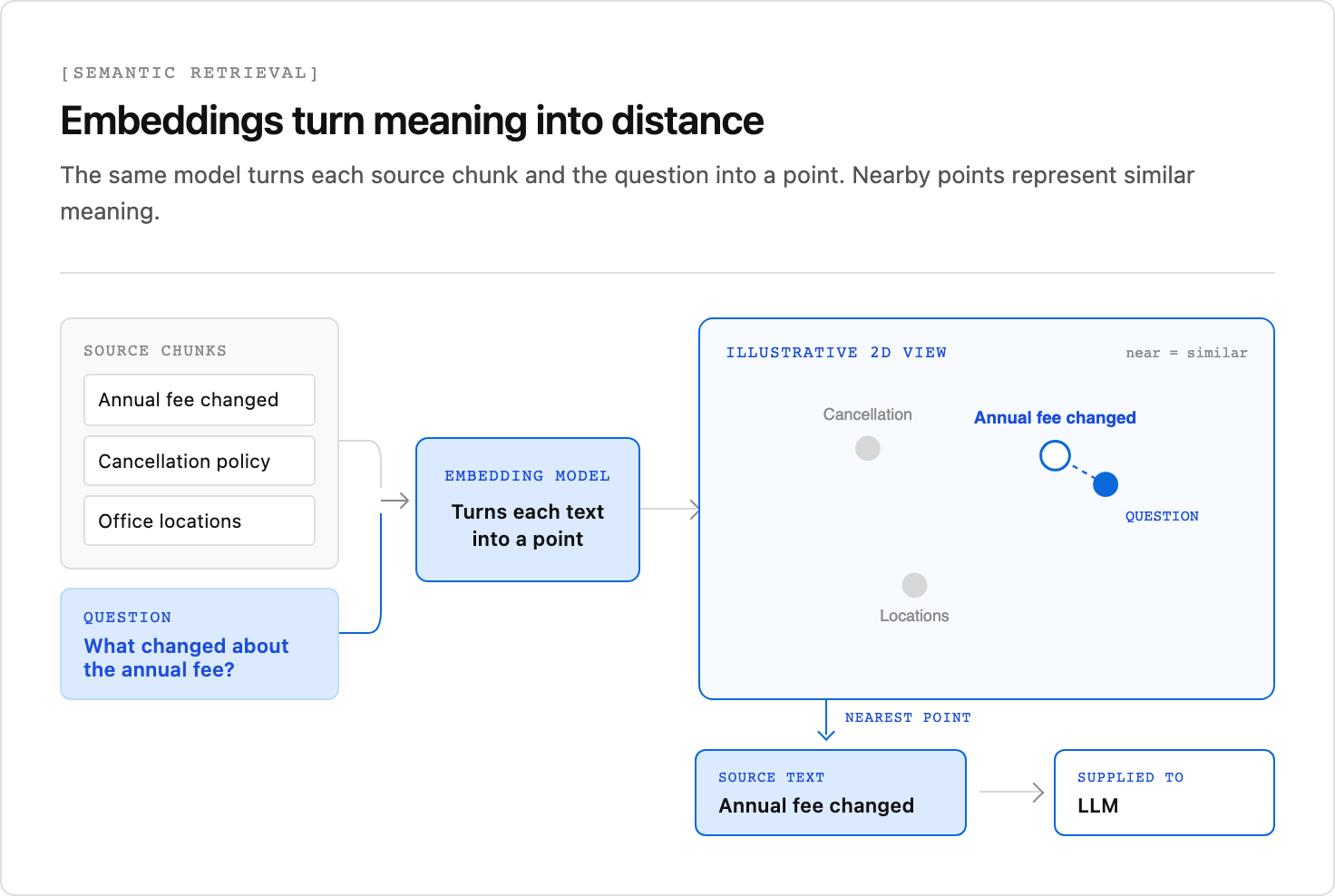
In a common RAG retrieval flow, documents get chunked, and each chunk is embedded and stored in a vector database. When a user submits a query, a compatible query encoder places it in the same vector space. The system compares it with the stored vectors, retrieves the closest matches, and supplies their source text to the LLM as context.
The query and source chunks take separate routes into one shared vector space before the closest source text reaches the LLM.
The quality of retrieval shapes every answer the model generates. Hybrid RAG systems combine keyword and vector search. Vector search can find conceptually similar material, while keyword search is precise for exact terms such as names and product codes. Prompt engineering cannot recover relevant source material that retrieval never supplied.
How Do You Choose an Embedding Model?
Not every embedding approach handles every input type. The modality of your data, how much context the model needs, vector dimensions, and evaluation results determine which technique actually fits.
Embedding Types and Example Models
| Type | Example Models | Primary Use Case |
|---|---|---|
| Word | Word2Vec, GloVe | Word similarity, query expansion |
| Sentence / Passage | Sentence-BERT, E5 | Semantic search, classification |
| Image | ResNet, CLIP | Visual retrieval, image similarity |
| Audio | wav2vec 2.0, CLAP | Speech representations, audio search |
| Multimodal | CLIP, ImageBind | Cross-modal search, document understanding |
The sharpest architectural divide is between static and contextual embeddings. Word2Vec assigns one fixed vector per word regardless of context, so "bank" maps to the same point whether you mean a river bank or a financial institution. BERT generates a different representation for that same word depending on the surrounding tokens. Contextual models are usually the better candidates when the distinction changes the meaning of a passage. Static embeddings can still suit lightweight word-level lookups where context matters less.
How Embedding Dimensions Affect Vector Search
In a single-vector retrieval system, each input produces a vector with a configured number of dimensions. Longer vectors require more storage and comparison work, but dimensionality alone does not determine retrieval quality. A well-trained smaller representation can outperform a larger one from a different model.
Some models support shortened embeddings, but truncation behavior is model-specific. Do not cut arbitrary vectors to a preferred size. Choose a supported dimension and measure retrieval quality, storage, and latency on your own data.
When to Fine-Tune an Embedding Model
Generic embeddings may miss distinctions that matter in specialized domains such as law, medicine, and finance. Fine-tuning on representative examples is one way to adapt a model, but it is not automatically an improvement. Compare the tuned model with a general-purpose baseline on real queries before deploying it.
How to Measure Embedding Quality
For document retrieval, create a held-out set of queries with known relevant chunks, then compare how often each model retrieves those chunks in its top results. Use the same documents and number of returned results for each model.
- Intrinsic evaluation. Tests the embedding space itself. Cosine similarity between known-related word pairs, analogy tasks like "king minus man plus woman equals queen," and clustering coherence all give a sense of whether the geometry of the space is meaningful.
- Extrinsic evaluation. Measures downstream task performance, whether that's retrieval accuracy in a RAG pipeline, classification F1, or reranking quality. This is usually the more informative signal for production use cases.
- Visualization. Uses dimensionality reduction tools like t-SNE or UMAP to inspect cluster structure visually, which is useful for spotting unexpected groupings or poor separation between categories.
Why Parsing and Chunk Quality Affect Embeddings
An embedding represents the chunk it receives, not the original file. If parsing drops a table header, scrambles reading order, or separates a value from its label, the model embeds that damaged input. The vector cannot restore context that disappeared earlier in the pipeline.
The same table can produce coherent or disconnected chunks depending on what the parser preserves before embedding.
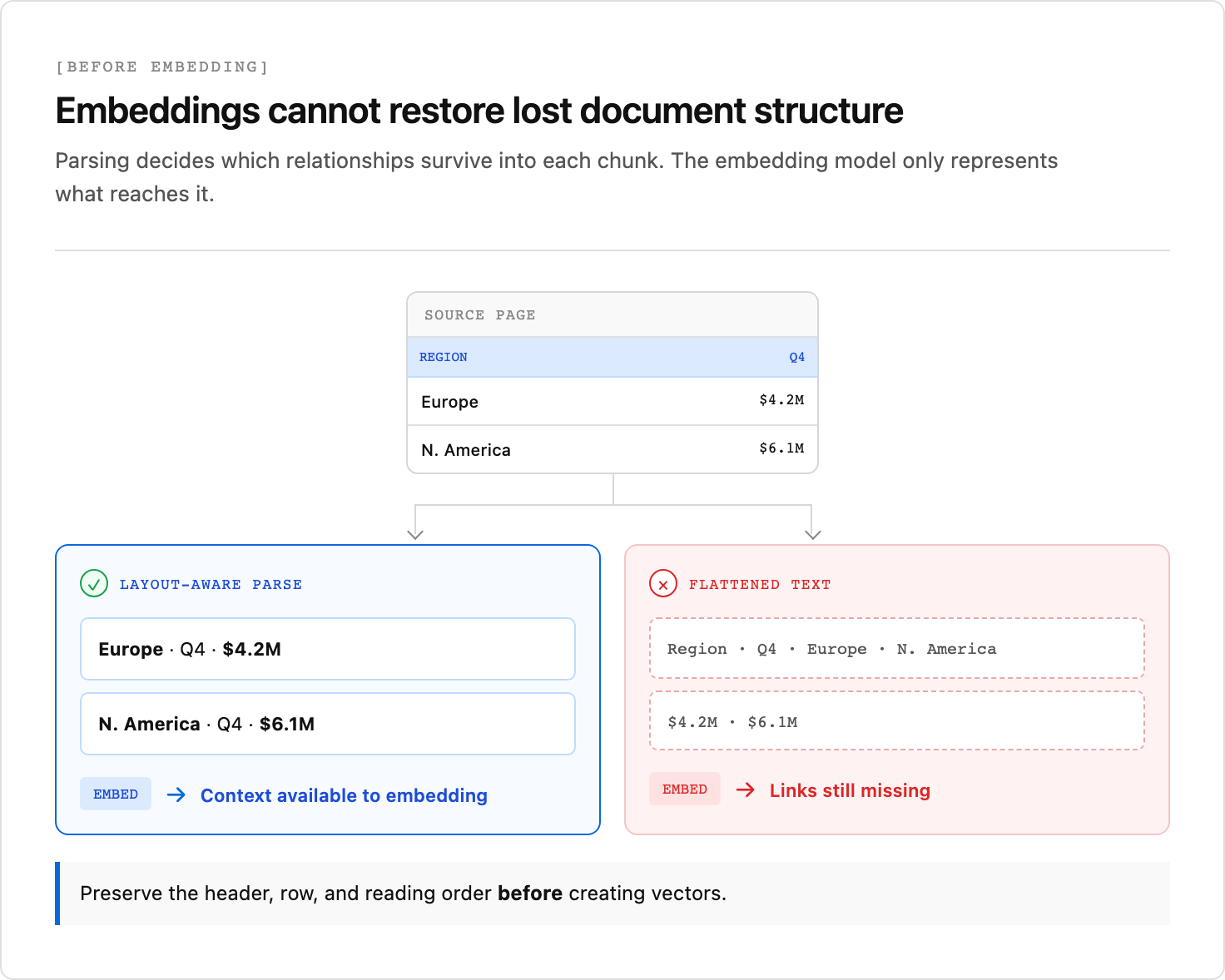
This is where document preparation affects retrieval. A layout-aware parser can keep headings, tables, and reading order available when chunks are constructed. If you use Unsiloed Parse, it sits at this preparation stage. A separate embedding model then represents the resulting chunks for storage and search.
Choosing an Embedding Model for Document Retrieval
Choose an embedding model by testing it against real queries and measuring retrieval quality, storage, and latency. For complex source files, test the parser output format and chunking strategy too because an embedding can only encode the input it receives. If tables, headings, or reading order matter to your retrieval system, book a demo to see how Unsiloed prepares documents before embedding.
FAQ
What Is an Embedding in AI?
An embedding is a dense vector of floating-point numbers that represents data like words, sentences, or images in high-dimensional space. The vectors position semantically similar inputs close together, allowing AI models to reason about meaning and similarity through mathematical operations rather than rigid rules.
Embedding Model vs LLM: What's the Difference?
Embedding models convert inputs into fixed-size numerical vectors for similarity comparison and retrieval, while LLMs generate text by predicting sequences token by token. You use embeddings to find and rank relevant information, then pass that context to an LLM for reasoning and generation.
Can I Use the Same Embedding Model for Both Queries and Documents in RAG?
Use encoders designed to produce comparable query and document vectors. Many systems use the same embedding model for both. Others use a paired or asymmetric setup that distinguishes query and document inputs. Unrelated embedding models generally produce incompatible vector spaces, so do not mix them unless the model or retrieval architecture explicitly supports it.
What Are the Best LLM Embedding Models for Production RAG Systems?
There is no single best production model. Start with models built for retrieval rather than raw language-model representations, shortlist them by supported language, context length, dimensions, latency, and licensing, then benchmark them on your own queries and documents. Include both general-purpose and domain-adapted candidates when specialist vocabulary matters.
When Should I Fine-Tune an Embedding Model Instead of Using a Pre-Trained One?
Consider fine-tuning when a strong pretrained baseline repeatedly confuses domain-specific concepts and you have representative training pairs plus a held-out evaluation set. Specialized vocabulary alone is not enough reason. First measure whether the errors come from the embedding model, document preparation, or retrieval configuration.