
Why Generic Parsers Fail on High-Stakes Documents (September 2026)
Generic parsers can return plausible text while stripping the layout and domain relationships that give high-stakes documents meaning. Learn how domain-specific extraction preserves structure, exposes field-level confidence, and supports auditable review.


Most document parsing failures are silent. Your pipeline returns a result, the confidence score looks plausible, and a misread covenant or orphaned lab value moves downstream. This article explains why general-purpose extractors plateau on finance, legal, and healthcare documents, and how domain-specific document extraction accounts for their layout, vocabulary, and review requirements.
TL;DR:
- Generic parsers lose meaning when they flatten domain vocabulary, spatial layout, and document hierarchies.
- Financial tables, legal cross-references, and mixed-format healthcare records each create distinct extraction failures.
- Domain-aware workflows preserve spatial layout and apply schemas designed for the documents being processed.
- Field-level confidence and optional source citations help teams detect ambiguous output before it reaches downstream systems.
High-Stakes Document Parsing Challenges
High-stakes documents combine structures that depend on domain conventions. A 10-K filing can contain tables with spanning headers and footnotes tied to earlier line items. A clinical summary may embed ICD-10 codes in free-text notes. A legal contract layers defined terms, cross-references, and obligation clauses.
These documents have three structural properties that defeat template-based extraction:
- Layout encodes meaning: a table column or indentation level determines what a value represents.
- Domain-controlled terms such as "net realized gain," "indemnification carve-out," and "creatinine clearance" require domain context.
- A patient record or loan file may span multiple document types and schemas.
A domain-specific extractor maps content to a schema designed for the document type. Domain terminology and layout rules guide how it interprets each field.
Why Generic Document Parsers Fail on Complex Layouts
Generic parsers perform well on clean, text-layer PDFs with predictable structure. They struggle with dense tables, nested clauses, handwritten annotations, and multi-column layouts where reading order carries meaning.
This mismatch produces predictable failures. A parser without domain-specific schema guidance cannot distinguish what a debt covenant means, how an ICD-10 code relates to a procedure note, or why a contract clause in section 4.2(b) carries different legal weight than identical language in a preamble. Without that context, the parser returns text with the relationships between fields stripped away.
The split below shows why preserving structure changes the evidence available to downstream systems.
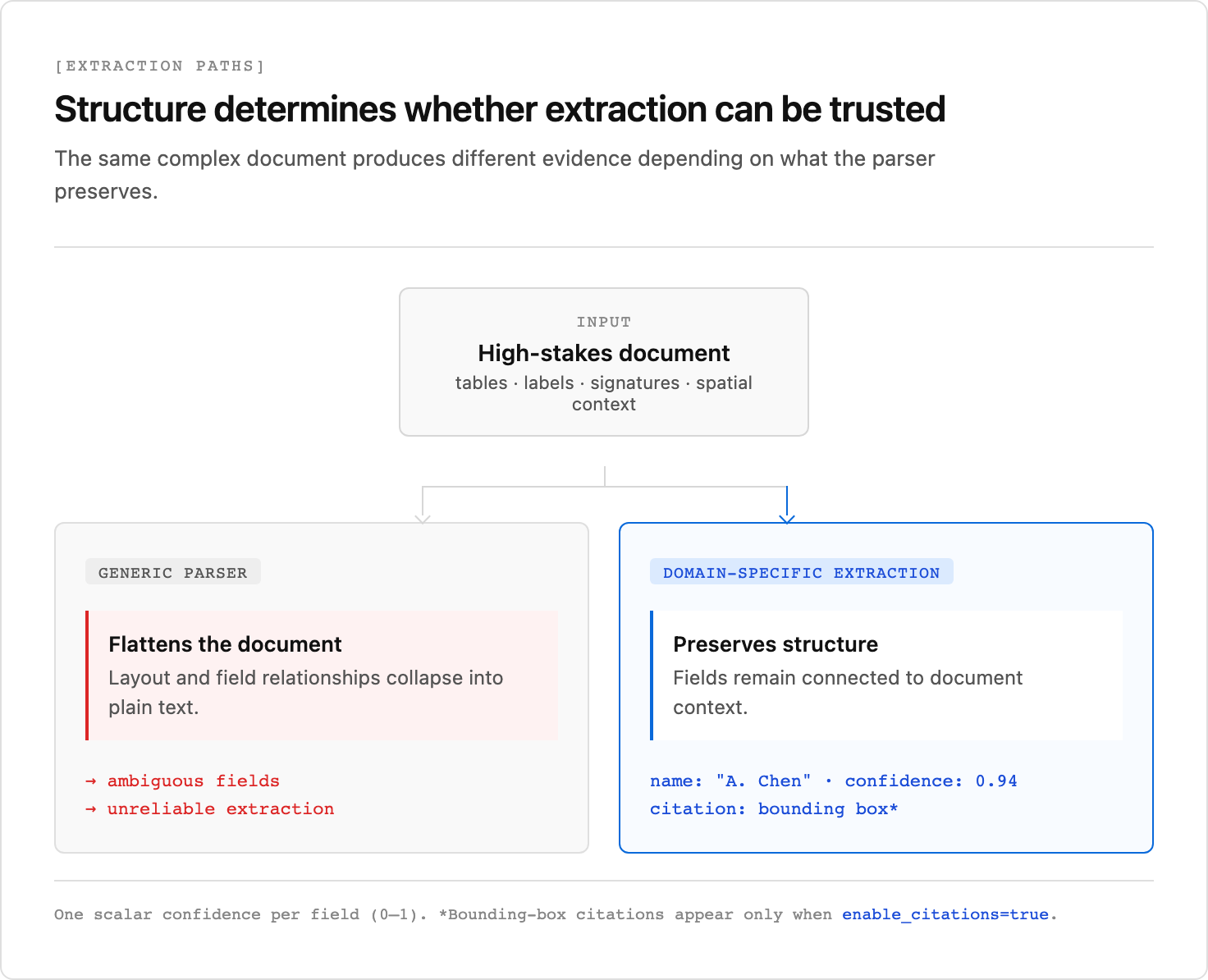
This is where domain-specific document extraction diverges from generic approaches:
- Generic parsers flatten structure, collapsing table rows, merged cells, and hierarchical headings into linear text streams that lose the relational context downstream systems depend on.
- They carry no concept of field criticality, so they handle a misread dosage figure like a misread date even when the dosage error carries greater risk.
- Optical character recognition (OCR) engines may expose character-recognition confidence, but extraction workflows also need confidence at the semantic field level. See our guide to confidence scoring for document extraction.
Why Financial Document Parsing Demands More Than OCR
Financial documents break generic parsers in ways that compound downstream. A balance sheet carries nested hierarchies, multi-row column headers, cross-referenced footnotes, and numerical relationships that only hold when the spatial layout is preserved. For a deeper look, see our financial PDF table extraction guide. When a generic OCR pipeline flattens that structure into a linear token stream, the reading order scrambles, table cells detach from their headers, and the extracted numbers become semantically orphaned.
The failure modes are specific:
- Multi-page tables and multi-column income statements get merged into a single text stream, collapsing the distinction between current and prior-period figures.
- Footnote references lose their anchor to the line items they qualify, breaking the audit trail that compliance workflows depend on.
- Parentheses can encode negative values in financial statements, so stripping that convention can reverse a number's sign.
A financial document parsing workflow must preserve these conventions at the structural level. It should treat parentheses around a numeric cell in a profit and loss statement as the sign of a negative value.
Why Legal Document Extraction Depends on Cross-References
Legal documents carry extraction problems that go well beyond format complexity. Contracts, briefs, and regulatory filings rely on defined terms, cross-references, and clause hierarchies where the meaning of one sentence often depends on language from several pages prior. A generic parser reading a contract linearly cannot resolve that dependency. Section references can also fail after chunking, leaving extracted values without the context that gives them legal weight.
The governing jurisdiction can change the interpretation and effect of a clause, so legal extraction workflows still need qualified review for consequential decisions.
Domain-specific document extraction for legal work requires models that treat defined-term scope, clause inheritance, and cross-reference resolution as structural properties of the document. Resolving them after extraction loses the hierarchy that connects each reference to its source clause.
Why Healthcare Document Extraction Requires Mixed-Format Support
Healthcare records sit at the intersection of handwritten notes, scanned forms, faxed referrals, and structured electronic health record (EHR) exports, often within the same patient file. When a discharge summary arrives as a scanned PDF with handwritten physician annotations overlaid on a printed template, a text-layer extractor returns partial output at best and silently drops the rest.
A published review reports that about 80% of medical data remains unstructured and untapped after it is created. Clinical notes, lab reports, imaging requisitions, and prior authorization forms each carry their own layout conventions, abbreviation sets, and regulatory sensitivity.
Healthcare document processing application programming interfaces (APIs) require models trained on clinical vocabulary, form layouts, and the specific failure modes that appear in medical records. A few labeled examples may improve recognition, but they do not by themselves add layout-aware support for those structures.
How Domain-Specific Document Extraction Preserves Structure
Generic parsers often reduce a document to a text stream in the order a PDF renderer exposes it. That approach works on predictable single-column documents but discards structure in more complex files.
An effective domain-aware workflow preserves page structure before mapping content to a domain-specific schema. Layout-aware OCR can identify regions such as tables, headings, and paragraphs. The extraction stage can then interpret those regions in the context of the requested fields.
Domain-Specific Extraction Rules by Industry
The rules and schemas for each workflow should reflect its document types:
- A financial workflow should preserve multi-row hierarchical tables and validate subtotals across columns.
- A clinical workflow should account for freeform prose, medication abbreviations, and ICD-10 code references.
- A legal workflow should preserve clause boundaries and numbering hierarchies so cross-references remain usable.
How Field-Level Confidence Makes Document Extraction Auditable
Generic parsers can return a value without indicating whether it needs review. A field-extraction workflow can attach a confidence signal that supports a routing decision. Finance, legal, and healthcare workflows need that signal before they send extracted values downstream.
Every extracted field should carry a confidence signal, with source citations enabled when reviewers need to trace values back to page regions. Teams can then calibrate routing thresholds against their own documents, risk tolerance, and measured accuracy. The continuum below shows one illustrative policy.
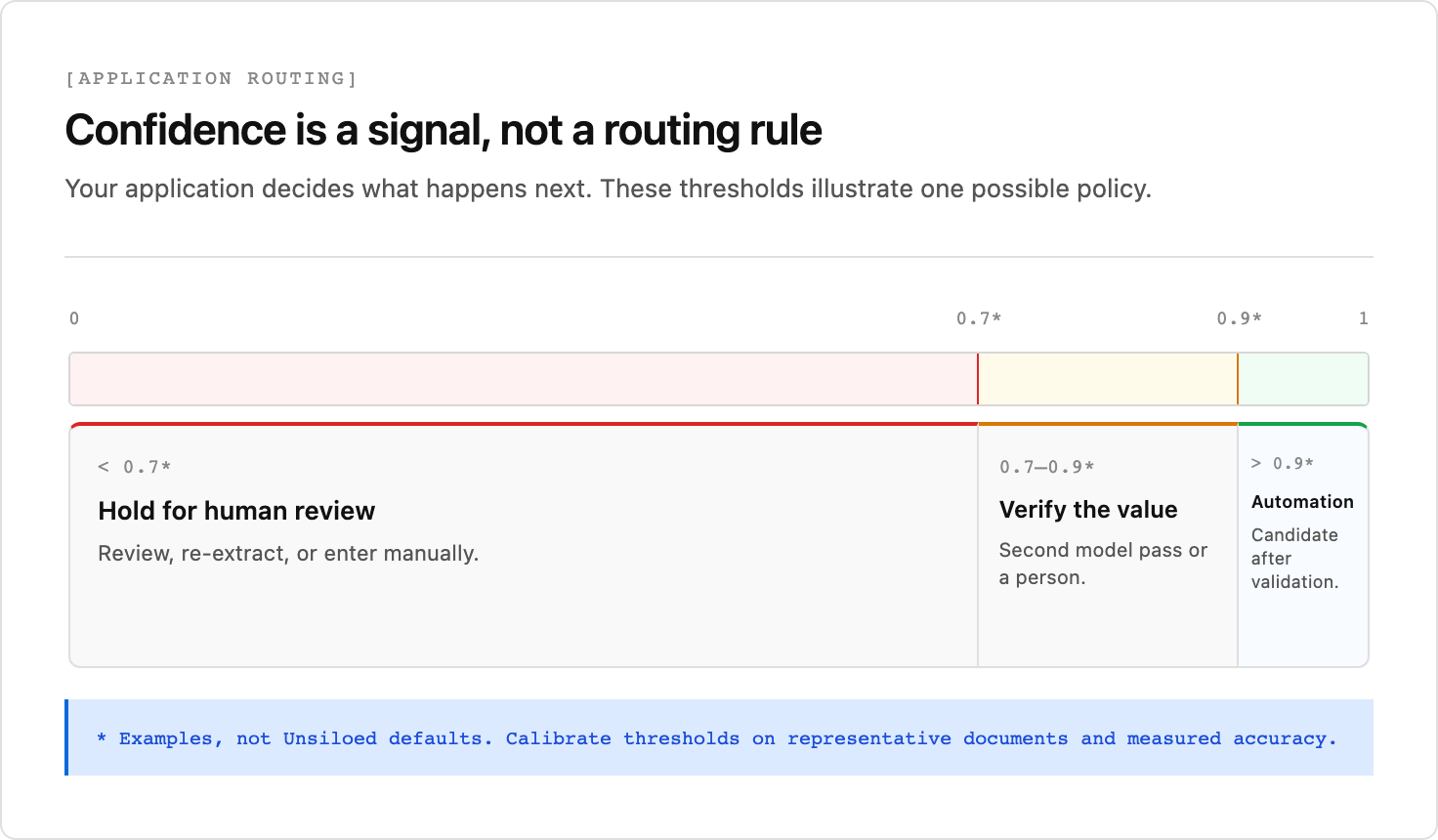
Without that signal, a pipeline has no way to distinguish a clean extraction from a hallucinated one at the field level. In compliance-sensitive domains, that ambiguity exposes the organization to compliance failures as well as inaccurate data. Selecting document intelligence APIs for financial services requires treating this auditability as a hard requirement.
Domain-Specific Document Extraction with Unsiloed AI
Unsiloed is built for the extraction failures that generic parsers produce on high-stakes documents. Its parsing documentation describes output with labeled layout regions, preserved reading order, and tables kept as structured content rather than flattened text.
The extraction response includes one 0-to-1 confidence score for each extracted field. Set enable_citations=true to request optional bounding-box citations.
For compliance-sensitive industries, Unsiloed supports on-premises and air-gapped deployments that can keep protected health information (PHI), financial records, and privileged legal documents off third-party infrastructure (see our audit-ready extraction guide).
How to Choose a Document Parser for High-Stakes Documents
A generic parser that flattens documents cannot preserve the structures in high-stakes files. Domain-specific document extraction preserves table structure, resolves cross-references, and returns confidence scores on every field, giving your downstream systems evidence they can use to route each result. Talk to the Unsiloed team to see what that looks like in your environment.
FAQ
These answers summarize why domain structure matters and how Unsiloed exposes confidence and citations.
Why do generic parsers fail on financial statements, legal contracts, and clinical records when they work fine on standard PDFs?
Generic parsers assume consistent structure and general vocabulary, and both assumptions break down on high-stakes documents. A balance sheet encodes meaning through spatial layout, a legal contract depends on cross-referenced clause hierarchies, and a clinical note mixes free-text prose with ICD-10 codes and institution-specific abbreviations. Without domain-specific training on those structural conventions, a parser extracts tokens in document order and returns values that are semantically orphaned from the context that gives them meaning.
What's the difference between Unsiloed AI's domain-aware decoders and a generic extractor retrained on finance or healthcare documents?
Retraining a generic extractor changes its training data but can still leave pages flattened into text streams. Unsiloed preserves page structure and maps document content to the schema you request. The response includes field confidence, and it can include source locations when citations are enabled, so downstream systems can separate automated results from values that need review.
How does Unsiloed AI's confidence scoring work in domain-specific document extraction, and how is it different from OCR confidence?
Unsiloed returns one 0-to-1 confidence score for each extracted field, and your application decides how to route it. Thresholds such as 0.9 and 0.7 are examples to calibrate against representative documents, while the API leaves the routing rules to your application. OCR-level confidence reflects character recognition certainty, whereas field-level confidence describes the extraction model's certainty about the returned value. Citations can provide a separate audit trail to the source region when you set enable_citations=true.