What Is Intelligent Character Recognition? (June 2026)
Traditional OCR reads a printed invoice flawlessly, then falls apart on a handwritten note. The problem isn't image quality, it's architecture. OCR matches pixels against a fixed library of character shapes, which only holds when letters are consistent and predictable. Handwriting isn't. Intelligent

Traditional OCR reads a printed invoice flawlessly, then falls apart on a handwritten note. The problem isn't image quality, it's architecture. OCR matches pixels against a fixed library of character shapes, which only holds when letters are consistent and predictable. Handwriting isn't.
Intelligent character recognition (ICR) takes a different approach. It uses vision models trained on labeled handwriting to read stroke patterns, spacing, and context across a whole line, so it can recognize a letter even when it looks nothing like its printed form. This article covers what ICR is, how the vision architecture reads handwriting, how confidence scores make the output auditable, and how to build a pipeline in Python.
TLDR:
- ICR uses vision models trained on handwriting datasets to read varied letter forms that break traditional OCR's fixed template matching
- Modern ICR returns confidence scores (0–1 scale) per field; scores above 0.9 automate straight through, 0.7–0.9 flag for review, below 0.7 signal an uncertain reading
- Handwriting accuracy sits at 3 to 8% character error on benchmarks, with print handwriting scoring 4 to 6 points higher than cursive
- ICR embeds a searchable text layer into PDFs with positional citations back to source pages for regulatory traceability
- Unsiloed AI processes handwritten and printed fields in one pass using vision models that return confidence scores and bounding boxes per extraction
What Is Intelligent Character Recognition (ICR)?
Intelligent character recognition (ICR) is a form of optical character recognition built to read handwritten text. Where standard OCR relies on fixed font templates and predictable character shapes, ICR uses trained vision models that learn handwriting patterns, accounting for variation in stroke weight, letter size, slant, and spacing.
ICR models train on large corpora of labeled handwriting, learning to recognize characters even when they deviate substantially from any canonical form. Most production systems combine a convolutional feature extractor with a sequence model, so they resolve an ambiguous character from its surrounding context instead of reading each glyph in isolation. A printed invoice scanned to PDF is straightforward for either approach. A handwritten form, a doctor's note, or a marginally annotated contract is where ICR separates from OCR.
ICR vs OCR: What Traditional OCR Can't Read
Traditional OCR was built to read printed text with consistent fonts, clean backgrounds, and predictable layouts. It matches pixel patterns against known character templates, so any deviation from that baseline creates errors.
| Dimension | Traditional OCR | ICR (Vision Models) |
| Recognition method | Fixed character templates matched against pixel patterns | Trained vision models that learn handwriting patterns from labeled datasets |
| Handles handwriting variation | No: fails when letters deviate from canonical forms | Yes: recognizes characters across multiple writing styles |
| Context awareness | Character-by-character matching in isolation | Reads stroke patterns and context across full lines |
| Accuracy on printed text | Above 99% | Above 99% |
| Accuracy on handwriting | Fails on cursive and varied handwriting | 3 to 8% character error rate on benchmarks; print handwriting 4 to 6 points higher than cursive |
| Output format | Text string only | Text with confidence scores (0–1 scale) per field |
| Automation threshold | No confidence scoring (all-or-nothing) | Scores above 0.9 automate; 0.7–0.9 flag for review; below 0.7 signal an uncertain reading |
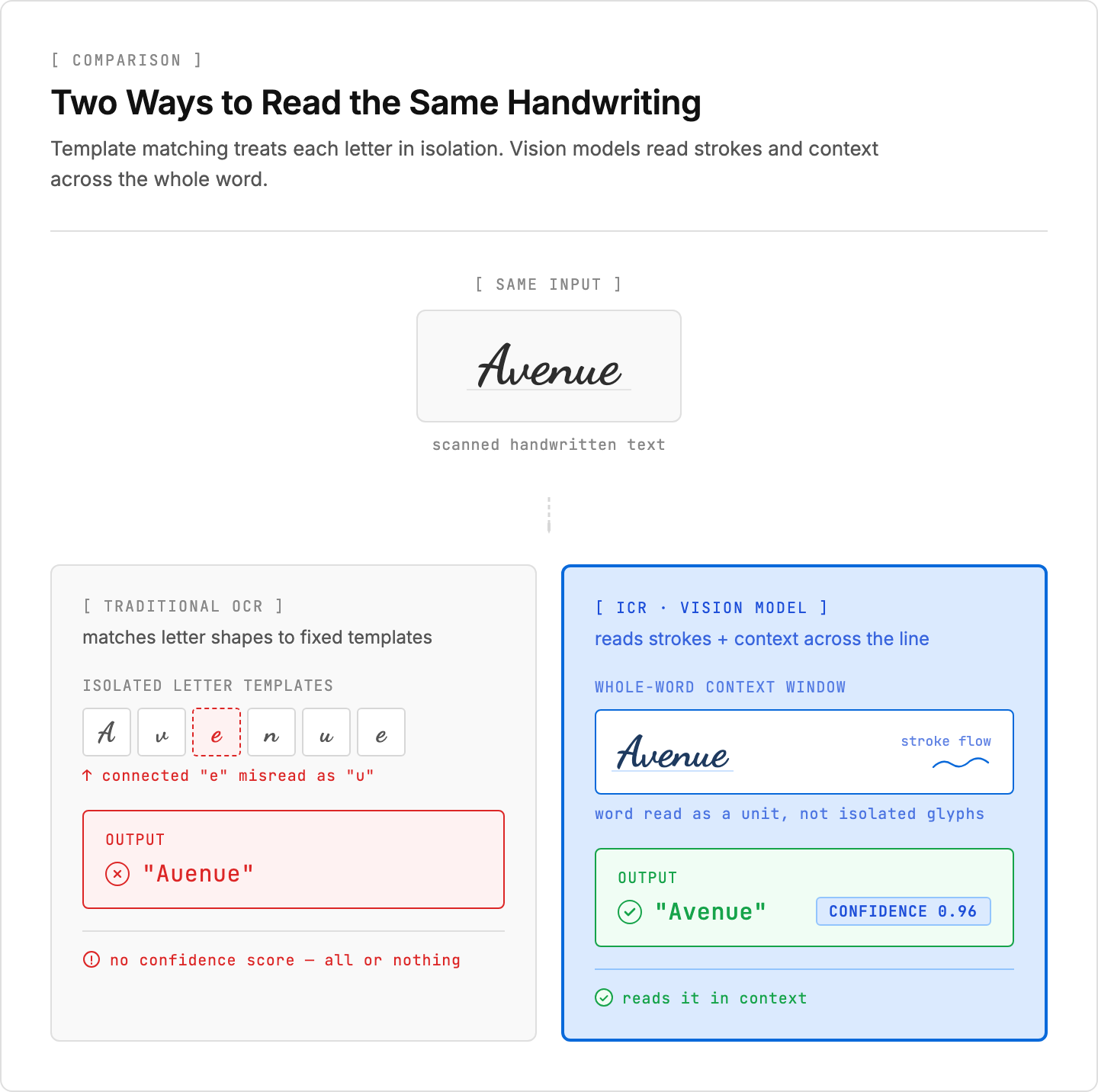
Handwriting breaks every assumption OCR relies on. Letter shapes vary between writers and even within a single document. Strokes connect, spacing changes, and baseline alignment drifts in ways fixed templates cannot anticipate. ICR handles this by learning character variations from training data, so it recognizes a letter "a" written a dozen different ways instead of matching it against one fixed shape.
This is what makes ICR the only viable path for workflows where handwriting is locked in by regulation or process: check amounts and loan fields in banking, patient intake forms in healthcare, handwritten contract annotations in legal discovery, and census or permit forms in government.
How Vision Models Read Handwriting
Vision models read documents the way a human would: by looking at the full page as an image instead of parsing a character stream. Where traditional OCR converts pixels to text through template matching and rule-based heuristics, vision models trained on large datasets learn spatial relationships, contextual cues, and letterform variations directly from examples.
This matters for handwriting because no two people form letters identically. A vision model can infer that a looping shape in context is a lowercase "l" even when it looks nothing like a printed character, because it has seen thousands of similar loops paired with surrounding words that confirm the reading.
How Confidence Scoring Works
Modern ICR returns each recognized character or word alongside a confidence score between 0 and 1, not a flat text string. A score above 0.9 is reliable enough for straight-through processing. The 0.7 to 0.9 range flags a field for human review. Anything below 0.7 signals the model's reading is uncertain and the source image likely needs re-examination. This scoring layer is what makes ICR usable in production instead of only in research: you automate the confident fields and route the rest.
How Accurate Is Handwriting Recognition?
Accuracy on clean, typed text sits above 99% for mature OCR engines. Handwriting tells a different story. Vision models fine-tuned on handwritten datasets report character error rates between 3% and 8% on standard handwriting recognition benchmarks like the IAM Handwriting Database, depending on writing style variability and training data coverage.
Several variables move accuracy meaningfully in production:
- Cursive vs. print: print handwriting consistently scores 4 to 6 percentage points higher, since character boundaries are unambiguous.
- Domain vocabulary: models trained on general text struggle with medical shorthand, legal notation, or field-specific abbreviations where out-of-vocabulary terms spike error rates.
- Document condition: low-contrast ink, paper bleed, or skewed scans degrade confidence scores before character-level inference even runs.
How ICR Makes a PDF Searchable
Turning a scanned form into a searchable document runs through a few distinct stages, regardless of the underlying model architecture.
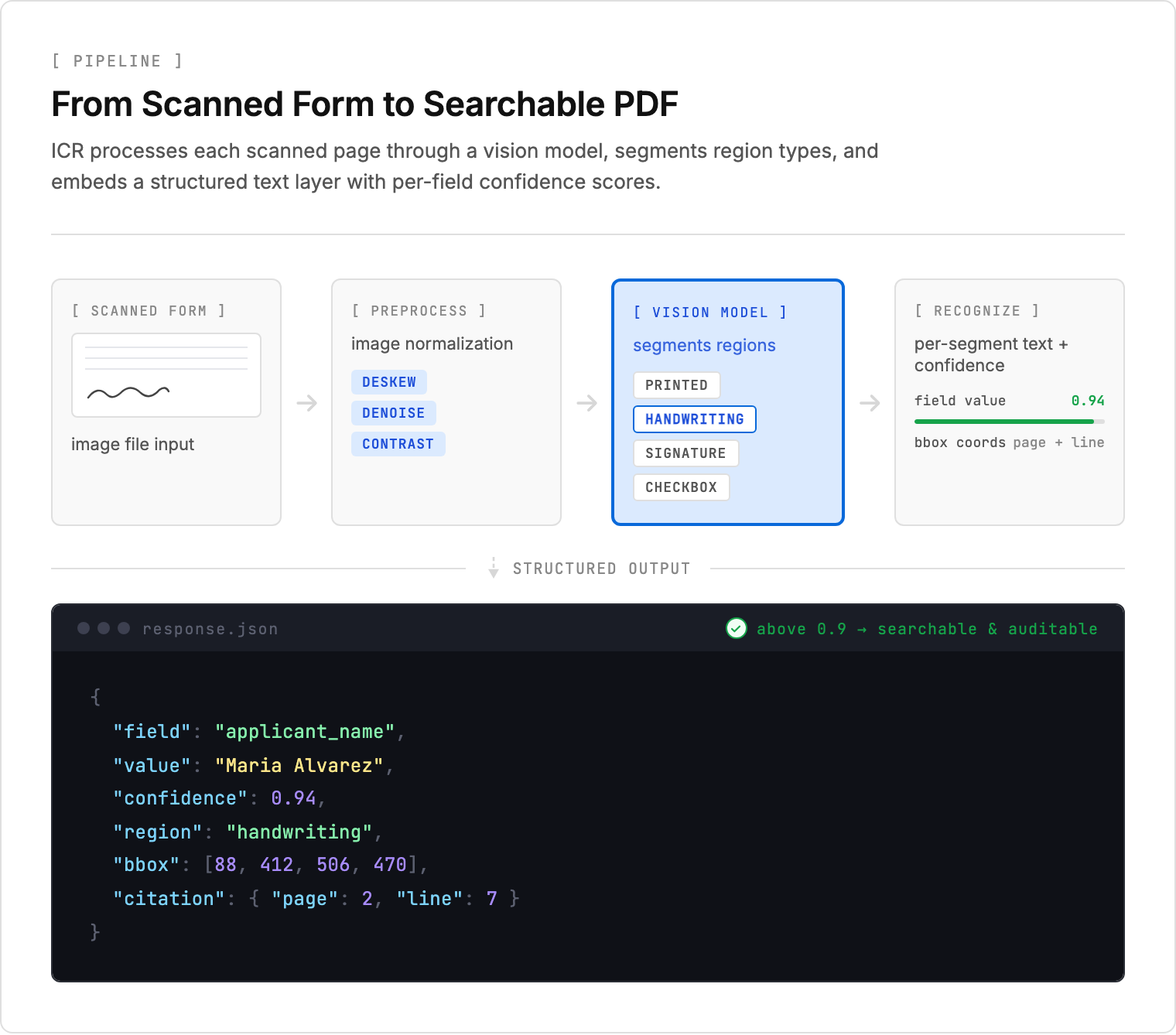
First, preprocessing cleans the input: deskewing, denoising, and contrast normalization so the model receives a clean signal. For scanned PDFs, this also means separating page regions before any recognition runs.
Next, the vision model reads the full page as an image, segmenting regions by type (printed text, handwritten fields, signatures, and checkboxes) before attempting recognition on any of them. It then runs recognition per segment, producing character predictions alongside confidence scores. A rule-based OCR engine would fail or misread degraded handwriting at this stage; a vision model treats low confidence as a signal to flag for review instead of silently producing a wrong value.
Finally, those scored outputs map to a text layer embedded into the original document, so the PDF becomes searchable without altering its visual appearance. Every field carries a confidence score and a positional reference back to the source, so an auditor can trace any value to its exact location on the page. The searchable output is useful; the provenance behind it is what makes it auditable.
Python Character Recognition with Open Source Tools
Python character recognition for handwriting starts with two main paths: Tesseract via the pytesseract wrapper, and deep learning frameworks like PyTorch or TensorFlow for training custom ICR models.
Tesseract for Handwriting
Tesseract's default mode struggles with cursive, but activating LSTM mode (--oem 1) and setting the page segmentation to single-line (--psm 7) improves results on printed handwriting. For genuine cursive or mixed scripts, accuracy remains low without fine-tuning.
Vision Models for ICR
Pretrained vision models like TrOCR (from Microsoft, available on Hugging Face) are trained on handwritten text datasets and outperform Tesseract on most handwriting benchmarks. A basic inference pipeline looks like this:
from transformers import TrOCRProcessor, VisionEncoderDecoderModel
from PIL import Image

processor = TrOCRProcessor.from_pretrained("microsoft/trocr-base-handwritten")
model = VisionEncoderDecoderModel.from_pretrained("microsoft/trocr-base-handwritten")

image = Image.open("handwritten_note.png").convert("RGB")
pixel_values = processor(image, return_tensors="pt").pixel_values
generated_ids = model.generate(pixel_values)
transcription = processor.batch_decode(generated_ids, skip_special_tokens=True)[0]
For production document pipelines requiring structured output, confidence scores, and bounding boxes alongside transcription, open source tooling alone requires substantial custom engineering to reach that reliability threshold.
Where Handwriting Recognition Still Fails
Some failure modes persist regardless of model quality or training data size.
- Messy cursive: accuracy drops to 50 to 60% when stroke patterns are highly irregular and letter boundaries overlap.
- Mixed documents: print and handwriting need separate recognition passes, and unclear region boundaries produce errors at the seams that document extraction tools handle with varying success.
- Low-resolution scans: below 150 DPI, preprocessing cannot recover enough edge detail for reliable character inference.
Vision-First Document Processing with Unsiloed AI
Unsiloed AI's document processing pipeline is built around vision models instead of OCR templates, which matters when your input documents include handwritten fields, degraded print, or mixed layouts that rule-based parsers misread or skip entirely.
Every extracted field returns a confidence score, a bounding box, and a word-level citation back to the source page. That traceability lets downstream systems route low-confidence fields for human review while automating the rest, without treating every extraction result as equally trustworthy. For teams in compliance-sensitive industries where handwritten signatures, annotations, or form fields appear alongside typed text, this architecture handles both in a single pass without separate preprocessing steps.
Final Thoughts on Building Production ICR Pipelines
Handwriting recognition shifted from a research problem to a production capability when vision models started returning confidence scores alongside predictions. That scoring layer is what makes ICR pipelines auditable: you automate fields above 0.9 confidence and route everything else for review instead of treating every extraction as equally reliable. Open source tools give you inference, but structured output with bounding boxes and word-level citations requires custom engineering unless you're using infrastructure built for document workflows. Book a demo if your forms include handwritten fields and you need traceability back to the source page for compliance or audit requirements.
FAQ
What's the difference between ICR and traditional OCR?
Traditional OCR matches pixel patterns against fixed font templates and fails when characters deviate from those templates, while ICR uses trained vision models that learn statistical patterns of handwriting, allowing it to recognize the same letter written a dozen different ways. ICR also uses surrounding context to resolve ambiguous characters instead of checking each in isolation.
Can I build handwriting recognition with Python without training my own model?
Yes. Pretrained vision models like TrOCR (available on Hugging Face) are trained on handwritten text datasets and can be deployed with a few lines of Python using the transformers library. For production pipelines requiring confidence scores, bounding boxes, and structured output, you'll need additional custom engineering beyond the base model inference.
How does ICR make a PDF searchable when it contains handwritten forms?
A vision model reads the full page as an image, segments regions by type (printed text, handwritten fields, signatures), runs recognition per segment with confidence scores, then embeds a text layer into the original document without altering its visual appearance. The result is a searchable PDF where low-confidence fields can be flagged for human review instead of silently producing wrong values.
What accuracy can I expect from ICR on cursive writing?
Vision models fine-tuned on handwriting achieve character error rates between 3% and 8% on standard benchmarks, compared to above 99% accuracy for printed text. Print handwriting consistently scores 4 to 6 percentage points higher than cursive, and accuracy drops further on low-contrast scans below 150 DPI or documents with domain-specific abbreviations outside the training vocabulary.