
How to Build a Document Extraction Audit Trail That Compliance Teams Trust
A field citation is only one part of an audit trail. This guide shows how to combine source citations, calibrated confidence, extraction metadata, and reviewer history into a durable record.


A high extraction accuracy rate does not make a document pipeline audit-ready. When a reviewer challenges a value, the system has to answer a narrower question: where exactly did this field come from?
Bounding-box citations close part of that gap. A confidence score records how strongly the model supports an extracted value. A citation shows the page, region, and text span the model used, so a reviewer can decide whether the evidence supports the value. Together, they form the evidence layer of a document extraction audit trail. A compliance-grade trail also records how the value was produced, reviewed, and changed.
TLDR:
- Bounding-box citations tie extracted fields to page regions and text spans, so reviewers can verify the source.
- Accuracy alone does not answer audit questions. Reviewers also need the extraction context and change history behind each value.
- A field-level provenance record stores the extracted value, its source location, and its extraction-time confidence.
- A compliance-grade audit trail also records source and configuration versions, timestamps, reviewer actions, corrections, and durable change history.
- Confidence should drive automation only after teams calibrate thresholds against labeled documents for each field and document type.
- Unsiloed AI returns a confidence score with every extracted field, and a bounding-box citation on request, so downstream systems can inspect what was extracted and where it came from.
What Is a Bounding-Box Citation in Document Extraction?
A bounding-box citation answers "where did this come from?" by linking the extracted value to a precise location in the source document.
A useful citation includes:
- The source page.
- The document region around the extracted value.
- The text span or word-level anchor the model used.
- The coordinates and page dimensions needed to render the box back onto the document.
Confidence and citation answer different questions. Confidence records the system's certainty at extraction time, while the citation shows which source region it used. The reviewer still decides whether that region supports the extracted value. For document data extraction at scale, teams need both.
The Three Parts of a Field-Level Provenance Record
"The AI extracted it" is not enough for an audit trail. A reviewer needs to verify the value without rerunning the model.
A verifiable field record has three parts:
- Source location: A citation that binds the value to its page, region, and text span.
- Extraction-time confidence: The score recorded when the field was extracted, before any human correction.
- Extracted value: The original structured value returned by the extraction job.
These three components make one extracted field inspectable, but they do not capture its full operational history.
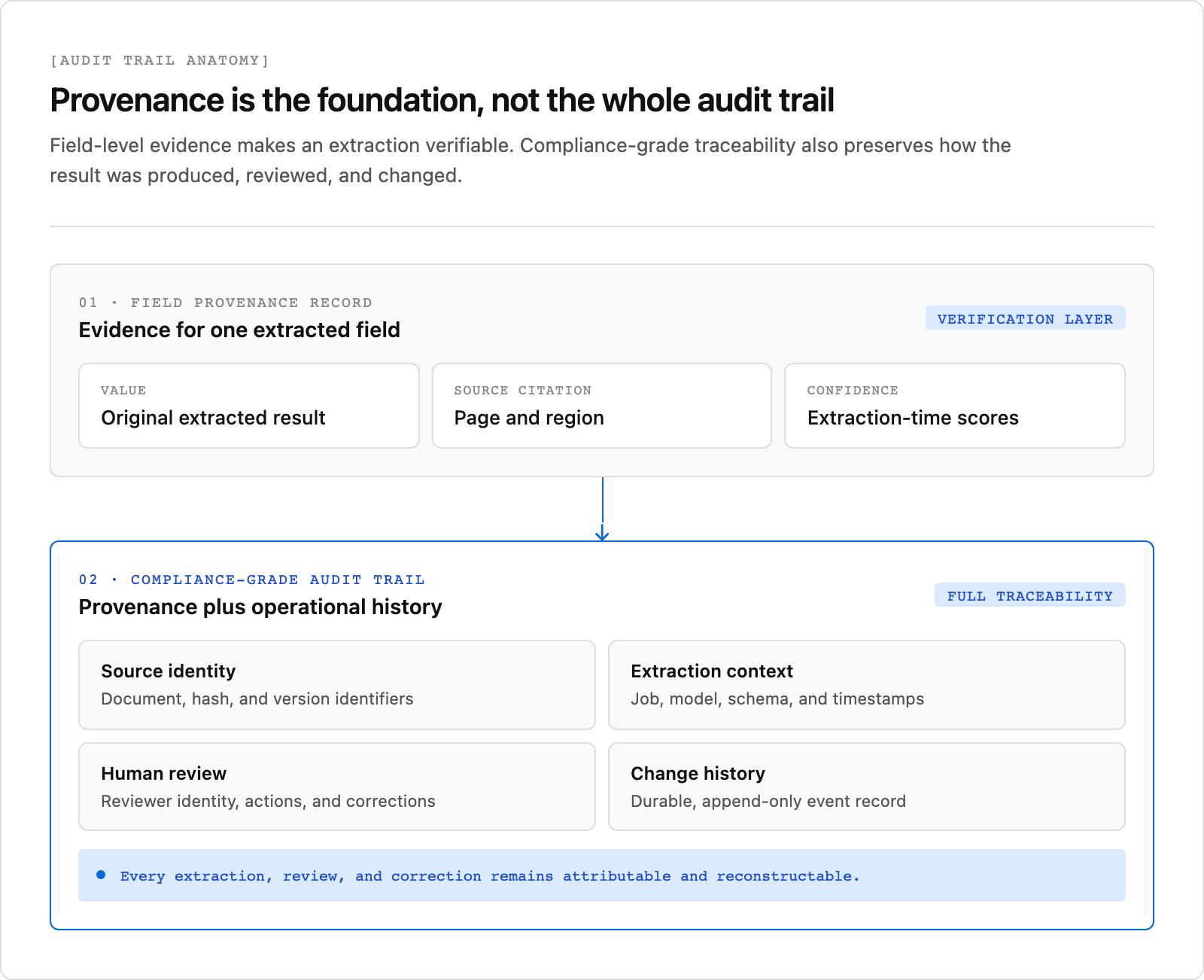
A compliance-grade audit trail adds the context required to reconstruct the decision:
- A stable source document identifier, hash, and version.
- The extraction job ID, timestamp, model version, and schema version.
- The original value, confidence scores, and source citation.
- The reviewer's identity, action, timestamp, correction, and reason.
- An append-only history of changes and deletions.
The citation locates the evidence, confidence helps prioritize review, and the event history shows how the final value changed. Together, those records let an organization compare versions and reconstruct a decision months later. Without that context, downstream teams take model accuracy on faith, a risk covered in this document data extraction software comparison.
Why Extraction Accuracy Alone Fails Compliance Review
Accuracy tells you whether a system usually extracts the right value, but not where a specific value came from, which document version produced it, or whether a reviewer can reproduce the extraction decision.
A system that averages 95% accuracy can still leave reviewers unable to investigate the 5% that went wrong. Without provenance, teams have to open the original document, search by hand, and decide whether the output was copied, inferred, or hallucinated.
The problem gets worse at volume, where a single mortgage packet, insurance claim, or clinical file carries dozens of fields across many pages, the kind of input any document parsing API for RAG has to handle. Without citations, review becomes sampling, and errors outside the sample stay hidden until they affect a downstream decision.
How Provenance Supports Regulated Workflows
Review looks different across industries, but extracted fields still need a traceable path back to the source document. Citations support that verification work; they do not satisfy a regulation by themselves.
- Financial services: Loan files, trade confirmations, statements, and onboarding documents often need value-level verification, and the evidence may have to outlive the account itself. SEC Rule 17a-4 requires broker-dealers to preserve specified account records for at least six years after an account closes. Its electronic-recordkeeping provisions also require time-stamped change history for covered records. A source citation can help a reviewer verify a value, but the surrounding recordkeeping system must preserve the required history and controls. This distinction matters when evaluating document intelligence APIs for financial services.
- Legal: Contract terms, dates, obligations, and party names need clause-level traceability. If a value is disputed, reviewers need to see the source clause, not just the extracted JSON.
- Healthcare: A misread diagnosis code or member ID can propagate into a chart or claim. HIPAA's audit controls standard requires mechanisms that record and examine activity in information systems holding electronic protected health information. Activity logs show who did what and when; source citations help reviewers check where an extracted value came from. A healthcare workflow may need both, but they solve different problems. That separation is important when assessing healthcare document processing APIs.
Citations do not replace governance, retention policies, activity logs, or access controls. They give those processes a field-level evidence layer to work from.
How Confidence Scores Route Fields to Human Review
Confidence scores are most useful when they drive routing decisions. Instead of reviewing every extracted field, teams can define confidence bands and route fields based on risk.
| Confidence Band | Routing Outcome | Reviewer Action |
|---|---|---|
| High confidence | Candidate for straight-through processing | Automate only after validating the threshold |
| Borderline confidence | Second check | Reviewer verifies the field against its cited source region |
| Low confidence | Manual review queue | Document or field is routed to a reviewer |
A confidence score is not automatically the probability that a value is correct. Calibrate each threshold against representative labeled documents, measure the resulting error rate, and monitor it as document layouts change.
Thresholds should also depend on field sensitivity. A borrower name, diagnosis code, or contract renewal date needs a stricter threshold than a secondary reference field. Document quality and the cost of a mistake move the line too.
Bounding-box citations make this routing practical. A flagged field points back to its own source region, so the reviewer does not have to reprocess the document or search the file by hand. For an example, see how ACORD 25 certificate of insurance extraction routes low-scoring policy numbers to review.
How Unsiloed AI Handles Document Extraction Provenance
Unsiloed's extraction API returns confidence scores with every extracted field, whether or not you ask for citations. Request citations and each field also carries the page it came from and the coordinates of the box around its value. Parsed page geometry provides the dimensions needed to draw that box back onto the document.
Inspect the completed extraction job response. An abridged field looks like this:
{
  "invoice_total": {
    "value": "$161.59",
    "score": {
      "grounding_score": 0.92,
      "extraction_score": 0.99
    },
    "citation": {
      "bbox": [490, 646, 539, 662],
      "page": 1
    }
  }
}
The structured value stays next to the scores used for routing and the citation used for review. Store that response with the extraction metadata and any later reviewer events rather than overwriting it with the corrected value.
Provenance goes deeper than the field, because extraction runs on top of a layout-aware OCR pass. That pass gives every document region its own box and its own confidence score, and every word inside the region its own box, text, and confidence.
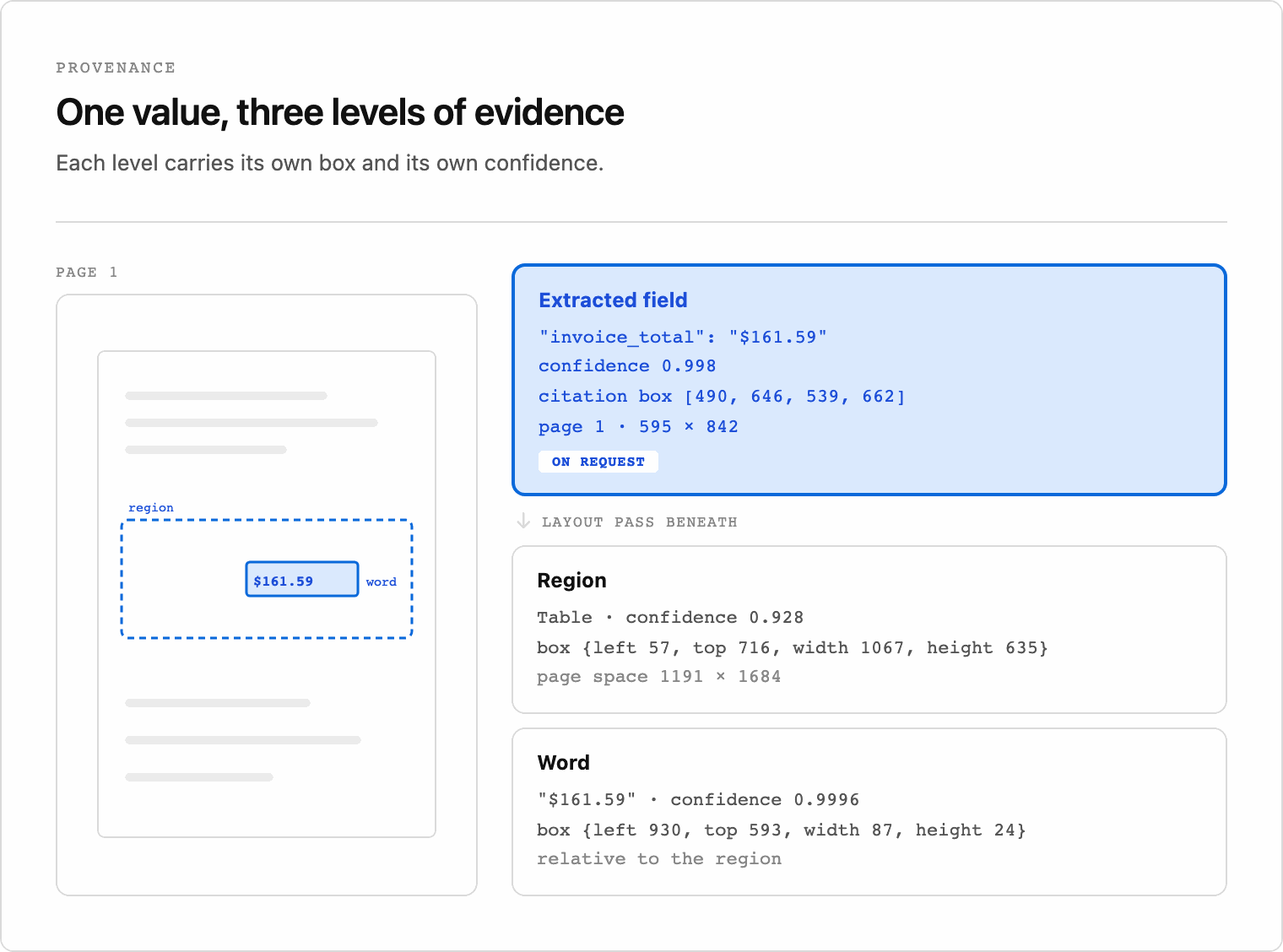
That three-level evidence chain connects the extracted field to the region containing the evidence and the word-level span that produced the value. The pipeline keeps the structured value, its confidence, and its provenance together, rather than as separate artifacts to reconcile later.
Making Document Extraction Auditable in Regulated Workflows
The gap between extraction accuracy and extraction provenance is where audit risk lives. A field-level record closes part of it with the original value, confidence recorded at extraction, and a citation showing the source evidence. A compliance-grade trail adds the source version and extraction configuration, timestamps, reviewer activity, and append-only change history needed to reconstruct the final decision.
In regulated workflows, that combination is the difference between "the model said so" and "here is the field, the confidence, and the source region." Book a demo to see how bounding-box citations and confidence scores work in a real extraction pipeline.
FAQ
These answers summarize the implementation decisions that matter most when you design the audit trail.
What's the difference between a confidence score and a bounding-box citation?
A confidence score records the system's confidence signal for an extracted value. A bounding-box citation shows where the value came from in the source document. An audit trail needs both, because confidence without provenance cannot show the source, while provenance without confidence gives reviewers no signal about which fields need attention.
What should I store for compliance review?
Store the original extracted value, confidence scores, citation, source identifier and version, extraction job and configuration versions, timestamps, reviewer identity and actions, corrections, and an append-only history. The exact retention and integrity controls depend on the regulations and policies that apply to your organization.
Can I automate straight-through processing without reviewing every field?
Yes, after validating the routing thresholds against labeled examples. High-confidence fields can move through automation, borderline fields can be flagged for a second check, and low-confidence fields can go to manual review. Calibrate thresholds separately by field sensitivity and document type, then monitor the error rate as inputs change.