
AI Automation: Understanding the Technology and Implementation Approaches (August 2026)
You automate one process successfully, then hit a wall scaling it across the organization. Your CRM does not expose the right API, your document parser scrambles multi-column layouts, and compliance will not sign off on anything that cannot trace a value back to its page. This guide covers the components, the rule-based versus AI-driven tradeoff, and the deployment models that hold up when input data varies.


You automate one process successfully with an AI automation bot, then try to scale it across the organization and hit a wall. Your CRM doesn't expose the right API, your document parser scrambles multi-column layouts, and your compliance team won't sign off on a cloud-based AI automation platform that can't show an audit trail for every value it extracts.
What separates a workflow that runs in a controlled demo from one that handles real invoices, contracts, or clinical records is integration depth, data quality, and whether your deployment model meets regulatory requirements.
This guide covers the components of an AI automation stack, the tradeoff between rule-based and AI-driven systems, and the deployment models that hold up when your input data varies and your compliance bar is high.
TLDR:
- AI automation uses trained models to handle ambiguous inputs and make decisions at scale, unlike rule-based systems that break when conditions vary.
- Teams measure returns in cost per transaction, error rates, and employee hours redirected to higher-value work.
- Common blockers include legacy systems lacking APIs, poor training data quality, employee resistance, and compliance requirements that demand audit trails.
- Unsiloed AI handles document extraction with a vision-first architecture that preserves layout and returns confidence scores with word-level citations for regulated industries.
What Is AI Automation
AI automation refers to the use of AI to execute tasks, make decisions, and run workflows with little or no human input across business functions. Where traditional automation follows fixed rules, AI-driven systems adapt based on data, context, and learned patterns.
AI automation covers everything from a single bot handling customer emails to multi-step workflows where AI agents plan, execute, and hand off tasks across systems.
How AI Automation Works
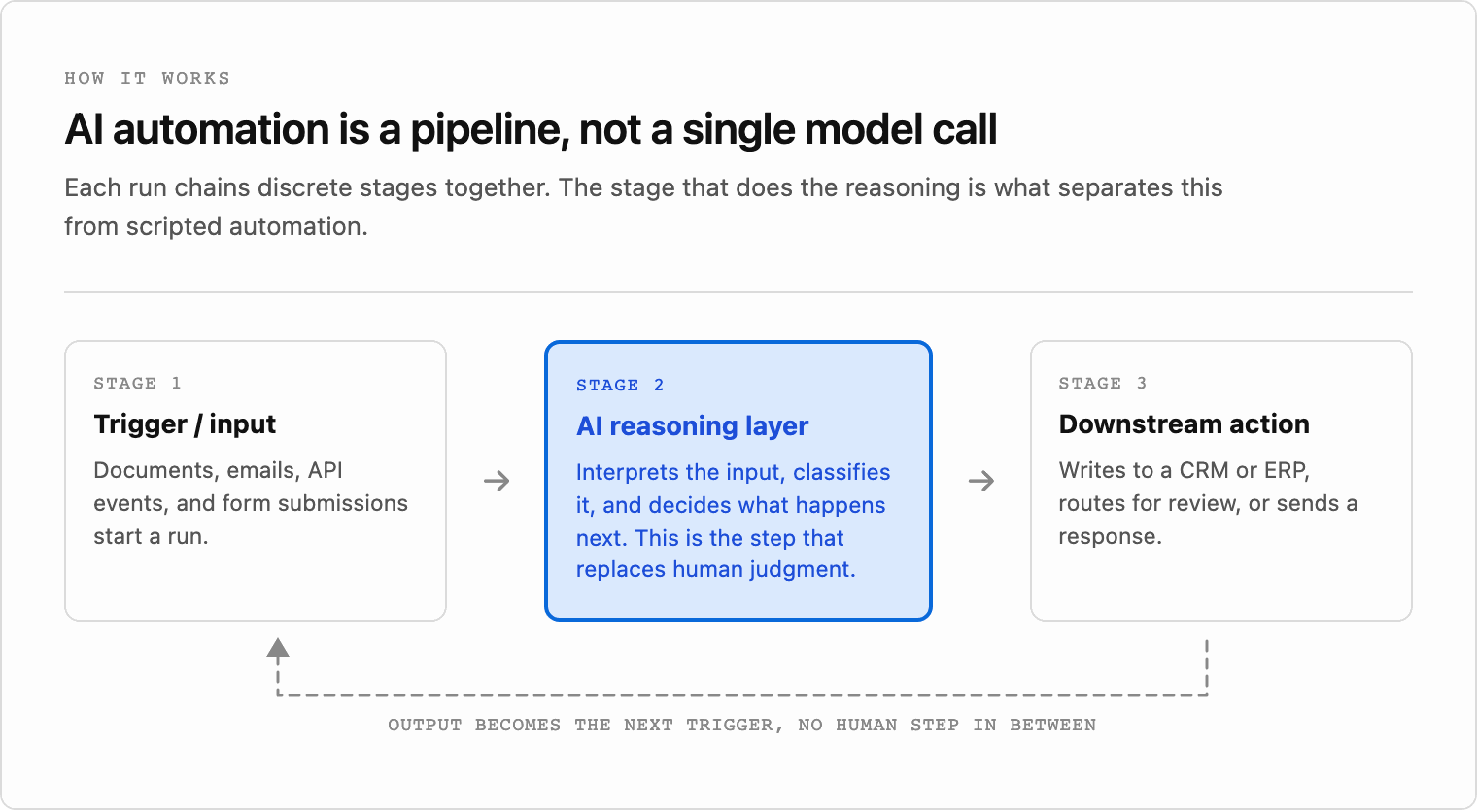
The core mechanism involves three steps: a trigger or input is received, an AI layer processes and reasons about that input, and an action is executed downstream. These steps can chain together across dozens of tools without a human in the loop.
The Key Components of an AI Automation Stack
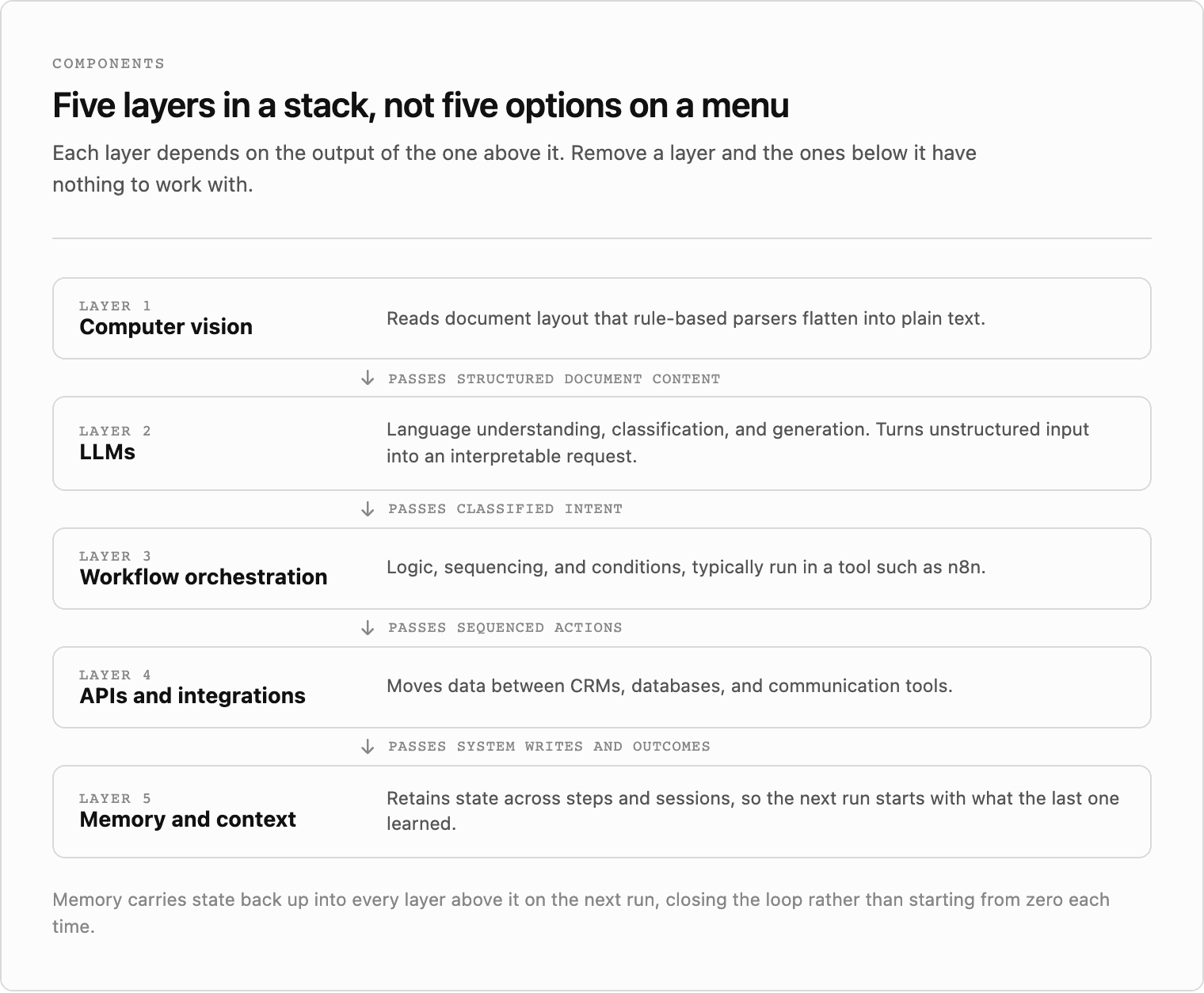
Several building blocks appear across most AI automation architectures:
- LLMs handle language understanding, classification, and generation within a workflow, from drafting responses to summarizing documents.
- Computer vision automates document processing, reading layouts that rule-based parsers flatten incorrectly.
- Workflow orchestration tools like n8n define the logic, sequencing, and conditions that connect discrete steps into end-to-end pipelines without custom glue code.
- APIs and integrations pass data between systems, whether CRMs, databases, or communication tools.
- Memory and context layers let the system retain information across steps or sessions, rather than treating every input as isolated.
Together, these components let a workflow do things like read an incoming email, classify its intent, query a database for relevant context, draft a response, and route it for review or send it automatically.
AI Automation Tools: Rule-Based vs. AI-Driven Systems
Rule-based systems follow fixed logic trees: if X, then Y. They work well for stable, predictable processes but break when inputs vary. AI-driven automation uses trained models to handle ambiguity, classify inputs, and make probabilistic decisions at scale.
AI Automation Examples by Industry
The highest-value AI automation deployments cluster in verticals where input volume is high, data varies in format, and manual review is costly.
| Industry | Common Application | Measurable Outcome |
|---|---|---|
| Customer service | Automated triage, routing, and response drafting | 30% of cases handled by AI today, projected to reach 50% by 2027 (Salesforce) |
| Finance & legal | Intelligent document processing, contract and filing extraction | Faster review cycles, lower manual data-entry overhead |
| IT operations | Incident detection and automated remediation workflows | Faster detection and automated remediation of routine incidents |
| Manufacturing | Predictive maintenance, visual quality control on production lines | Reduced unplanned downtime |
| Healthcare | Clinical document structuring, record extraction for downstream systems | Structured records available without manual transcription |
Across all five verticals, AI handles high-frequency, judgment-light steps so human reviewers can focus on exceptions. What changes is where the data originates and what accuracy threshold the workflow actually requires.
Document Processing Automation with AI
AI systems now handle document intake at scale, extracting structured data from contracts, invoices, forms, and reports without requiring manual review. Traditional OCR tools collapse multi-column layouts into scrambled text streams, which corrupts every step downstream.
What Gets Automated in Document Workflows
- Invoice and receipt processing routes extracted line items, totals, and vendor fields directly into ERP systems, cutting accounts payable cycle times.
- Contract review pulls defined terms, dates, and obligations into structured records for legal and compliance workflows.
- Form digitization converts handwritten submissions into validated JSON without human transcription.
AI Automation Implementation Challenges and How to Overcome Them
AI automation projects usually stall on integration, data quality, and change management issues left unresolved before deployment, rather than on the underlying tech.
Common blockers include:
- Legacy systems often lack APIs, requiring middleware or custom connectors before any document data extraction can attach to existing workflows.
- Poor or inconsistent training data produces unreliable outputs, making data cleaning and labeling a prerequisite rather than an afterthought.
- Employees resist automation when they perceive it as a job threat, so early stakeholder communication and retraining plans reduce friction.
- Compliance requirements in regulated industries demand audit trails and explainability that many out-of-the-box tools do not provide by default.
Start with a narrow, well-defined process where success is measurable, then expand scope once the integration patterns and governance guardrails are established.
Measuring AI Automation ROI and Business Impact
AI automation lets teams scale output without scaling staff. A process that once required ten people reviewing documents can run with one person auditing AI decisions.
Quantifying that value requires tracking metrics across cost, speed, and accuracy. Key indicators include cost per transaction (comparing pre- and post-automation figures), error rates, throughput volume, cycle and customer response times, and employee hours redirected to higher-value work.
Payback periods depend on task volume and complexity, and teams running high-frequency document or data workflows typically see the fastest gains.
AI Automation Platform Deployment Models
AI automation runs on a few distinct deployment models, each suited to different team structures and risk tolerances.
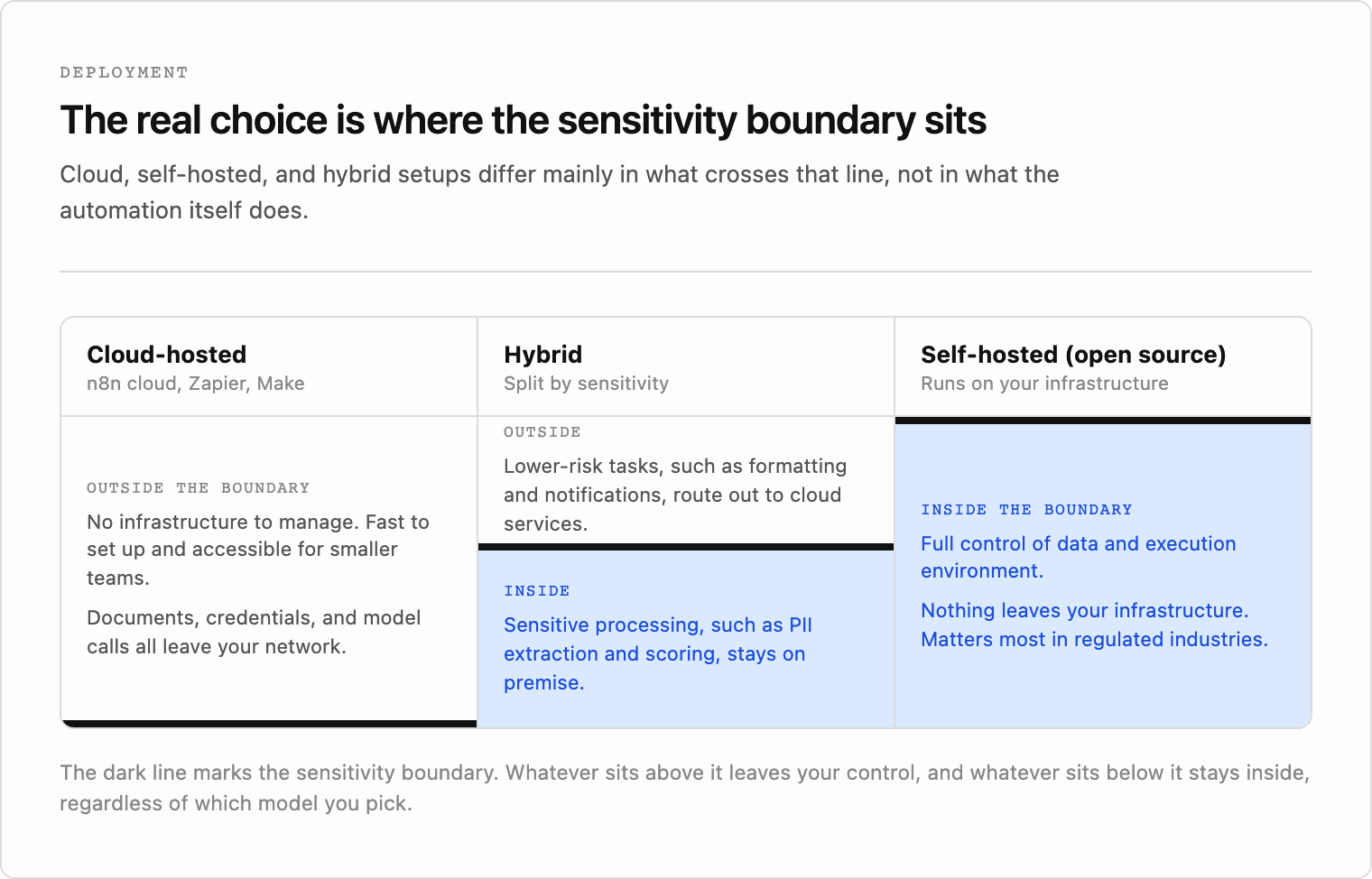
- Cloud-hosted AI workflow automation tools like n8n or Zapier connect APIs and trigger actions without requiring infrastructure management, making them accessible for smaller teams.
- Self-hosted, open-source setups give engineering teams full control over data and execution environment, which matters in regulated industries.
- Hybrid architectures split sensitive processing on-premise while routing lower-risk tasks to cloud services.
The right choice depends on data sensitivity, existing stack, and how much your team wants to own in production.
Unsiloed AI for Document-Driven Automation
Unsiloed AI is built for teams where automation depends on getting structured data out of complex documents accurately. While general-purpose AI automation tools handle form submissions and API triggers well, they break down on PDFs, contracts, invoices, and filings where layout, tables, and reading order carry meaning, issues that a production-grade document processing system must solve.
Unsiloed parses documents using a vision-first architecture that preserves layout and reading order, then returns each extracted field with a confidence score and a word-level citation back to the source. Any figure sitting in a downstream system can be traced to the words it was read from, which is what makes it suited to finance, legal, and healthcare, where being able to show where a number came from matters as much as speed.
Final Thoughts on AI Automation
AI automation delivers when the underlying data extraction is accurate enough to trust. If you're routing decisions based on fields pulled from contracts, invoices, or filings, vision-based parsing matters more than the workflow tool wrapping it. For teams in finance, legal, or healthcare where auditability isn't optional, book a demo to see what that changes about which processes you can hand over end-to-end. Pick a single high-volume process and measure cycle time reduction within the first month.
FAQ
What is AI automation and how is it different from traditional automation?
AI automation uses AI models to execute tasks and make decisions based on data and learned patterns, rather than following fixed rules. Traditional automation runs predefined if-then logic that breaks when inputs vary, while AI-driven systems handle ambiguity and adapt to new scenarios without reprogramming.
Can I build AI automation workflows without coding experience?
You can start with cloud-hosted workflow tools like n8n or Zapier that connect APIs through visual interfaces, though production deployments in regulated industries typically require engineering resources to handle data validation, error handling, and compliance requirements. Self-hosted open-source setups give full control but need technical implementation.
AI automation tools free vs enterprise platforms: what's the tradeoff?
Free AI automation tools work for prototyping and low-volume workflows but typically lack production-grade features like confidence scoring, audit trails, and on-premise deployment options that regulated industries require. Enterprise platforms add deterministic outputs, traceability, and SLAs needed for high-stakes document processing where parsing errors carry material business consequences.
How long does it take to see ROI from AI automation?
Payback depends on task volume and complexity rather than on a fixed timeline, and it arrives fastest in high-frequency document or data workflows. Teams track cost per transaction, error rates, throughput volume, and hours redirected from manual review to quantify impact.
What are the best AI automation tools for document processing in finance and legal?
Vision-first extraction platforms that preserve layout and reading order outperform traditional OCR on complex documents like contracts, SEC filings, and invoices. Look for tools that return confidence scores and word-level citations with each extracted field, since auditability matters as much as speed in regulated verticals where parsing errors trigger compliance violations.