
Document Processing Platform: A Technical Comparison (May 2026)
You need an intelligent document processing solution that handles invoices, contracts, medical records, and financial statements without breaking on nested tables or scanned forms, but the technical specifications across vendors look nearly identical until you deploy them. The differences that surfa


You need an intelligent document processing solution that handles invoices, contracts, medical records, and financial statements without breaking on nested tables or scanned forms, but the technical specifications across vendors look nearly identical until you deploy them. The differences that surface in production come from how systems preserve layout context, whether extracted values trace back to source locations with confidence scores, and how exceptions route to manual review queues before they corrupt downstream workflows. We're breaking down what separates vision-based architectures from text-first parsers, when on-premises deployments become non-negotiable for compliance, and which API patterns support the kind of deterministic outputs that banks and healthcare providers actually need when processing millions of pages.
Key Takeaways
- IDP converts unstructured PDFs into structured JSON with confidence scores and bounding boxes
- The market grows at 26.20% CAGR, driven by banking, healthcare, and legal compliance needs
- Vision-based models outperform traditional OCR by 5-14% on complex documents with tables
- Unsiloed AI processes millions of pages weekly for Fortune 150 banks using dual-stream architecture
What Intelligent Document Processing Does
Most documents that enterprises deal with are PDFs with nested tables, scanned forms, multi-column layouts, embedded charts, and inconsistent formatting across pages. Generic text extraction breaks on all of it.
Intelligent document processing (IDP) solves this by combining computer vision, OCR, and AI to convert unstructured, multimodal documents into structured, machine-readable outputs like Markdown or JSON. The goal is deterministic output, where every extracted value is traceable back to a specific location in the source document, with a confidence score attached.
That structured output is what lets downstream LLMs, AI agents, and automation workflows consume document data reliably.
Market Growth and Adoption Patterns
The global IDP market sits at USD 14.16 billion in 2026 and is projected to reach USD 91.02 billion by 2034, a CAGR of 26.20%. That growth reflects infrastructure enterprises have already committed to, not experimental tech still finding its footing.
Banking, healthcare, and legal are leading adoption for a consistent reason: high document volume, low error tolerance, and regulatory pressure make manual review both expensive and legally risky. IDP has moved from a point solution to a foundational layer in how these industries handle data.
OCR vs Vision Language Models: Technical Architecture
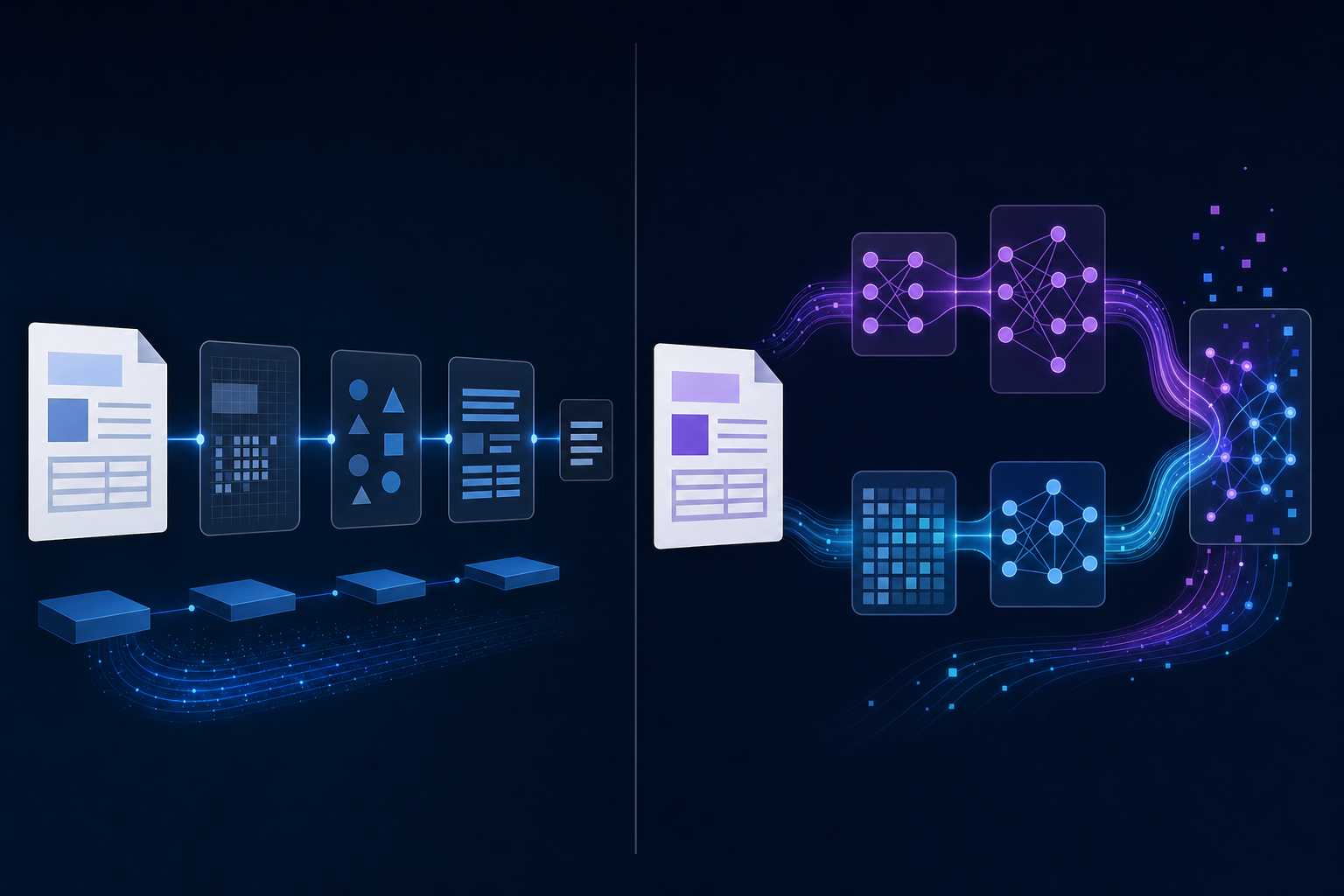
Traditional OCR reads documents as images and converts pixels to text using pattern recognition, but it struggles with complex layouts, handwriting, and low-quality scans. Vision language models take a fundamentally different approach, treating documents as multimodal inputs where spatial relationships, visual context, and text interact together.
This shift matters for accuracy. OCR-based pipelines typically require extensive post-processing rules, while vision-based architectures handle variability natively across document types.
Accuracy Benchmarks and Performance Metrics
Accuracy rates vary widely across document processing tools, and the gap matters in production. General-purpose OCR typically achieves 85-90% field-level accuracy on clean documents, while specialized intelligent document processing (IDP) systems reach 95-99% on structured forms. Throughput benchmarks show a similar spread: cloud-hosted tools process 50-200 pages per minute, whereas on-premise deployments often cap at 20-80 pages per minute depending on hardware.
API Design Patterns for Document Processing
Most document processing APIs follow one of two core patterns: synchronous processing for real-time extraction on smaller documents, and asynchronous job queuing for batch workloads. REST remains the dominant interface style, though some vendors expose gRPC endpoints for lower-latency use cases. Webhook callbacks handle completion notifications in async flows, reducing polling overhead. For PDF-heavy workloads, multipart form uploads are standard, while base64 encoding is common for embedded payloads in JSON requests.
Schema-Driven Extraction and Deterministic Outputs
Schema-driven extraction inverts the typical parsing flow. You define exactly what you need first: field names, types, required vs. optional, and nesting rules via JSON Schema. The extraction engine then locates each field, validates the type, and returns structured JSON with a confidence score, page reference, and word-level bounding boxes for every value. Malformed outputs get rejected before they reach your pipeline.
That combination of type safety and source traceability is what makes IDP viable for financial reconciliation, contract analysis, and compliance-critical workflows where a wrong value carries real consequences.
Deployment Models: Cloud, On-Premises, and Hybrid
Deployment model is determined by compliance posture before it's a product decision. Cloud-native hosting gives you elastic scaling and managed infrastructure with no day-to-day maintenance, which works well for teams without strict data residency requirements. On-premises and air-gapped deployments serve a different purpose: compliance-driven industries like banking and healthcare often cannot route documents to external endpoints at all. That constraint isn't negotiable.
Hybrid architectures handle the middle case. High-sensitivity documents route to a private deployment; lower-sensitivity workloads hit the cloud API. In heavily compliance-driven industries, this is how most production systems end up being designed, with routing logic determined by document classification.
| Solution Type | Architecture Approach | Deployment Options | Typical Accuracy Range | Best Use Cases |
| Unsiloed AI | Vision-first dual-stream architecture with domain-specific decoders for finance, healthcare, and legal documents | Cloud-native, on-premises, air-gapped, and hybrid deployments with deterministic JSON outputs | 95-99% on complex documents with hierarchical indexing and word-level bounding boxes | Fortune 150 banks, NASDAQ-listed companies, compliance-critical workflows requiring full source traceability |
| Cloud-Based IDP (Google Document AI, AWS Textract) | Vision language models with general-purpose training across document types | Cloud-native only with managed infrastructure and elastic scaling | 85-95% depending on document complexity and customization level | High-volume workloads without strict data residency requirements, teams that favor managed infrastructure over accuracy |
| Traditional OCR-Based Systems | Text-first parsers using pattern recognition with extensive post-processing rules | Cloud and on-premises with template-driven extraction workflows | 85-90% on clean documents, degrades sharply on complex layouts | Structured forms with consistent layouts, low-variability document sets where templates can be predefined |
| Open Source Solutions (Tesseract, Apache Tika) | OCR engines with customizable extraction pipelines requiring engineering overhead | Self-hosted on-premises or private cloud infrastructure | 70-85% base accuracy without extensive model tuning and post-processing | Teams with strong ML capabilities, cost-sensitive deployments willing to trade engineering effort for licensing savings |
| Enterprise Platforms (Gartner Magic Quadrant vendors) | Hybrid OCR and ML approaches with workflow automation and RPA integration | Cloud, on-premises, and hybrid with enterprise SLA guarantees | 90-96% on supported document types with human-in-the-loop validation | Large enterprises requiring vendor support, pre-built ERP connectors, and multi-department workflow orchestration |
Integration Architecture and Workflow Automation
Most intelligent document processing (IDP) solutions offer REST APIs and webhook support, but integration depth varies widely. The shift toward low-code development is accelerating this trend, with 75% of apps built on low-code platforms, where 80% of operators will be non-IT developers, driving demand for codeless IDP integration capabilities.
Some tools connect natively with ERPs like SAP or Oracle, while others require middleware layers such as Zapier or custom-built connectors. Workflow automation capabilities range from basic triggered outputs to multi-step conditional routing with human-in-the-loop review queues. When assessing any IDP tool, check whether its API supports batch processing, async job handling, and structured JSON output, as these determine how cleanly it fits into production data pipelines.
Human-in-the-Loop and Confidence Thresholds
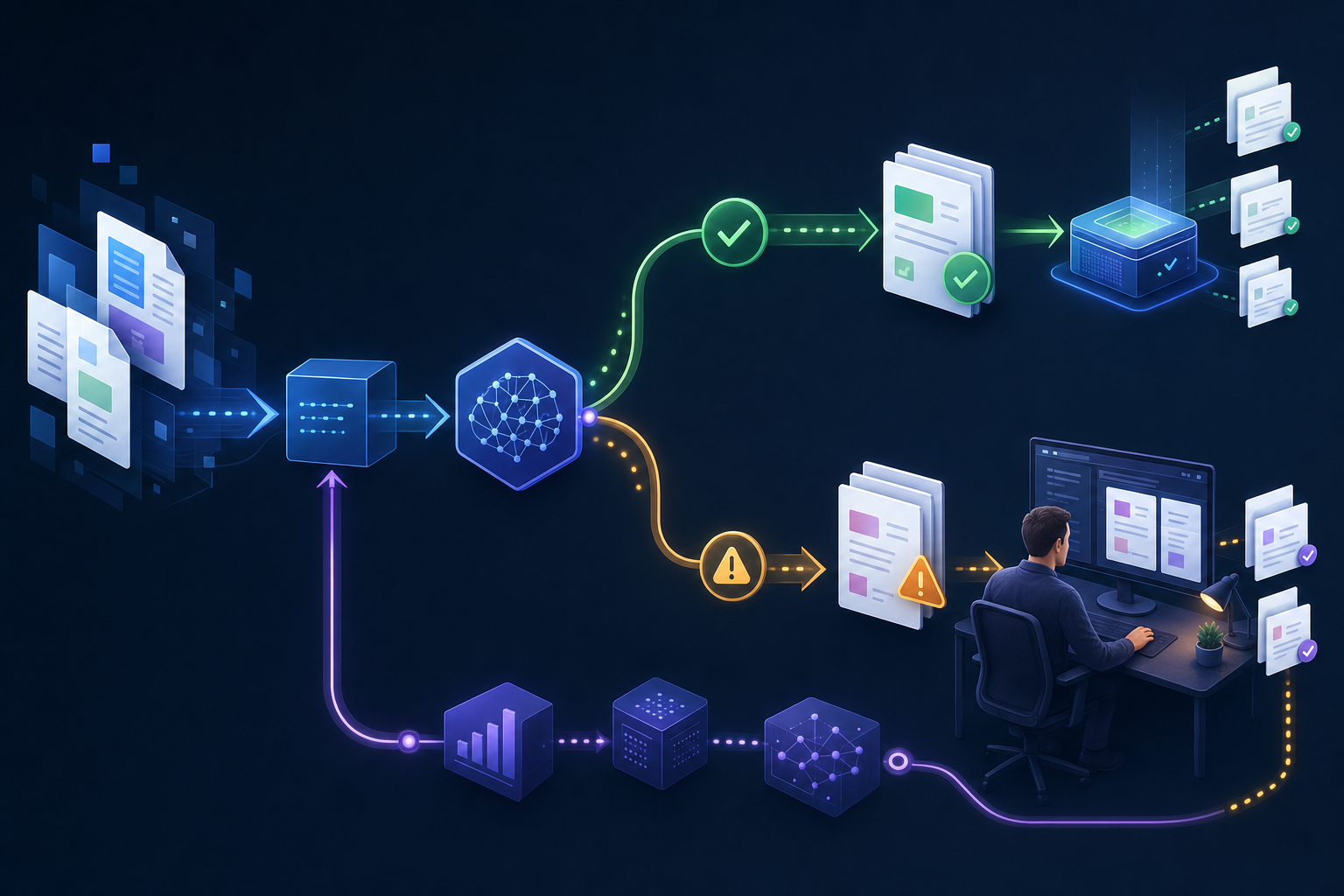
No extraction system achieves perfect accuracy. The gap between base model performance and effective production accuracy gets closed through confidence thresholds. Fields scoring below a set cutoff route to a manual review queue instead of passing downstream. High-risk fields like invoice totals or contract dates carry stricter thresholds than lower-stakes metadata.
Active learning pipelines close the remaining gap. Corrections made during manual review feed back into the model, improving accuracy on similar documents over time. A system at 95% base accuracy can reach 99% effective accuracy in production by handling exceptions systematically instead of ignoring them.
Multi-Format Support and Document Variability
Real-world document workflows rarely involve clean, uniform files. Contracts, invoices, medical records, and research reports each carry different structures, layouts, and encoding schemes. A capable document processing system must handle PDFs, scanned images, Word documents, Excel spreadsheets, and HTML with consistent accuracy across all of them.
Multi-format support also means handling variability within a single format. Two invoices from different vendors may share no structural similarity whatsoever, requiring adaptive extraction logic instead of rigid templates.
Cost Structure and Performance Tradeoffs
Pricing across document processing tools varies widely and directly affects total cost of ownership. Cloud-based solutions like Google Document AI charge per page, which scales poorly at high volumes.
Vision-First Architecture for Layout Preservation
Vision-first systems read structure and content together in a single pass, while text-first parsers discard layout context entirely.
Every extracted value returns with word-level bounding boxes, a confidence score, and a page reference, making each output fully auditable. That traceability is what Fortune 150 banks and NASDAQ-listed companies rely on when processing millions of pages weekly.
Final Thoughts on Document Processing Architecture
If you're assessing AI document processing tools, focus on how they handle layout preservation and type safety before comparing price per page. Vision-based architectures that read structure and content in a single pass consistently outperform OCR pipelines that discard spatial relationships, especially on complex documents with tables and multi-column layouts. Your deployment model is determined by compliance posture, so clarify data residency requirements before testing cloud APIs. See a technical demo to understand how different systems perform on your actual document types and volumes. The right system reduces manual review overhead while keeping every extracted value traceable back to its source location.
FAQ
What's the best document processing tool for extracting data from complex PDFs?
Vision-based systems consistently outperform OCR-only tools on complex layouts. Look for platforms that provide deterministic outputs with word-level bounding boxes, confidence scores, and source traceability instead of just raw text extraction.
Can I use open source AI document processing for production workflows?
Yes, but be prepared for substantial engineering overhead. Open source options reduce licensing costs but require you to build extraction logic, maintain infrastructure, and handle model updates yourself. This tradeoff works well for teams with strong ML capabilities but becomes expensive for accuracy-sensitive workflows at scale.
How do I choose between cloud and on-premises IDP deployment?
Your compliance requirements decide this before product features do. Cloud-native hosting works if you have no data residency restrictions and need elastic scaling. On-premises or air-gapped deployments are non-negotiable for compliance-driven industries like banking and healthcare where documents cannot route to external endpoints.
Schema-driven extraction vs traditional document parsing?
Schema-driven extraction lets you define your required fields, types, and validation rules upfront, then returns type-safe JSON with confidence scores for every value. Traditional parsing returns unstructured text that requires extensive post-processing rules and offers no built-in validation or traceability.
What accuracy should I expect from intelligent document processing software?
General OCR achieves 85-90% on clean documents, while specialized IDP systems reach 95-99% on structured forms. Production accuracy depends heavily on your confidence threshold settings and whether you implement human-in-the-loop review for low-confidence extractions.