
Document Detection: How to Identify Fraud and AI-Generated Files (August 2026)
Rule-based forgery detection works by finding a region that does not match the rest of a file, which is why it catches retouching and misses documents generated end to end. This guide covers what still works, what liveness detection actually reads, and what KYC and privacy law require of the files you collect.


AI-generated document fraud is now easier to execute than to detect. A convincing fake driver's license, altered bank statement, or fabricated employment letter takes minutes and no technical expertise. Nothing in those files was spliced or retouched, so they carry none of the editing artifacts older forgery detection scans for, and free document detection tools and fake document detection apps miss them entirely.
Document fraud detection software has to read what the generator left behind instead, and show a reviewer where it found it.
TLDR:
- Fake IDs, bank statements, and employment letters now take minutes to generate and no technical skill.
- Generated documents have no splice boundary and no compression mismatch, so rule-based detection finds nothing to flag. The traces they do leave take a different class of tool to read.
- Document liveness detection checks physical presence: angle-dependent features such as holograms, and whether the object in frame behaves like a document rather than a screen.
- Document fraud detection software layers metadata forensics, font analysis, authenticity scoring, and tamper localization.
- Unsiloed's layout-aware parsing returns every extracted value with a confidence score and a bounding box, so a reviewer can go straight to the region in question.
What Is Document Detection and Why It Matters for Fraud Teams in 2026
Document detection establishes whether a file is what it claims to be and whether it has been altered, before it influences any downstream decision.
Fabricating a document once took design expertise or insider access. With synthetic identities linked to a record number of newly opened accounts, U.S. lenders faced more than $3.3 billion in exposure for the year ending 2024, according to TransUnion research.
These files pass visual inspection, so what is left to look at is structural. Judge an AI document extraction layer on the fraud signals it preserves, not only on its accuracy, which is what layout-aware OCR is for.
Traditional Document Forgery Detection Techniques and Their Limits
Verification once meant physical features: watermarks, UV-reactive inks, holographic overlays, microprinting that degrades when photocopied. Almost none of that survives an upload, so digital forensics carries the check:
- EXIF metadata reveals creation timestamps, software signatures, and device identifiers.
- Error Level Analysis surfaces regions saved at different compression levels, which likely indicates a digital modification, though its own documentation cautions the result can be inconclusive and needs corroborating.
- Pixel-level inspection exposes cloning artifacts, inconsistent noise gradients, and the boundaries left by cut-and-paste manipulation.
Each catches a specific forgery class. None catches content generated wholesale.
Why Rule-Based Fraudulent Document Detection Fails
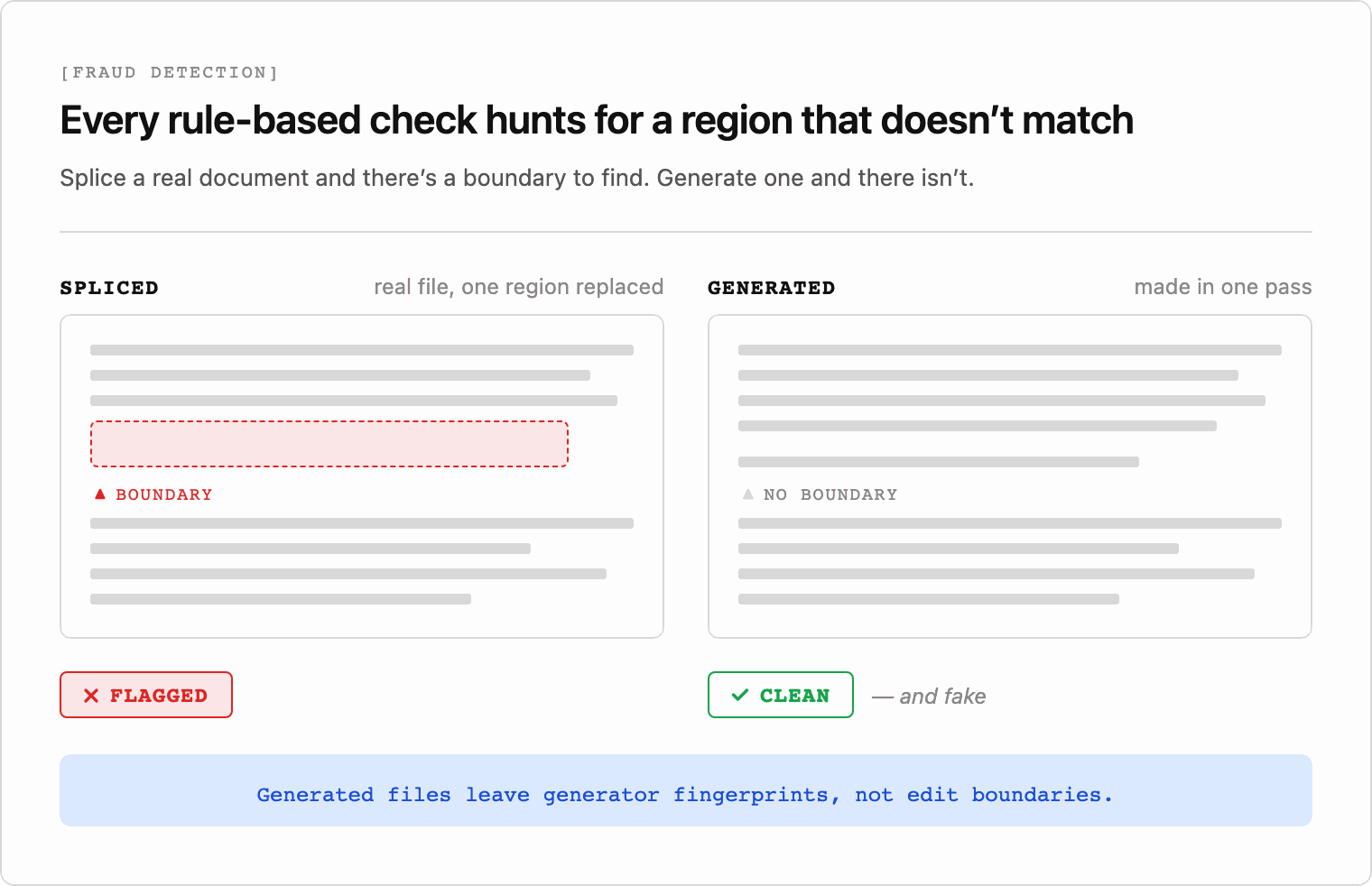
Every rule-based check works the same way underneath, whether it reads fonts, metadata, or compression: it hunts for a region that does not match the rest of the file.
So they catch retouching and miss wholesale generation. Altering a real bank statement leaves an edited patch inside an untouched original, and that boundary is what every test is really finding. A statement generated end to end has no patch, because there was no original to paste into.
Generated files are not trace-free. Research on synthetic imagery finds that generators leave systematic flaws a detector can learn, but those are fingerprints rather than editing signatures, and reading them takes a different class of tool. Whatever document data extraction layer your fraud checks run on has to look past surface artifacts.
How Document Liveness Detection Verifies Physical Presence
Everything above concerns a file that arrives as a file. Liveness detection covers the other intake path, where someone photographs a document with a phone during onboarding, and it is the one check a wholly generated document can never pass. A file that only ever existed as pixels was never an object in front of a camera.
It confirms, as vendor Regula puts it, that the document presented is "physically present and genuine, rather than a screenshot, printout, or replayed video".
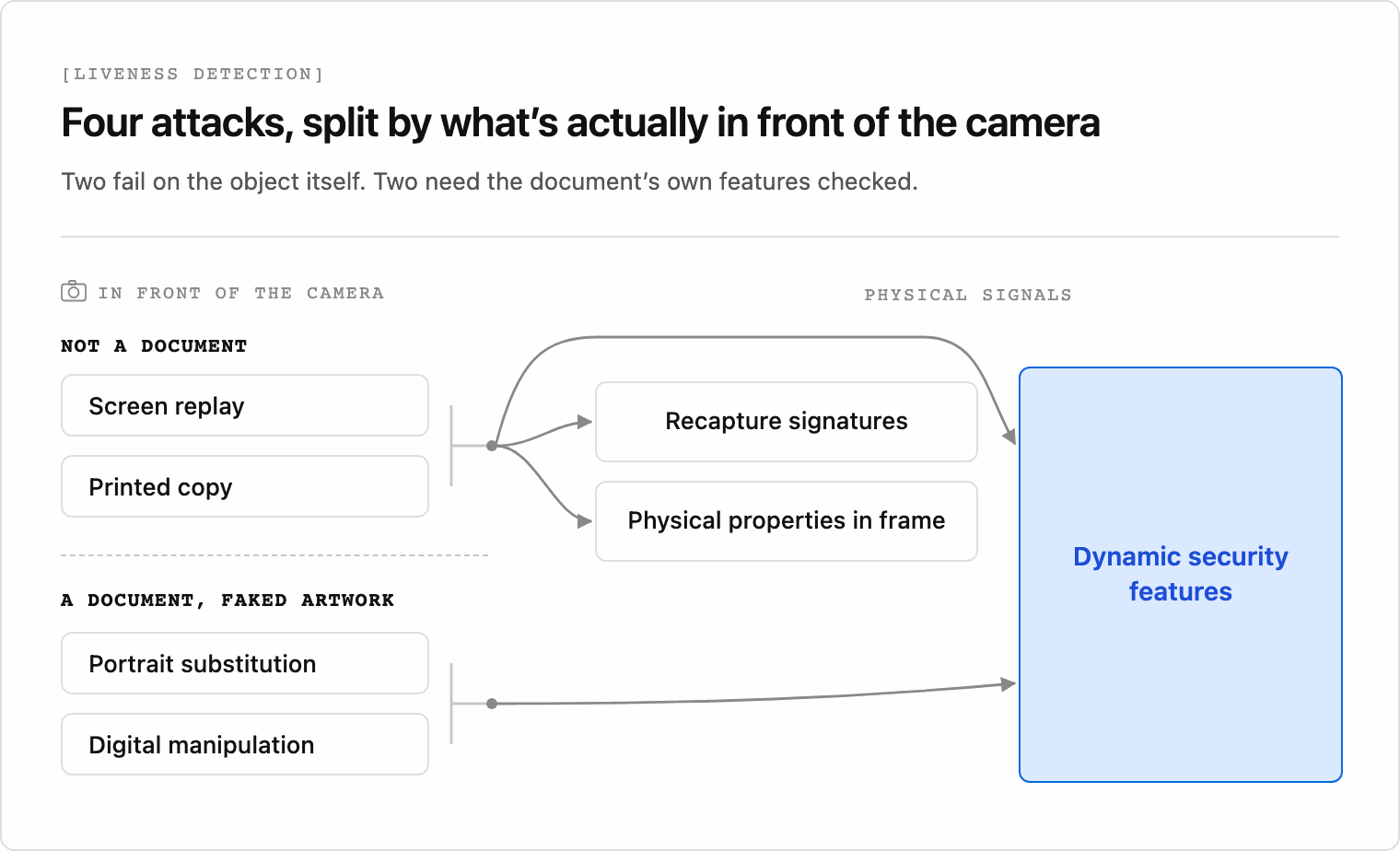
The four attack types ID R&D's documentation catalogs divide on a single question: is the thing in front of the camera a real document at all?
Not a document. Screen replay presents an image or video back to the system, and printed copy holds a photocopy up to the camera. Both are reproductions, so both fail on the object itself: on recapture signatures left by photographing a screen or a printout, and on Regula's check that "assesses the spatial position and ratio to conclude whether it behaves like a real object in front of the camera".
A real document with faked artwork. Portrait substitution swaps the photo on an authentic ID, and digital manipulation alters text, seals, or holograms. Here the object in frame is physically real, so both of those signals pass. What catches it is the document's own security printing: dynamic security features, which Regula defines as "elements that change appearance when the angle of illumination or observation changes". That is why capture flows ask you to tilt the document under a phone flashlight, and it is the only signal that reaches both groups, because a screen cannot reproduce angle-dependent change either.
How much of this needs video is a vendor decision. Regula's flow collects motion across frames, while ID R&D's IDLive Doc "relies solely on a single image frame" and asks for no movement at all.
Key Features of Document Fraud Detection Software
Document fraud detection software runs those checks with liveness scoring, and adds three more:
- Content verification, which cross-references extracted fields against known templates and issuing authority databases.
- AI-based authenticity scoring, which assigns a confidence value to the document instead of a binary pass/fail verdict, though confidence score reliability matters as much as the score itself.
- Tamper localization, which pinpoints the region of the image or text layer where manipulation occurred instead of rejecting the whole file.
KYC, AML, and Privacy Rules That Govern Document Verification
KYC obligations make identity checks mandatory, but the mechanics differ by regime, and the labels get misused often enough to be worth pinning down.
In the EU, the 2024 AML package put customer due diligence rules in the directly applicable AML Regulation. AMLD6, the directive alongside it, covers national supervisors and financial intelligence units rather than customer checks.
In the U.S., the Bank Secrecy Act's Customer Identification Program rule (31 CFR 1020.220) requires a bank to obtain a customer's name, date of birth, address, and identification number before opening an account, then verify that identity "within a reasonable time after the account is opened", using an unexpired government-issued photo ID, non-documentary methods, or both.
Document verification is one route the rule sanctions, not a mandate, and it need not precede onboarding.
Privacy law then constrains what you keep. Under GDPR, data minimization (Article 5(1)(c)) limits you to data "adequate, relevant and limited to what is necessary" for the purpose, and storage limitation (Article 5(1)(e)) requires that identifiable data be kept "no longer than is necessary".
California's CCPA requires that a business's collection, use, retention, and sharing of personal information be "reasonably necessary and proportionate" to the disclosed purpose, with retention periods disclosed at collection.
Enforcement is where the exposure lands. FinCEN's record $1.3 billion penalty against TD Bank in October 2024 covered Bank Secrecy Act violations including unfiled suspicious activity reports on roughly $1.5 billion of transactions.
Regulators increasingly expect an audit trail carrying timestamps, confidence scores, and tamper flags.
How Unsiloed Detects Document Fraud With Layout-Aware Parsing
A fraud check is only as good as the data under it, which makes the document intelligence API you pick a fraud decision. Flattening a mortgage packet into raw text discards the signals fraud teams work from: field-level anomalies, layout irregularities, and spacing inconsistencies.
Unsiloed's layout-aware vision model identifies tables, form fields, headers, and visual regions before extraction begins, so every value in the returned JSON carries a confidence score, a word-level citation, and a bounding box mapped to its source location on the page.
That is what a review queue runs on. A low confidence score on an income figure arrives with the bounding box that sends a reviewer straight to it, and two statements claiming the same employer in different layouts stay distinguishable instead of collapsing into flat text.
Choosing Fraud Detection Software That Scales
Document fraud detection fails when the parser cannot tell you where the problem is, and a binary verdict is no help to a reviewer facing 10,000 submissions a month. Book a demo to see how word-level citations and bounding boxes point a fraud team at the region to inspect instead of rejecting whole files.
FAQ
Can I use free document detection tools to catch AI-generated forgeries?
No. Free tools rely on metadata inspection and pixel-level artifact detection, and both work by finding a region that does not match the rest of the file. A document generated end to end has no edited patch and no compression mismatch, so those checks come back clean. Catching one means reading content authenticity, structural consistency, or the generator fingerprints the file does carry.
What's the difference between document liveness detection and traditional forgery detection?
Liveness detection verifies that a document is physically present during capture, checking angle-dependent security features such as holograms and whether the object in frame behaves like a real document. Traditional forgery detection inspects a static file for editing artifacts and metadata mismatches. Only liveness stops a replay attack, where a scan or recording of a real document is presented back to the system, so remote onboarding needs both.
Is document fraud detection software better than manual review?
Software scales to thousands of documents an hour and catches pixel-level anomalies, metadata mismatches, and generated content that human reviewers miss. Manual review still handles the borderline cases confidence scoring flags. At volume, reviewing by hand alone means accepting either the fraud exposure or the headcount.
How do banks verify mortgage documents without slowing down approval times?
Banks screen files automatically before they reach an underwriter, combining metadata forensics, layout analysis, and authenticity scoring into a confidence value rather than a binary pass/fail verdict. Each lender sets its own threshold against the risk the document carries: scores above it clear automatically, and scores below it route to a reviewer, which keeps approvals moving without dropping verification rigor.
When should document detection systems preserve layout structure instead of extracting raw text?
Preserve layout structure whenever field-level anomalies, spacing inconsistencies, or formatting differences carry fraud signals that a flat text stream discards. Layout-aware parsers trace each extracted value back to a page region through bounding boxes and word-level citations, which is what a compliance reviewer needs to inspect the exact location of a flagged income figure or employment date.