
LlamaIndex Alternatives, Pricing, and Reviews (July 2026)
LlamaIndex is a strong framework for prototyping retrieval-augmented generation (RAG) systems, but production pipelines tend to surface the same three limits: parsing accuracy on complex documents, the engineering needed to wire the pieces together, and auditability when an extracted field has to tr


LlamaIndex is a strong framework for prototyping retrieval-augmented generation (RAG) systems, but production pipelines tend to surface the same three limits: parsing accuracy on complex documents, the engineering needed to wire the pieces together, and auditability when an extracted field has to trace back to its source. The alternatives below beat LlamaIndex on at least one of those, and one of them, Unsiloed AI, beats it on all three for document-heavy workloads.
This is a roundup, not a single head-to-head. Here we rank the strongest options in June 2026, with verified pricing and where each one is a better choice than LlamaIndex.
TLDR:
- LlamaIndex works well for prototyping, but teams move off it in production when parsing accuracy, field-level auditability, or setup overhead become bottlenecks.
- Unsiloed AI is the best alternative for the parsing and extraction layer: it leads the open olmOCR-Bench at 88.0 to LlamaParse's 73.5 on the same scorer, returns a 0 to 1 confidence score and bounding-box citation on every value by default, and runs on-premise or air-gapped.
- LangChain and Haystack are the strongest orchestration alternatives, and Weaviate is the strongest move if you want to consolidate retrieval into the vector database itself.
- LlamaCloud, LlamaIndex's own managed service, is cheaper per page than its reputation suggests (1 to 45 credits per page, with 1,000 credits at $1.25), and it does offer self-hosting, but only on Enterprise plans.
- Pick Unsiloed when accuracy and traceability are non-negotiable, an orchestration framework when you mainly need to wire up retrieval, and a managed service when you want to skip infrastructure entirely.
What is LlamaIndex?
LlamaIndex is an open-source data framework (MIT licensed, with roughly 50,000 GitHub stars) for connecting external data to AI models (LLMs) through RAG. It ingests documents, chunks them into nodes, embeds those nodes, stores them in an index, and at query time retrieves the most relevant chunks to pass to a model.
LlamaIndex is really three things, which matters when you go looking for alternatives:
- The open-source orchestration framework, which handles indexing, retrieval, and query logic.
- LlamaParse, a document parser that turns PDFs and scans into clean text for the framework to index.
- LlamaCloud, a managed service that hosts parsing, ingestion, and indexing so you don't have to self-host the stack.
An alternative can replace any one of those layers, so the right choice depends on which part is holding you back.
Why Teams Look for LlamaIndex Alternatives
LlamaIndex is well regarded, but a few limitations push teams toward alternatives once they move past prototyping.
The first is setup overhead. Assembling data connectors, query pipelines, and retrieval logic takes real engineering time, and for teams without dedicated AI engineers that cost compounds.
The second is parsing accuracy on complex documents. Retrieval quality depends on the parser feeding the index, and when a parser flattens tables, misreads multi-column layouts, or drops headers, no amount of query tuning recovers the lost structure. On the open olmOCR-Bench, scored with the unmodified Allen AI scorer, LlamaParse's agentic mode scores 73.5, well behind the leaders.
The third is auditability. LlamaExtract can return citations and confidence scores, but both are opt-in, the confidence feature is in beta, and LlamaIndex's own documentation warns that activating them "will considerably slow down extraction processing time." For a pipeline that needs a confidence signal on every field by default, that is a meaningful gap.
The Best LlamaIndex Alternatives in June 2026
The five tools below cover the parsing, orchestration, retrieval, and managed-service layers. Each entry lists what it is, where it beats LlamaIndex, its verified pricing, and who it fits.
Unsiloed AI
Unsiloed AI is a document ingestion API built for production pipelines where accuracy and traceability are non-negotiable. Where LlamaIndex depends on a separate parser feeding text into the index, Unsiloed uses a vision-first architecture that preserves reading order, table structure, and spatial relationships across complex documents.
It beats LlamaIndex in three concrete ways:
- Parsing accuracy: Unsiloed leads the open olmOCR-Bench at 88.0, against LlamaParse's 73.5 on the same scorer and dataset.
- Verifiability by default: every extracted value returns a confidence score from 0 to 1 and a bounding-box citation back to the source page, with no opt-in flag and no processing-speed penalty.
- Deployment reach: Unsiloed runs on-premise and in air-gapped, isolated networks, so documents never leave a controlled environment.
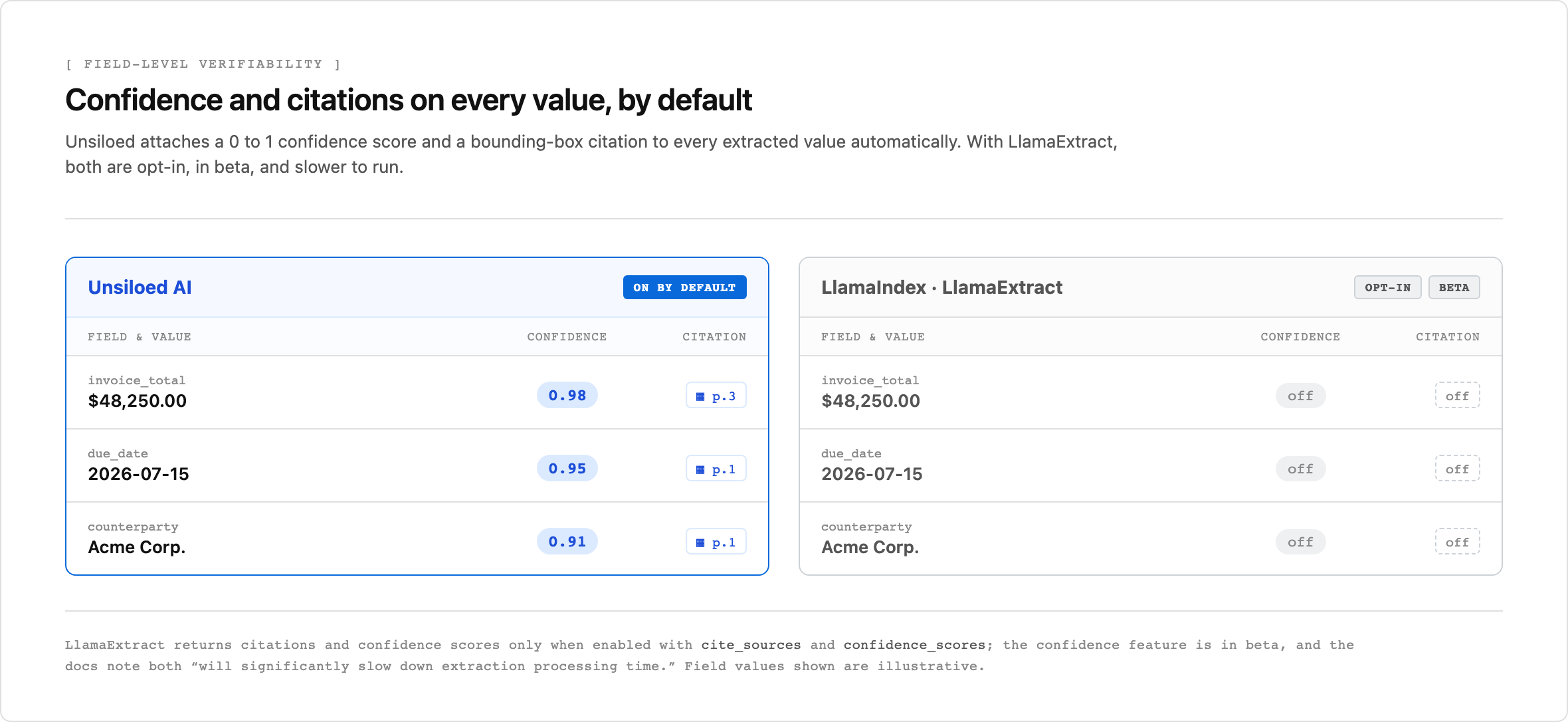
Unsiloed returns a confidence score and a source citation on every value by default. With LlamaExtract, both are opt-in, in beta, and, per LlamaIndex's docs, "significantly slow down extraction."
Parsing, extraction, classification, and splitting run through one REST API, so Unsiloed replaces the whole ingestion layer, not just the parser. Pricing is published: Standard is 250permonthforupto20, 000pages(0.012 per page), Growth is 750permonthforupto75, 000pages(0.010 per page), and Enterprise pricing covers VPC, on-premise, and air-gapped deployments.
Best for: finance, legal, and healthcare teams that need verifiable extraction with field-level citations and the option to deploy in a controlled environment.
LangChain
LangChain is an open-source framework (MIT licensed, around 138,000 GitHub stars, the largest community in this roundup) for building LLM applications through composable chains that connect prompts, retrieval, memory, and tool calls. Its chain abstractions give engineering teams fine-grained control over each step of a pipeline, and it ships alongside LangSmith for tracing and debugging.
Where it beats LlamaIndex is breadth and observability. LangChain's ecosystem of integrations and its agent abstractions are larger, and LangSmith gives you production tracing that LlamaIndex doesn't match natively. Like LlamaIndex, it relies on external parsers for layout-aware extraction, so complex PDFs still need a dedicated parsing layer in front of it.
LangChain itself is free and open source. LangSmith, the managed observability product, runs a Developer tier at $0 per seat (up to 5,000 traces per month, then pay as you go), a Plus tier at $39 per seat per month, and custom Enterprise pricing.
Best for: teams that want the widest integration ecosystem, agent tooling, and production tracing for complex multi-step chains.
Haystack
Haystack is an open-source framework from deepset (Apache 2.0 licensed, around 25,500 GitHub stars) for building production RAG pipelines as directed graphs, where each node is an explicit processing step. That structure gives you clear control over execution order and lets you swap components without rewriting application logic.
Where it beats LlamaIndex is production transparency. Haystack's graph model makes pipelines easier to debug and version, it supports both dense and sparse retrieval, and it ships built-in evaluation tools for measuring retrieval quality. As with the other frameworks, document parsing is a separate concern you supply.
Haystack is free to self-host. deepset, the company behind it, offers deepset Studio at no cost, with a custom-priced Enterprise product for teams that want a managed environment.
Best for: teams that want transparent, debuggable pipelines and built-in evaluation for production retrieval.
Weaviate
Weaviate is an open-source vector database (BSD-3-Clause licensed, around 16,300 GitHub stars) with retrieval built into the storage layer. Instead of wiring together separate components for embedding and retrieval, Weaviate handles vectorization, indexing, and hybrid search in one place, and adds reranking and multi-tenancy.
Where it beats LlamaIndex is consolidation and throughput. Teams running high-volume retrieval where latency matters often collapse their stack around Weaviate to remove orchestration overhead. The tradeoff is composability: changing embedding models or retrieval logic means reconfiguring the database instead of editing a few lines of framework code.
Weaviate Cloud starts with a free sandbox, then moves to Flex at $45 per month, Plus from $280 per month, and Premium from $400 per month, with per-dimension rates that fall as you scale.
Best for: teams that want to consolidate retrieval into the database and favor throughput over pipeline flexibility.
LlamaParse and LlamaCloud
If LlamaIndex works for you and the friction is infrastructure-related instead of architectural, the managed version is the most direct alternative to self-hosting. LlamaCloud hosts parsing, ingestion, and indexing, and LlamaParse handles document conversion across several quality tiers.
LlamaCloud's pricing is lower than many assume. It runs on credits, with 1,000 credits priced at $1.25. Parsing runs from 1 credit per page on the Fast tier up to 45 credits per page on Agentic Plus, so even the most expensive mode is roughly 0.056perpage.PlansareFree(0, 10,000 credits per month), Starter (50permonth, 40, 000credits), Pro(500 per month, 400,000 credits), and custom Enterprise. Self-hosting through a bring-your-own-cloud model is available, but only on Enterprise plans, and it runs in your cloud tenant instead of a fully air-gapped environment.
Best for: teams already invested in LlamaIndex who want to drop the infrastructure burden without changing frameworks.
How the Alternatives Compare
The tools here cover different layers, so the table compares them on type, licensing, managed pricing, and where each one is a stronger choice than LlamaIndex.
| Tool | Layer it replaces | Open source | Managed pricing | Stronger than LlamaIndex at |
| Unsiloed AI | Parsing and extraction | No, API | From $250/mo | Parsing accuracy, by-default citations, air-gapped deployment |
| LangChain | Orchestration framework | Yes, MIT | LangSmith from $0 to $39/seat | Integration ecosystem, agents, tracing |
| Haystack | Orchestration framework | Yes, Apache 2.0 | Free, Enterprise custom | Pipeline transparency and evaluation |
| Weaviate | Vector database and retrieval | Yes, BSD-3 | Free, then from $45/mo | Throughput and consolidated retrieval |
| LlamaCloud | Managed LlamaIndex | Core is MIT | Free, $50, or $500/mo | Removing infrastructure overhead |
Why Unsiloed AI is the Best LlamaIndex Alternative
Most of the tools here replace one layer of LlamaIndex. Unsiloed replaces the layer that most often breaks in production, the parsing and extraction step, and it does so with the accuracy and auditability that compliance-driven workloads require.
The orchestration frameworks and the vector database all assume clean, structured input. They sit downstream of parsing and inherit whatever the parser gives them. When a table is flattened or a clause is dropped before retrieval runs, no query engine recovers it. Unsiloed sits upstream of them all, at the document parsing layer. It leads the neutral benchmark on parsing accuracy, and returns a confidence score and citation on every field by default, not as a slow opt-in mode.
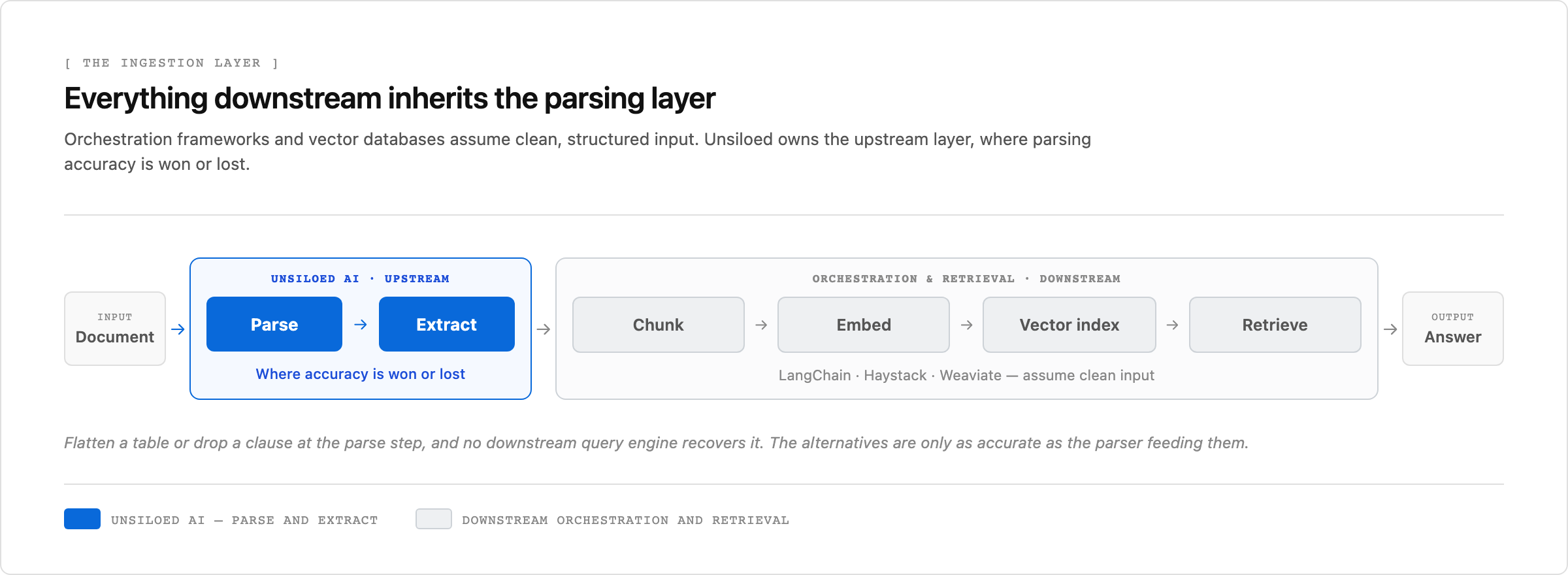
The orchestration frameworks and vector database sit downstream of parsing and are only as accurate as the parser feeding them. Unsiloed owns the upstream parse and extract layer, where accuracy is won or lost.
It also clears the deployment bar that managed services cannot. LlamaCloud's self-hosting keeps data in your cloud tenant, which suits many teams, but Unsiloed adds true on-premise and air-gapped deployment for environments where data cannot touch a public cloud at all. Once documents are parsed reliably, any orchestration layer, including LlamaIndex itself, can sit downstream and handle retrieval.
Final Thoughts on Choosing a LlamaIndex Alternative
The right alternative depends on which layer is holding you back. If you mainly need to wire up retrieval, LangChain and Haystack are mature orchestration frameworks, and Weaviate consolidates retrieval into the database. If you want to keep LlamaIndex but drop the infrastructure, LlamaCloud is the managed path. If the bottleneck is parsing accuracy or field-level auditability, which is where most document-heavy pipelines struggle, Unsiloed AI is the strongest choice. If you're building in finance, legal, or healthcare, book a demo to see how vision-first parsing handles documents the other tools depend on a parser to get right.
FAQ
What is the best alternative to LlamaIndex?
It depends on the layer you're replacing. For parsing and extraction accuracy with field-level auditability, Unsiloed AI is the strongest choice. For orchestration, LangChain and Haystack are the leading frameworks. For retrieval, Weaviate consolidates the vector database and search. For a managed version of LlamaIndex itself, LlamaCloud is the most direct option.
Is LlamaIndex free?
The core framework is open source under the MIT license and free to self-host, so you only pay for the infrastructure you run it on. LlamaCloud, the managed service, is credit-based, with a free tier of 10,000 credits per month and paid plans at $50 and $500 per month.
Does LlamaIndex support confidence scores and citations?
Yes, through LlamaExtract, but both are opt-in, the confidence scores are in beta, and the documentation notes they considerably slow down extraction. Unsiloed AI returns a 0 to 1 confidence score and a bounding-box citation on every value by default, without a speed penalty.
Can I deploy a LlamaIndex alternative on my own infrastructure?
Yes. LlamaCloud offers bring-your-own-cloud self-hosting on Enterprise plans, which keeps data in your cloud tenant. Unsiloed AI goes further with on-premise and air-gapped deployment for environments that cannot connect to a public cloud at all. The open-source frameworks can be self-hosted on any infrastructure you manage.
When should I switch from LlamaIndex to Unsiloed AI?
Switch when parsing accuracy on complex documents becomes a bottleneck, when you need deterministic extraction with field-level citations for compliance or audit trails, or when your infrastructure requires on-premise or air-gapped deployment. Unsiloed handles the ingestion layer, and LlamaIndex or any other framework can still sit downstream for retrieval.