Unsiloed AI vs Extend AI: Which is Better in June 2026?

A document parser that returns clean JSON is only half of a retrieval pipeline. Unsiloed AI runs the other half too, taking a document all the way to a queryable vector index in one platform, where Extend stops at extraction and leaves embeddings, the vector store, and retrieval to you.
On paper the two look alike: both parse complex documents into structured JSON, return confidence scores and optional bounding-box citations, and carry SOC 2 and HIPAA. Scope is one difference that decides it. Accuracy is the other: run both through the same parsing benchmark, scored the same way, and Unsiloed finishes 24 points ahead, 88.0 to 64.0.
TLDR:
- Unsiloed AI and Extend both parse complex documents into structured JSON with confidence scores and citations, and both carry SOC 2 and HIPAA. This is a comparison of accuracy and scope, not basic capability.
- On Unsiloed's open olmOCR-Bench harness, which scores every parser with the unmodified Allen AI scorer, Unsiloed leads at 88.0 and Extend scores 64.0.
- Unsiloed can be used two ways: as a parser that feeds your existing stack, or as a full pipeline that chunks, embeds, and stores documents in a hosted vector index you can query. Extend covers parsing and extraction, but leaves embeddings, vector storage, and retrieval to your own infrastructure.
- Both offer cloud deployment and the option to run in your own cloud account so documents never leave your environment. Unsiloed adds air-gapped and isolated-network deployment, which Extend's documentation does not list.
- Choose Unsiloed for higher benchmark accuracy, the option of parsing and retrieval in one platform, and air-gapped deployment. Extend fits teams that only need parsing and extraction and run their own retrieval stack.
What is Extend?
Extend is an agentic document processing platform that turns complex documents into structured data. Its API covers parsing, extraction, classification, splitting, and PDF editing, and it returns layout-aware output with bounding boxes, confidence scores, and optional citations. It handles scanned pages, handwriting, and mixed-format documents.
Extend focuses on the extraction step and the operations around it, including optional human review of flagged fields. It does not host embeddings, a vector store, or retrieval, so those stages run in your own infrastructure.
What is Unsiloed AI?
Unsiloed AI is agentic OCR for AI pipelines that need to trust the page. It parses PDFs, scans, Office files, and images into Markdown and structured JSON, with a confidence score on every value and optional bounding-box citations. Parsing, extraction, classification, and splitting are all available through one API.
You can use Unsiloed two ways:
- As a parser that drops into your existing stack, returning structured, confidence-scored output you feed into your own embeddings, vector store, and retrieval.
- As a full pipeline, where a workflow layer chunks parsed content, embeds it, and stores it in a hosted vector index with a retrieval endpoint, so you can go from a raw document to a queryable index without leaving the platform.
Either way, every value stays auditable through its confidence score, and Unsiloed leads olmOCR-Bench at 88.0 on an open harness that scores every parser the same way.
How Unsiloed AI and Extend Compare
Both platforms parse, extract, classify, and split, with confidence-scored output, so the table below focuses on where their accuracy and scope diverge rather than on basic capability.
Capability | Unsiloed AI | Extend |
|---|---|---|
olmOCR-Bench, same scorer | 88.0 (#1) | 64.0 |
Reproducible, neutral accuracy benchmark | Yes, open harness | Self-reported benchmarks |
Hosted chunking, embedding, vector index, and retrieval | Yes | No |
Usable as a drop-in parser for your own stack | Yes | Yes |
Parsing, extraction, classification, and splitting | Yes | Yes |
Per-field confidence scores by default | Yes | Yes |
Bounding-box citations | Yes | Yes |
Schema-based structured extraction | Yes | Yes |
Deploy in your own cloud account (data stays in your environment) | Yes | Yes |
Air-gapped and isolated-network deployment | Yes | No |
SOC 2 and HIPAA support | Yes | Yes |
Parsing Accuracy
Both tools are vision-based parsers that preserve tables, multi-column reading order, and scanned content that generic OCR loses. Extend advertises high accuracy numbers, but they come from benchmarks it defines and runs itself, which measure different tasks and are not directly comparable across vendors. The cleanest way to compare two parsers is on the same benchmark, scored the same way.
Unsiloed publishes an open olmOCR-Bench harness that runs each parser through the unmodified Allen AI scorer on the same dataset of more than 1,400 PDFs, so the scores are directly comparable. On that benchmark, Unsiloed scores 88.0 and Extend's agentic mode scores 64.0, with GPT-5.5, Claude, and LlamaParse in between. Every row is reproducible: the per-vendor numbers from the harness, and Unsiloed's score through its public API.
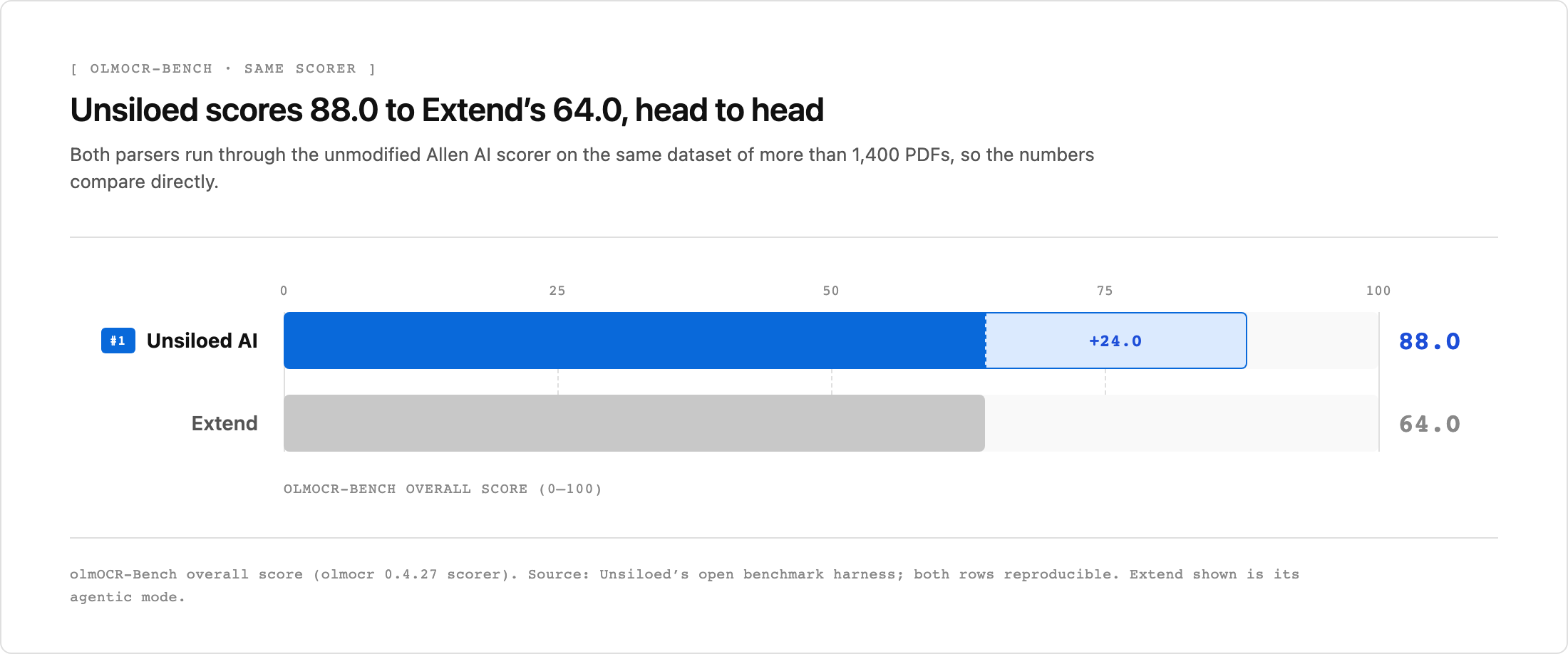
Unsiloed scores 88.0 and Extend scores 64.0 on olmOCR-Bench, a 24-point lead, both run through the same unmodified Allen AI scorer on the same dataset. Both numbers are reproducible from Unsiloed's open harness.
Drop-in Parser or End-to-End Pipeline
Unsiloed covers the whole retrieval pipeline. Extend stops at the extraction layer, so when you build a retrieval-augmented generation (RAG) system on Extend, you choose and run the embedding model, the vector database, and the retrieval service yourself.
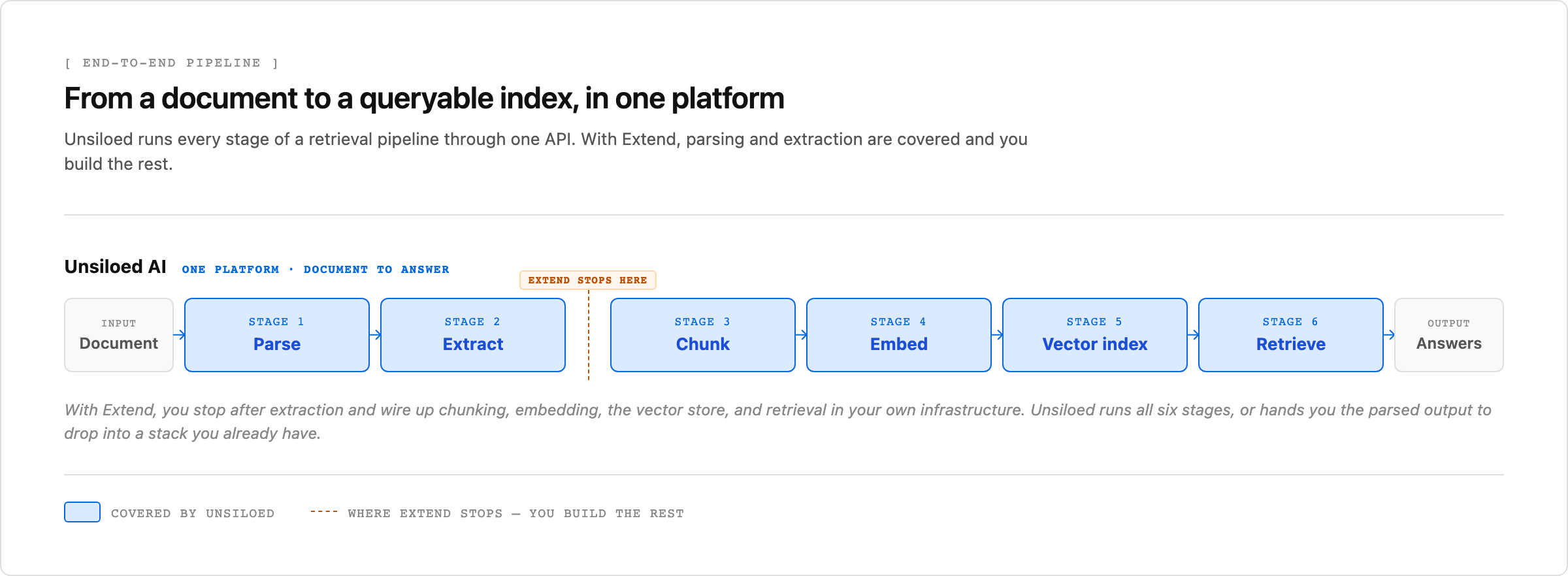
Unsiloed runs all six stages from a document to a queryable index in one platform. Extend covers parse and extract; chunking, embedding, the vector store, and retrieval are left to your own infrastructure.
Unsiloed gives you both options on the same API. Use it purely as a parser and you get structured, confidence-scored output to feed into whatever stack you already run. Or use the workflow layer, where File, Chunking, Embedding, and Vector DB nodes take a document through to a hosted vector index, with a retrieval mode for the query side. For a RAG system, that is the difference between maintaining three more services yourself and handing those stages to the platform when it suits you.
Choosing Unsiloed does not lock you into the full pipeline. It keeps the drop-in path Extend offers and adds the end-to-end retrieval path Extend does not.
Verifiable Output
For finance, legal, and healthcare workflows, traceability is a production requirement: each extracted value needs a confidence signal and a way back to the source.
Both platforms provide this, and here they are closely matched. Unsiloed returns a numerical confidence score, from 0 to 1, on every value by default, with optional bounding-box citations. Extend returns confidence scores in its extraction metadata by default, and bounding-box citations when you enable them. Either way, both give traceable output for an audit-heavy pipeline, so verifiability is rarely the deciding factor between them.
Deployment and Compliance
Deployment is often where enterprise procurement decisions are made, and here the two are closely matched at the top. Both run as managed cloud services, both carry SOC 2, HIPAA, and GDPR, and both let you keep documents in your own environment: Extend through a bring-your-own-cloud model that deploys into your cloud account, and Unsiloed through self-hosted deployment in your own cloud. Both also offer a hybrid option.
They diverge only at the most restrictive end. Unsiloed lists air-gapped and isolated-network deployment, for organizations that cannot connect document processing to the public internet at all. Extend's documentation describes cloud, bring-your-own-cloud, and hybrid, but no air-gapped option. For a team in defense, government, or the most tightly regulated parts of healthcare and finance, that air-gapped requirement can decide the evaluation.
Where Each Tool Fits
- Unsiloed AI suits teams that want a parser they can drop into an existing stack, with the option to run chunking, embedding, indexing, and retrieval in the same platform, and the option to deploy air-gapped or in an isolated network.
- Extend suits teams that need parsing and extraction as a managed service and already run their own retrieval stack.
Why Unsiloed AI is the Better Choice for Document AI
Unsiloed matches Extend on the fundamentals: confidence-scored output, bounding-box citations, schema-based extraction, and SOC 2 and HIPAA. Three things set it apart:
- Benchmark accuracy, head to head: 88.0 on olmOCR-Bench versus Extend's 64.0, both run through the same unmodified Allen AI scorer on the same dataset, and both reproducible.
- Parser or full pipeline: use Unsiloed as a drop-in parser, or run parse, chunk, embed, index, and retrieve through one API. Extend leaves embeddings, vector storage, and retrieval to your own infrastructure.
- Deployment reach: both offer cloud and self-hosting in your own cloud, but only Unsiloed lists air-gapped and isolated-network deployment. Extend covers cloud, bring-your-own-cloud, and hybrid.
If you only need parsing and extraction and run your own retrieval stack, Extend fits that narrower case. If you want a parser that leads on accuracy, can grow into the whole ingestion-to-retrieval path, and can run inside an air-gapped network, Unsiloed covers all three.
Final Thoughts on Choosing a Document AI Platform
Unsiloed AI and Extend both produce confidence-scored, cited output and carry SOC 2 and HIPAA. Three differences decide it: Unsiloed parses more accurately on a like-for-like benchmark, 88.0 to 64.0; it covers the whole pipeline, from parsing through to a queryable index, where Extend stops at extraction; and it deploys air-gapped and in isolated networks, where Extend tops out at bring-your-own-cloud. If you want a parser that leads on accuracy, stands alone today, and can grow into the whole ingestion-to-retrieval path, try Unsiloed AI on your document set.
FAQ
How do I decide between Unsiloed AI and Extend?
Start with what matters most for your workflow. If you want the highest accuracy on a neutral benchmark and the option to run chunking, embedding, indexing, and retrieval in the same platform, Unsiloed covers both. If you only need parsing and extraction and already run your own retrieval stack, Extend fits that narrower case.
Do both tools return confidence scores and citations?
Yes. Both return confidence-scored output with bounding-box citations back to the source, so either supports audit and compliance workflows. Unsiloed returns a confidence score between 0 and 1 on every value by default, with optional citations. Extend returns confidence scores in its extraction metadata by default, with citations available as an option.
Does Extend handle retrieval, or just parsing and extraction?
Extend covers parsing and extraction, but embeddings, vector storage, and retrieval run in your own infrastructure. Unsiloed can do the same, and it also offers those stages through a workflow layer with a hosted vector index and a retrieval endpoint.
Can I deploy either tool on my own infrastructure?
Both offer cloud deployment, and both keep data in your environment through Extend's bring-your-own-cloud model or Unsiloed's self-hosted model. Only Unsiloed lists air-gapped and isolated-network deployment, for environments that cannot connect to the public internet at all.
Which tool is more accurate on complex documents?
Both are vision-based parsers. On Unsiloed's open olmOCR-Bench harness, which runs every parser through the unmodified Allen AI scorer on the same dataset, Unsiloed scores 88.0 and Extend's agentic mode scores 64.0. Every row is reproducible from the harness, or, for Unsiloed, through its public API.