
On-Prem Document Parsing in Air-Gapped, Regulated Environments (July 2026)
An air gap exposes every hidden cloud dependency. Learn how to design a self-contained document-extraction runtime with controlled updates and traceable fields.


An air gap exposes every hidden cloud dependency. A parser that works in a connected environment can fail before processing its first page if it needs to fetch a model, validate a license, or call a managed endpoint. For teams with a no-outbound-connectivity requirement, moving the software on-premise is not enough. The runtime must be self-contained, updates must cross the boundary through controlled procedures, and every extracted field must remain traceable to its source. This guide explains how to design and evaluate that system.
TLDR:
- Air-gapped environments isolate systems from external network connections. On-premise deployments may retain outbound connectivity, while parsers that depend on external services may not work in an isolated architecture.
- Extraction failures in regulated workflows can create liabilities beyond data-quality issues.
- HIPAA permits cloud processing of ePHI when the cloud provider is a business associate under a HIPAA-compliant BAA and the required safeguards are in place. Export-controlled and government environments need architecture-specific security and legal review.
- A self-contained pipeline needs its models, runtimes, and dependencies to be available locally, with a controlled update process.
- Unsiloed AI offers on-premise and air-gapped deployment options. It can return field-level grounding and extraction scores plus bounding-box citations to source-page regions.
On-Premise vs. Air-Gapped Document Processing
On-premise deployment keeps infrastructure in an organization's data center but can leave an external network connection intact. Air-gapped environments isolate systems from external network connections.
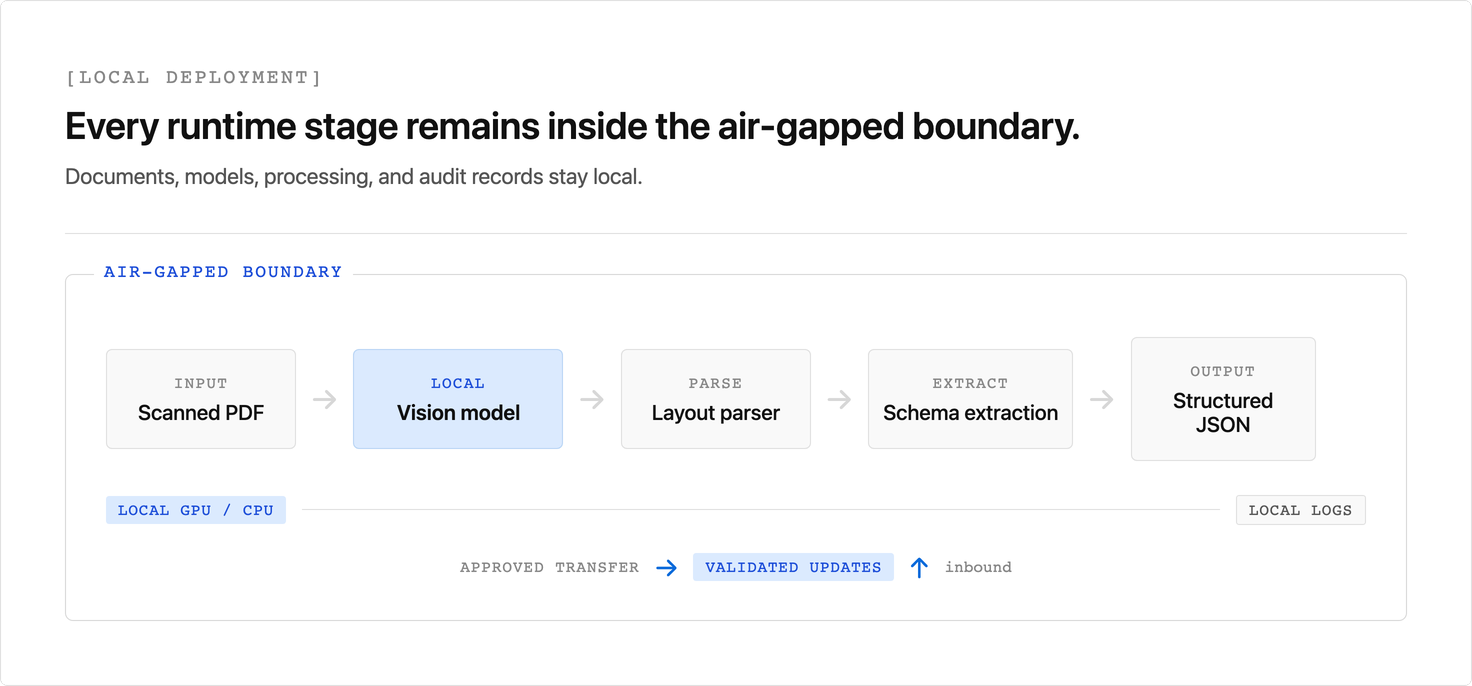
On-premise deployments can still reach external services for updates, license checks, or telemetry. In an air-gapped architecture, the components needed to run the parser must be available locally, and permitted transfers follow controlled procedures.
The practical differences are:
- Model delivery and updates use approved transfer and validation procedures.
- Licensing must work within the environment's network constraints.
- Audit logging needs a local destination and access controls that meet the organization's requirements.
A parser that requires an outbound service will not work where that service is unavailable.
Why Air-Gapped Document Extraction Needs Local Validation
Extraction failures propagate silently. A parser that flattens a multi-column regulatory table may return confident-looking output that downstream models treat as ground truth. By the time a compliance team catches it, the error has reached retrieval, generation, and review. This failure mode is common in PDF parsers for RAG pipelines.
In regulated workflows, a misread loan field or dropped clinical-trial row can create a liability.
Air-gapped deployments add another constraint because cloud reprocessing queues, managed retry infrastructure, and vendor-side monitoring may be unavailable to catch a silent failure.
Compliance Requirements for Air-Gapped Document Processing
| Framework | Governing Body / Scope | Document Processing Constraint | Architecture Consideration |
|---|---|---|---|
| HIPAA | HHS — U.S. healthcare organizations handling PHI | HHS permits a covered entity or business associate to use a cloud service to process ePHI when the cloud service provider is a business associate under a HIPAA-compliant BAA and the HIPAA Rules are met | HIPAA does not categorically require an air gap. The organization must assess its BAA, safeguards, and risk posture. |
| Export-controlled and federal environments | Organization-specific legal, security, and program requirements | Determine whether the particular data, users, infrastructure, and transfer paths are permitted before selecting a deployment model | An air gap may be an organizational requirement, but ITAR, FedRAMP, and classified-network requirements need case-specific legal and security review. |
For export-controlled, FedRAMP, or classified workloads, treat the deployment decision as an architecture and authorization question that needs case-specific review.
How to Build a Self-Hosted Document Extraction Pipeline
A self-hosted document extraction pipeline makes the dependencies needed at runtime available locally and avoids relying on unavailable external services.
The core components are:
- A locally bundled vision model for scanned PDFs, running on local GPU or CPU resources.
- A layout parser that preserves reading order and table structure in multi-column documents.
- A schema-driven layer that can return field-level grounding and extraction scores plus bounding-box citations to source-page regions.
- An output serializer that produces structured JSON for internal vector stores or document databases.
Unsiloed AI offers on-premise and air-gapped deployment options. Confirm the exact network, update, licensing, and support architecture during security review.
Auditability for Air-Gapped Document Extraction
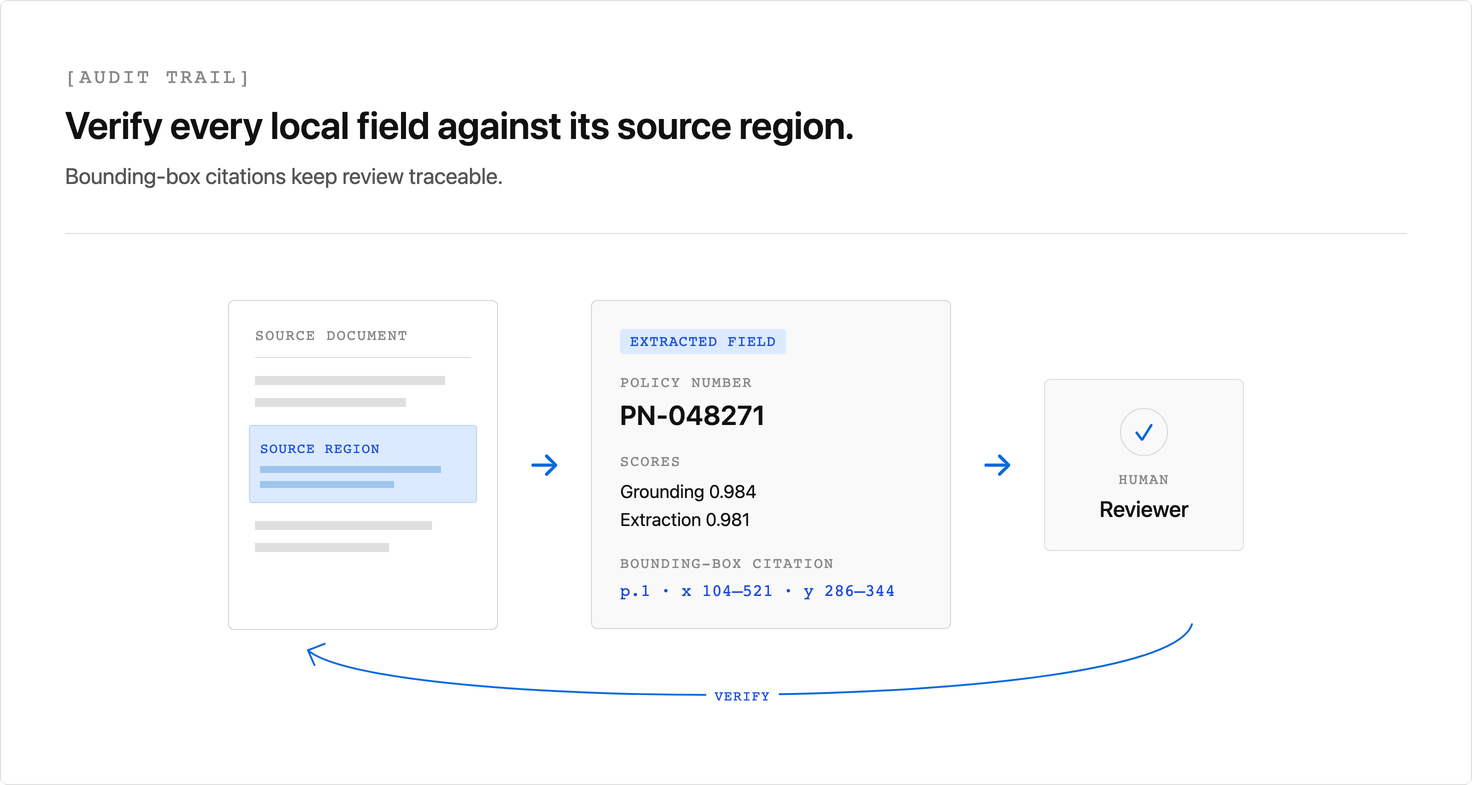
Every field from a contract, claim form, or compliance document needs a traceable path to its source for review, audit, model validation, and downstream trust.
Unsiloed can return field-level grounding and extraction scores plus bounding-box citations to source-page regions. These signals let reviewers compare an extracted value with the relevant part of the source document and are especially important in air-gapped deployments, where external logging services may be intentionally unavailable to catch missed values.
Maintaining Air-Gapped Document Processing Systems
Air-gapped extraction adds operational constraints to data-residency concerns. Model updates in isolated environments commonly pass through an organization's change-control, security-review, and approved-transfer process.
Python packages, inference runtimes, and container base images need a controlled delivery and versioning process, while teams that otherwise rely on vendor-hosted observability need a local logging and monitoring path.
How to Evaluate Air-Gapped Document Parsing Vendors
Vendors use "on-premise deployment" differently. For air-gapped environments, the decisive question is whether the proposed architecture can operate within the required network boundary.
Four questions cut through vendor ambiguity quickly:
- Does inference run locally, or does the container call an external API? Routing OCR or vision calls to a cloud endpoint is not air-gapped.
- Does licensing validation require periodic outbound connections?
- Can updates be transferred and verified through the organization's approved process?
- Does the vendor document every outbound network call? Without that inventory, security review cannot close.
Ask the vendor to document the deployment architecture and any dependencies that could require external connectivity.
Unsiloed AI for Air-Gapped Document Processing
Unsiloed AI offers on-premise and air-gapped deployment options for organizations that need to evaluate document extraction inside a controlled environment. It can return field-level grounding and extraction scores plus bounding-box citations to source-page regions. Validate the deployment architecture for your use case before production.
Self-Hosted Document Extraction for Air-Gapped Environments
Air-gapped document processing works when isolation is designed into model delivery, licensing, dependency management, and audit logging from the start. Talk to Unsiloed about the deployment architecture for your infrastructure.
FAQ
Can I run Unsiloed AI document extraction in a fully air-gapped environment with no outbound network calls?
Unsiloed AI offers self-hosted deployment. For a no-outbound-connectivity environment, confirm the specific deployment architecture, dependencies, licensing, update process, and support model with Unsiloed during security review.
What's the difference between on-premise document parsing and true air-gapped document processing?
On-premise infrastructure can still reach external endpoints for updates, license checks, or telemetry. Air-gapped deployments isolate systems from external network connections, so the runtime dependencies must be available locally and permitted transfers follow controlled procedures. HIPAA does not by itself require an air gap. ITAR, FedRAMP, and classified-network requirements require case-specific legal and security review.
Unsiloed AI vs LlamaCloud for self-hosted document extraction in a regulated environment?
LlamaCloud offers self-hosting on Enterprise plans. Whether LlamaCloud or Unsiloed can meet a true no-connectivity requirement depends on the proposed deployment architecture, so validate that requirement with each vendor. See our Unsiloed AI vs LlamaCloud comparison for the deployment and verifiability differences.
How do I verify which fields an air-gapped extraction pipeline parsed correctly without access to external logging services?
Unsiloed can return field-level grounding and extraction scores plus bounding-box citations to source-page regions. Reviewers can use the citations to compare an extracted value with the relevant source region.
What happens to on-premise document extraction model updates when the environment has no internet access?
Model updates must follow the environment's approved change-control and transfer process. Apply the same process to Python packages, inference runtimes, and container base images, and plan for a slower update cadence than an internet-connected deployment.