Unsiloed AI vs AWS Textract: Which Is Better in July 2026?
AWS Textract is good at OCR. Unsiloed AI is built for what comes after it. We compare schema-driven extraction, output shape, format coverage, deployment, and pricing to show where each tool fits in an AI or automation pipeline.

AWS Textract is good at OCR. Unsiloed AI is built for what comes after OCR.
That distinction matters if your document pipeline feeds LLMs, agents, RAG systems, or structured workflows. AWS Textract detects text, tables, forms, and layout in PDFs and images, then returns a graph of Block objects for your application to assemble. Unsiloed AI parses documents into structured chunks and extracts schema-shaped JSON with per-field confidence scores and source bounding boxes.
So the choice is less about whether both tools can read a PDF. They can. It's about how you define extraction, how much post-processing you need, what formats you can accept, and whether the service can run inside your deployment boundary.
TLDR:
Choose Textract if you need AWS-native OCR for PDFs and images and your team is comfortable assembling structured output from its Block graph.
Choose Unsiloed AI if your pipeline needs extraction-ready output for LLMs, agents, RAG, or automation workflows:
Unsiloed accepts a custom JSON schema and returns schema-shaped output with per-field confidence scores and source bounding boxes. Textract has no JSON Schema-driven extraction; Queries accepts batches of questions under hard per-page limits.
Unsiloed accepts PDFs, images, Word, Excel, PowerPoint, and scans directly. Textract supports JPEG, PNG, PDF, and TIFF.
Unsiloed returns hierarchical, RAG-ready chunks and typed JSON. Textract returns a flat graph of Block objects that application code has to traverse and reshape.
Unsiloed supports managed cloud, VPC, on-premises, and air-gapped deployment. Textract is an AWS-managed service, although PrivateLink can keep API traffic on the AWS network.
Unsiloed starts at $250 per month for 20,000 pages, with additional pages billed at the plan rate. In US West (Oregon), Textract charges $70 per 1,000 pages for forms, tables, and queries at the first volume tier.
What Is AWS Textract?
AWS Textract is a managed OCR and document analysis service for extracting text, handwriting, tables, forms, signatures, and layout elements from scanned documents and images.
Textract returns results as typed Block objects: words, lines, key-value pairs, table cells, and layout regions. Many detected blocks include confidence scores and bounding-box geometry. That output is useful, but it is not the final structure most applications need. To turn Textract output into an invoice object, customer record, RAG chunk, or workflow payload, application code has to traverse the Block graph and reassemble the relationships.
The service is split across several operations. DetectDocumentText handles raw OCR, AnalyzeDocument adds tables, forms, signatures, layout, and Queries, and specialized APIs such as AnalyzeExpense, AnalyzeID, and AnalyzeLending cover narrower document workflows. Textract also integrates with AWS services such as S3, Lambda, SNS, and Amazon A2I, which makes it a strong fit for teams already committed to AWS infrastructure.
That design makes Textract capable and flexible, but it also defines the trade-off: Textract gives developers low-level document analysis primitives, not schema-shaped extraction output.
What Is Unsiloed AI?
Unsiloed AI is a document intelligence platform for turning complex documents into structured output that LLMs, agents, RAG systems, and automation workflows can use directly.
Instead of returning raw OCR text or a low-level layout graph, Unsiloed returns structured document chunks and schema-shaped extraction results. Parsed output preserves reading order, tables, charts, and hierarchy. Extraction output matches a custom JSON schema and includes per-field confidence scores and bounding boxes that point back to the source document.
The platform is organized around four composable APIs:
Parsing converts documents into hierarchical, RAG-ready chunks.
Extraction pulls fields from documents using custom JSON schemas.
Classification routes documents by type using both visual and semantic signals.
Splitting breaks mixed or merged files into logical sections for downstream processing.
Unsiloed accepts PDFs, images, Word, Excel, PowerPoint, and scans directly. That makes it useful as the document layer between raw files and the AI or workflow system that needs reliable structured data.
How Unsiloed AI and AWS Textract Compare
The two services diverge most on input coverage, extraction model, output shape, and deployment, so those are the dimensions worth comparing in detail.
| Capability | Unsiloed AI | AWS Textract |
|---|---|---|
| Input formats | PDF, images, Word, Excel, PowerPoint, and scans | JPEG, PNG, PDF, and TIFF |
| Extraction model | Custom JSON schema submitted as one extraction job | Batches of natural-language queries under per-page limits |
| Output shape | Hierarchical chunks and typed JSON | Flat Block graph linked by relationship IDs |
| Traceability | Per-field confidence scores and source bounding boxes | Confidence scores and geometry on detected blocks; query answers link through Block relationships |
| Multi-page documents | Direct upload for supported documents | Multi-page PDF and TIFF files use an asynchronous, S3-backed Start/Get workflow |
| Classification and splitting | General-purpose APIs for routing and splitting documents | Available only inside AnalyzeLending for mortgage workflows |
| Deployment | Cloud, on-premise, or air-gapped | AWS cloud regions only, including GovCloud |
| Pricing model | Monthly plans with included pages and per-page overage | Per-page pricing by feature, such as OCR, forms, tables, and queries |
Parsing Architecture and Document Coverage
Document coverage matters before extraction starts. Textract accepts JPEG, PNG, PDF, and TIFF files. It does not process DOCX, XLSX, or PPTX directly, so pipelines that receive Office files need a conversion step before Textract can analyze them. Unsiloed accepts PDF, Word, Excel, PowerPoint, image, and scanned inputs directly.
The larger difference is the output model. Textract returns a JSON array of Block objects: words, lines, key-value sets, table cells, and layout regions. Document structure lives in relationships between those blocks. Reconstructing a table, matching a key to its value, or preparing chunks for RAG means traversing that graph in application code.
Unsiloed returns hierarchical, structure-aware chunks with tables, headers, and reading order preserved. That output can feed an LLM, vector store, or document workflow without a separate reassembly layer.
Accuracy and Benchmark Transparency
Accuracy is easier to evaluate when vendors publish reproducible benchmark results. Unsiloed reports a score of 88.0 on olmOCR-Bench using a vendor-run, open harness that teams can rerun. AWS documentation defines confidence scores and recommends thresholds with human review, but does not provide a directly comparable Textract score on that benchmark.
Schema-Driven Extraction vs Queries
The deepest difference between Unsiloed and Textract is how you tell the system what to extract.
With Unsiloed, you define a custom JSON schema and submit the document as one extraction job. The result matches that schema and includes a confidence score and source bounding box for each extracted field. The API produces the structured object your application expects rather than making your code construct it from individual answers.
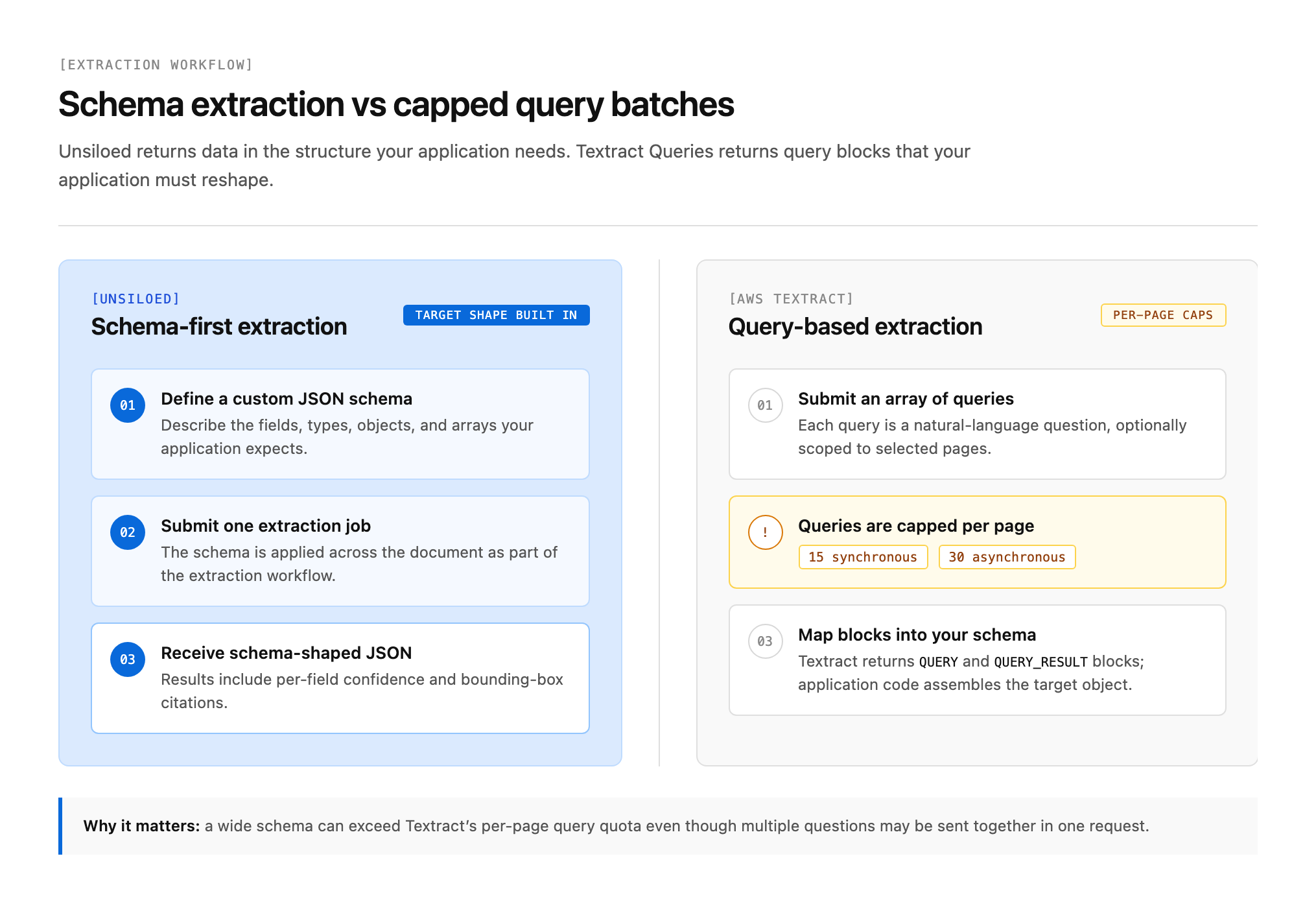 Unsiloed accepts the target schema and returns fields in that shape, with confidence scores and source locations. Textract accepts a batch of queries and returns linked query-result blocks that application code maps into the target object.
Textract does not accept a JSON Schema for general document extraction. Its closest feature is Queries, where you send an array of natural-language questions such as "What is the invoice total?" and receive an answer for each query. AWS sets a hard limit of 15 queries per page for synchronous operations and 30 per page for asynchronous operations. Query detection works in English only.
That model works for targeted lookups, but it becomes awkward for full document extraction. A 40-field schema targeting one page has to be decomposed into individual questions and split across at least three synchronous requests or two asynchronous jobs. Application code then maps the resulting Query blocks and QUERY_RESULT blocks into the target structure.
Pricing
The pricing difference is easier to see as a table. Unsiloed prices by plan and page volume. Textract prices each analysis feature separately, so the cost depends on which features you enable.
| Pricing item | Unsiloed AI | AWS Textract |
|---|---|---|
| Pricing model | Monthly plans with included pages and per-page overage | Per-page pricing by API and feature |
| Entry production plan | Standard plan: $250 per month for up to 20,000 pages | Raw OCR in US West (Oregon): $1.50 per 1,000 pages for the first one million pages |
| Higher-volume plan | Growth plan: $750 per month for up to 75,000 pages | Volume discounts vary by API and feature after the first tier |
| Additional pages | Standard: $0.012 per page; Growth: $0.010 per page | In US West (Oregon): tables $15 per 1,000 pages; forms $50; queries $15 at the first volume tier |
| Forms, tables, and queries | Included in the same document-processing surface | In US West (Oregon): $70 per 1,000 pages at the first volume tier |
Integration Complexity
Pricing is only part of the integration cost. Textract's synchronous operations accept a single page at a time, so multi-page PDF and TIFF files use the asynchronous flow: upload the file to S3, start a Textract job, wait for completion by polling or through an optional SNS notification, then retrieve and paginate through the results.
Unsiloed accepts supported multi-page documents through a direct upload and processes them as one job. Parsing, extraction, classification, and splitting are separate but composable endpoints, so the same document platform can parse a file, extract schema-shaped JSON, route it by type, or split a mixed PDF packet.
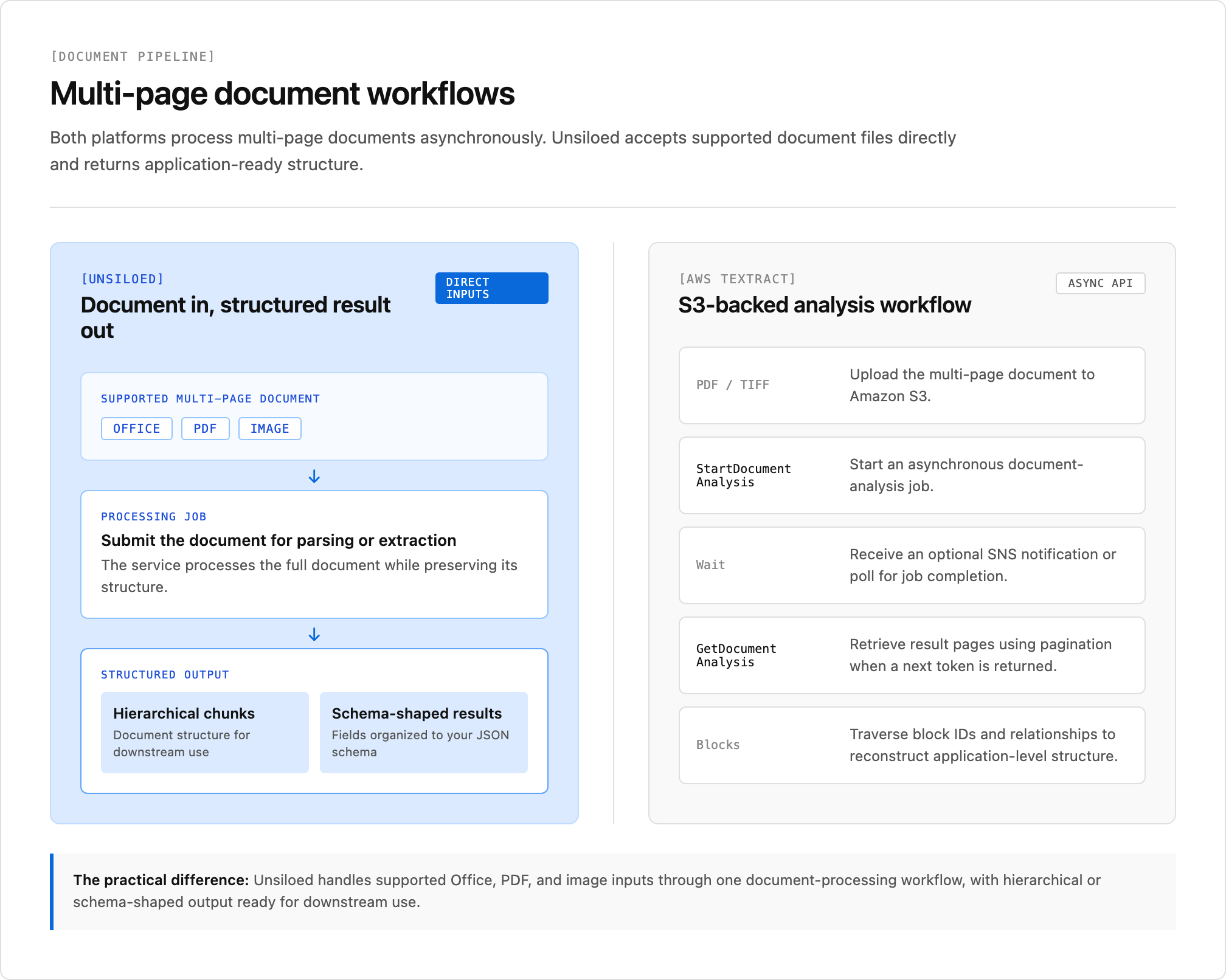 Unsiloed directly accepts the supported source document and returns structure-aware output. Textract requires an S3-backed asynchronous job for multi-page PDFs and TIFFs, followed by result retrieval and Block-relationship traversal.
Textract does support classification and splitting, but only inside AnalyzeLending for mortgage workflows. There is no general-purpose way to route or split mixed document batches.
Deployment and Enterprise Security
Both services can fit enterprise security reviews, but they give teams different control over where documents are processed.
Textract runs as a managed AWS service in supported AWS regions, including GovCloud. AWS PrivateLink can keep traffic between your VPC and Textract on the AWS network, but the documents are still processed by an AWS-operated service. There is no on-premise, self-hosted, or air-gapped Textract deployment. For teams with strict data residency or internal security requirements, that deployment boundary can decide the evaluation before accuracy or pricing matters.
Unsiloed supports managed cloud, VPC, on-premises, and air-gapped deployments, so the document-processing layer can run inside the environment where the documents are allowed to live.
When to Choose Unsiloed AI over AWS Textract
Textract is a strong choice when you need managed OCR inside an AWS-native stack, your documents are mostly PDFs or images, and your team is comfortable building extraction, conversion, and routing logic around Textract's Block output. It fits especially well when you want native integration with S3, Lambda, and Amazon A2I human review, need the specialized invoice, ID, or mortgage-packet APIs, or have to keep processing inside the AWS compliance boundary, including GovCloud and FedRAMP High.
Choose Unsiloed AI when document output has to feed LLMs, agents, RAG systems, or structured workflows without a custom reassembly layer. It is the better fit when you need:
Schema-shaped JSON from a custom extraction schema
Hierarchical chunks with reading order preserved
Per-field confidence scores and source bounding boxes
Direct support for Office files, PDFs, scans, and mixed document batches
General-purpose parsing, extraction, classification, and splitting APIs
Cloud, private, on-premise, or air-gapped deployment
The shorter version: Textract is best when OCR inside AWS is the job. Unsiloed is better when document intelligence is the input layer for an AI or automation system.
If your pipeline feeds LLMs, agents, or RAG systems, book a demo to see how Unsiloed handles the documents and formats that fall outside Textract's coverage.
FAQ
How should I decide between Unsiloed AI and AWS Textract?
Choose Textract if you need managed OCR, table, and form detection inside AWS, your documents are mostly PDFs or images, and your team can build around Textract's Block output. Choose Unsiloed AI if you need schema-driven extraction, RAG-ready parsing, field-level citations, Office-format support, general-purpose classification and splitting, or deployment outside a managed cloud service.
Does AWS Textract support extraction with a custom JSON schema?
No. Textract's Queries feature accepts batches of natural-language questions, up to 15 per page synchronously and 30 asynchronously, in English only. There is no general Textract operation that accepts a JSON Schema and returns an object in that shape. Unsiloed's extraction API accepts a custom JSON schema and returns matching typed JSON with per-field confidence scores and source bounding boxes.
Can AWS Textract or Unsiloed AI run on-premise or in an air-gapped environment?
Textract runs only as a managed AWS service in supported AWS regions, including GovCloud. AWS PrivateLink can keep traffic on the AWS network, but it does not move Textract into your infrastructure. Unsiloed AI supports cloud, private, on-premise, and air-gapped deployments.
What file formats do Unsiloed AI and AWS Textract support?
Textract accepts JPEG, PNG, PDF, and TIFF. It does not process DOCX, XLSX, or PPTX directly. Unsiloed AI accepts PDFs, images, Word, Excel, PowerPoint, and scans directly.
How does pricing differ between Unsiloed AI and AWS Textract?
Unsiloed prices by plan and page volume, with included pages and per-page overage. Textract prices by API and feature, so costs increase when you add tables, forms, queries, or custom query adapters.