
Best AI for Data Integration in Tech Industry: April 2026 Review
If you're comparing AI iPaaS solutions or Talend for master data management, you're probably asking the same question we hear from enterprise teams: what happens to the data locked in PDFs, forms, and reports that your pipelines can't read? Workflow automation tools move structured data well, but th


If you're comparing AI iPaaS solutions or Talend for master data management, you're probably asking the same question we hear from enterprise teams: what happens to the data locked in PDFs, forms, and reports that your pipelines can't read? Workflow automation tools move structured data well, but they can't extract tables from a 50-page financial filing or parse a contract with nested clauses and signature blocks. We compared the tools that claim to integrate AI into data workflows and identified which ones handle multimodal document parsing versus which ones just assume your data arrives pre-structured.
TLDR:
- AI data integration parses unstructured documents like PDFs and forms into machine-readable formats for LLMs and analytics
- Traditional iPaaS tools like Zapier and MuleSoft move structured data but can't extract from multimodal documents
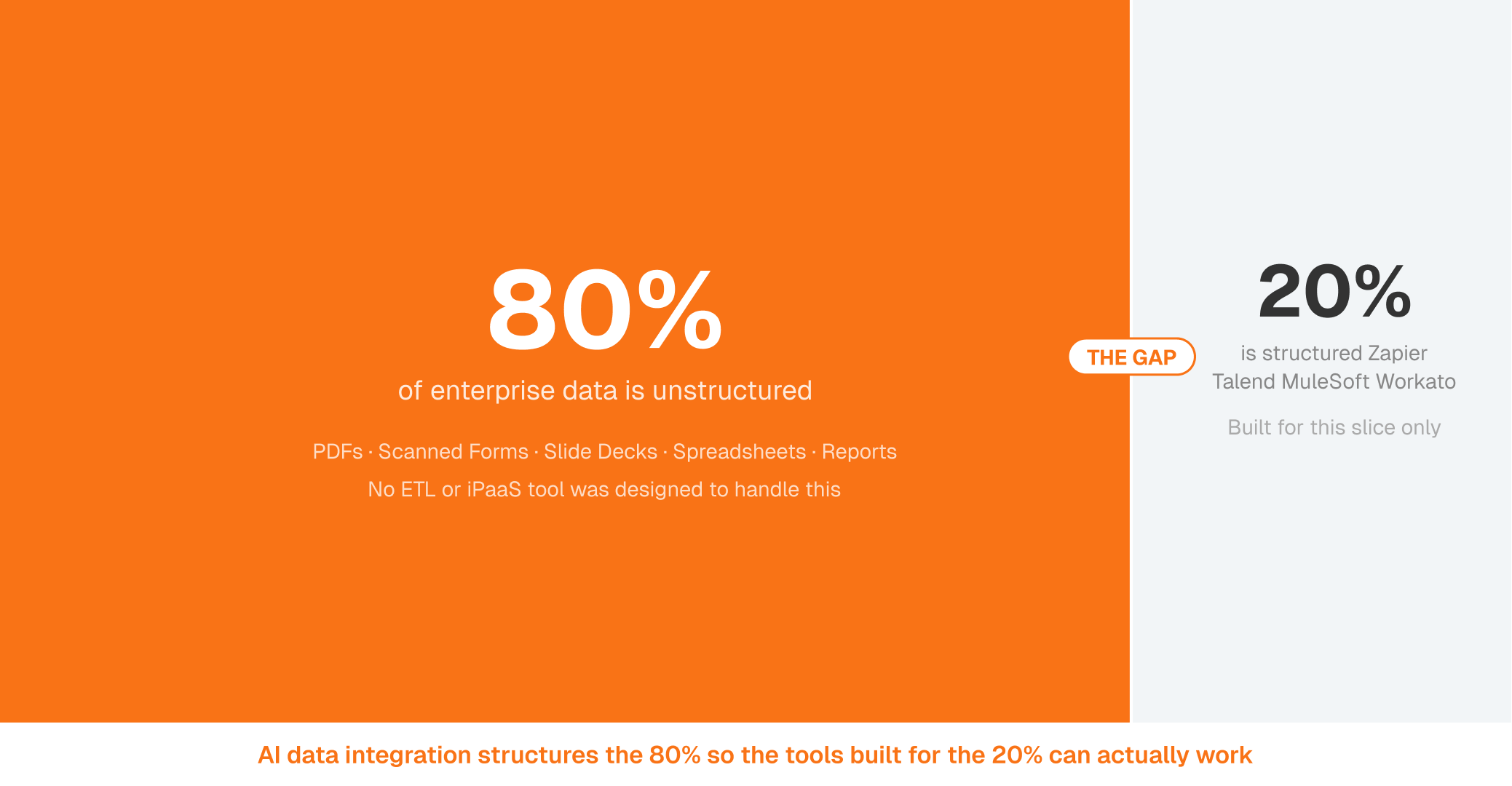
- 80% of enterprise data is unstructured, creating a critical gap before workflow automation can begin
- Unsiloed AI provides deterministic extraction with word-level citations and confidence scores for complex documents
- Unsiloed AI processes 10M+ pages weekly for Fortune 150 banks with vision-first parsing and full source traceability
What is AI for Data Integration in Tech Industry?
Traditional data integration was built for a structured world: rows, columns, clean schemas. But enterprise data rarely works that way. Most of it lives in PDFs, slide decks, scanned forms, and multi-page reports that no ETL pipeline was designed to handle.
AI for data integration changes the approach entirely. Instead of relying on rigid transformation rules, AI systems ingest documents and unstructured files, parse their layout, and produce structured outputs that downstream systems can actually use: think RAG pipelines, analytics engines, and business automation workflows that need reliable, machine-readable data to function.
Where traditional iPaaS or ETL tools connect APIs and move structured data between systems, AI-driven integration goes a layer deeper. It handles multimodal inputs like tables, charts, images, and formulas, converting them into deterministic JSON or Markdown without hallucinating values or dropping context.
For the tech industry, this matters because 80% of enterprise data is unstructured. AI integration infrastructure acts as the ingestion layer that sits before your AI agents or LLMs ever see the data, cleaning and structuring it so what reaches your model is accurate, complete, and traceable back to the source.
How We Ranked AI for Data Integration Tools
According to integrate.io's enterprise research, 95% of IT leaders cite integration issues as the primary blocker to AI adoption. Picking the wrong tool costs teams months of rework. Here's what we weighed when building this list, based on publicly available information and documented capabilities.
- Accuracy and determinism: Does the tool produce consistent, verifiable outputs for structured data like tables and forms, or does it guess?
- Multimodal document support: Can it handle charts, images, complex layouts, and mixed-format files beyond clean text?
- Traceability: Are confidence scores and word-level citations available so you can audit what the tool extracted and why?
- Deployment flexibility: Does it support cloud, on-premise, or air-gapped environments for teams with strict data residency requirements?
- API-first architecture: Is there a clean REST API with SDKs, or are you locked into a GUI that breaks at scale?
No vendor sponsorship influenced the order.
Best Overall AI for Data Integration: Unsiloed AI
Unsiloed AI is the unstructured data interface for LLMs and AI agents, purpose-built for enterprises that need deterministic, accurate parsing of complex multimodal documents. We process 10,000,000+ pages weekly for Fortune 150 banks, NASDAQ-listed companies, and YC startups across finance, legal, and healthcare.
What They Offer
- Vision-first parsing that preserves layout, reading order, and hierarchical structure from PDFs, PPTs, DOCX, images, and 20+ file formats
- Schema-driven extraction with word-level citations, bounding boxes, and confidence scores for every extracted field
- Document classification and intelligent splitting for routing multi-document files to the right pipelines
- A built-in RL pipeline that continuously improves accuracy using confidence score feedback
Good for: AI teams at Series B+ companies and Fortune 150 enterprises building RAG pipelines or document-driven automation where parsing errors have real consequences.
Bottom line: Unlike generic LLMs that hallucinate on structured data, or traditional OCR that collapses under changing layouts, Unsiloed delivers deterministic extraction with full source traceability. On public benchmarks, we consistently outperform LlamaIndex, Gemini, Mistral, and Unstructured.io.
Zapier
Zapier is a workflow automation tool built around event-driven triggers and actions across 8,000+ apps. It's the go-to for non-technical teams who need apps to talk to each other without writing code.
What They Offer
- Automated workflows (Zaps) with triggers from one app executing actions in another
- Visual workflow builder with conditional logic and multi-step automation
- MCP support for connecting AI agents to business apps
- Webhook capabilities for custom integration scenarios
Good for: Small to mid-market teams automating repetitive tasks like form submissions, notifications, and basic SaaS data transfers without technical expertise.
Limitation: Zapier has no native support for document parsing, multimodal extraction, or deterministic handling of tables and charts. It also gets expensive fast, which can price out smaller teams. There's no word-level confidence scoring or source traceability.
Bottom line: Zapier moves data between apps well. But if you need to parse and structure the data first, you need a dedicated extraction layer before Zapier ever enters the picture.
Talend Data Integration
Talend is an ETL and data integration tool built for combining data from multiple structured sources into warehouses and analytics environments.
Here is what it offers:
- Over 1,000 pre-built connectors for databases, applications, and cloud services
- Visual job design with drag-and-drop components for ETL workflows
- Data quality features including profiling, validation, and cleansing
- Batch and real-time processing support with big data frameworks like Hadoop and Spark
Good for: Data engineering teams at enterprises performing structured data warehouse consolidation, database migrations, or building traditional ETL pipelines from known schemas and tabular sources.
Limitation: Since Qlik acquired Talend, pricing has shifted considerably upward while the core feature set has remained largely unchanged over the past decade. Talend processes structured data from databases and applications, but cannot parse unstructured documents like PDFs, images, or complex forms. There are no vision models, layout understanding, or extraction capabilities for multimodal content.
Bottom line: Talend handles structured database integration well, but organizations that need to extract data from documents, reports, and forms first need a vision-first extraction layer before that data reaches a warehouse or analytics system.
MuleSoft Anypoint
MuleSoft Anypoint is an API management and enterprise integration suite for connecting applications and data across hybrid environments.
- API lifecycle management from design through deployment and monitoring
- Over 1,500 pre-built connectors for enterprise applications and cloud services
- Hybrid deployment across CloudHub, on-premises, and Kubernetes environments
- Visual flow designer with DataWeave transformation language
Good for: Large enterprises with complex API ecosystems requiring governance, reusability, and connectivity across on-premises legacy systems and cloud applications through API-led architecture.
Limitation: MuleSoft pricing scales by cores and usage, which can become prohibitive as integration volume grows. It has no ability to parse unstructured documents or handle multimodal content, no vision models for understanding document layouts, tables, or images, and no confidence-scored field extraction.
Bottom line: MuleSoft builds the connectivity layer between systems well. Teams ingesting data from documents still need a vision-first extraction layer to convert PDFs, images, and complex files into structured JSON before anything gets routed through API orchestration.
Workato
Workato is an enterprise automation and integration tool combining iPaaS capabilities with workflow orchestration for business process automation.
What They Offer
- Visual editor for complex integration workflows with branching and data transformation
- Enterprise-grade features for ERP, CRM, and business application integration
- Pre-built recipes for common integration patterns across business systems
- Support for both API-based and database connectivity
Good for: Mid-market to enterprise organizations automating business processes across multiple SaaS and enterprise applications where technical teams need more sophistication than basic workflow tools.
Limitation: Workato handles a broad range of structured integrations well, but it operates on data that's already structured. It cannot extract data from unstructured documents, parse complex PDFs with tables and images, or provide deterministic field-level extraction with confidence scoring.
Bottom line: Workato coordinates data across business systems well. But organizations processing invoices, contracts, forms, and reports need a document parsing layer to structure that data before workflow automation can begin.
Feature Comparison Table of AI for Data Integration Tools
Here's how these five tools stack up across the capabilities that matter most for document-heavy AI workloads.
| Capability | Unsiloed AI | Zapier | Talend | MuleSoft | Workato |
| Multimodal Document Parsing | Yes | No | No | No | No |
| Vision Model Architecture | Yes | No | No | No | No |
| Word-Level Confidence Scores | Yes | No | No | No | No |
| Complex Table Extraction | Yes | No | No | No | No |
| Layout-Aware Parsing | Yes | No | No | No | No |
| On-Premise Deployment | Yes | No | Yes | Yes | No |
| Air-Gapped Support | Yes | No | No | No | No |
| Deterministic Structured Output | Yes | No | No | No | No |
| REST API with SDKs | Yes | Yes | Yes | Yes | Yes |
The pattern is clear. Zapier, Talend, MuleSoft, and Workato each solve real integration problems, but none were built to handle unstructured documents at the ingestion layer.
Why Unsiloed AI is the Best AI for Data Integration
Every tool in this list solves part of the problem. Workflow automation moves structured data between apps. ETL pipelines consolidate database records. API management connects enterprise systems. But none of them handle the documents where business-critical data actually lives.
Over 80% of enterprise data is unstructured, and that's exactly the gap Unsiloed AI was built for. Fortune 150 banks and NASDAQ-listed companies choose us because word-level citations, bounding boxes, and confidence scores aren't optional features in accuracy-sensitive industries. They're the difference between a system you can trust in production and one you can't.
If your AI agents or analytics systems depend on document data, the ingestion layer matters more than anything downstream. That's where Unsiloed AI starts.
Final Thoughts on Data Integration in Tech
Workflow automation and API connectivity solve half the problem. The other half is getting data out of PDFs, images, and complex documents in a way your systems can trust. That's where best cloud integration tools fall short and specialized document parsing becomes critical. You need word-level citations, confidence scores, and deterministic outputs before any workflow tool can do its job. We process millions of pages weekly for companies that can't afford hallucinations or dropped tables. Book a demo to test us on your actual documents.
FAQ
How do I choose between document parsing and traditional integration tools for my use case?
Start by identifying where your data lives. If you're connecting structured databases or SaaS applications, traditional iPaaS tools handle that well. But if your data sits in PDFs, forms, reports, or scanned documents, you need a vision-first parsing layer to extract and structure that information before any workflow automation or ETL process can begin.
Which type of AI integration tool works best for teams without deep technical resources?
Workflow automation platforms with visual builders work well for simple app-to-app connections and event-driven tasks. However, if you need to extract data from complex documents with tables, charts, or mixed layouts, you'll still need technical resources to integrate a parsing API that can handle multimodal content accurately.
Can I use general-purpose LLMs for document data extraction instead of specialized parsing tools?
General-purpose LLMs tend to hallucinate on structured data like tables and forms, producing inconsistent outputs without source traceability. For production systems where accuracy matters, you need deterministic extraction with confidence scores and word-level citations that let you verify every extracted field against the source document.
What's the difference between ETL tools and document parsing APIs?
ETL tools move and reshape structured data between known schemas like databases and data warehouses. Document parsing APIs convert unstructured files into structured formats first, handling layout understanding, table extraction, and multimodal content that ETL systems weren't designed to process.
When should I consider switching from OCR-based extraction to vision model architecture?
If your OCR system breaks when document layouts change, drops table context, or requires constant manual tuning for new formats, vision models that understand document structure natively will save substantial engineering time and deliver more reliable outputs across varying document types.